
All done here! Check out our other subjects!
Core
Antibodies (also known as immunoglobulins, Ig) are Y-shaped proteins produced by B-cells (plasma cells) that are activated by the adaptive immune system when exposed to antigens (see article on adaptive immunity).
The antibody population produced in the body is polyclonal. This means that there are multiple B cells producing multiple different types of antibodies all simultaneously, creating a population of antibodies that are all different and all bind to different antigens.
Monoclonal antibodies (mAb) are antibodies made artificially by creating a population of identical cloned B-cells derived from a single parent B-cell. Every antibody in this monoclonal population will be identical.
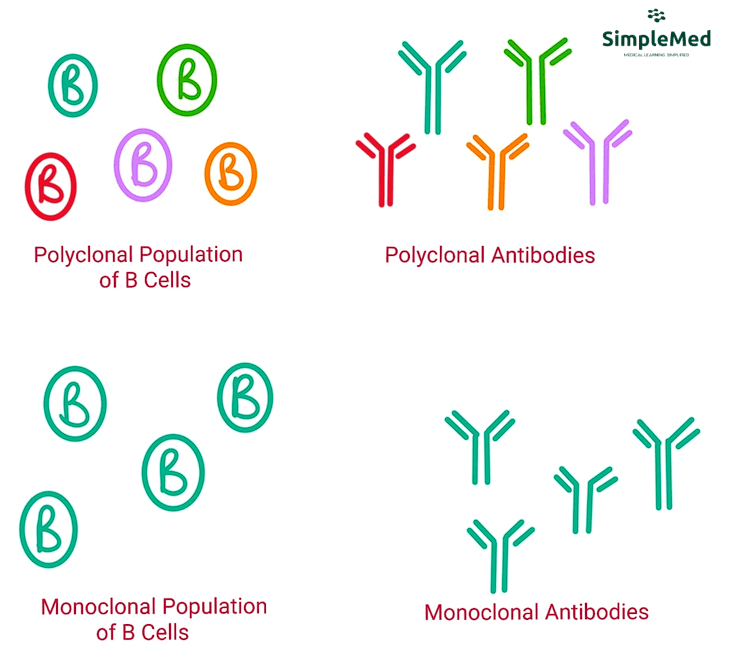
Diagram - Difference between a population of polyclonal antibodies produced by a variety of parent B cells, and a population of monoclonal antibodies produced by a single type of parent B cell
SimpleMed original by Dr. Maddie Swannack
Types of Monoclonal Antibodies
The historical source-based nomenclature distinguishes murine (-omab), chimeric (-ximab), humanised (-zumab) and fully human (-umab) antibodies. These endings remain useful for established medicines. WHO has replaced this scheme for newly assigned antibody names with structural categories using -tug, -bart, -ment and -mig; do not apply the old source endings as a universal current rule.
Murine Antibodies (end in -omab) - they are entirely derived from a mouse source. These have an increased potential for immunogenicity with a high risk of triggering an allergic reaction when used in humans. They also may not be acceptable to some patients if, for example, they hold religious beliefs on vegetarianism.
Chimeric antibodies (historically -ximab) combine non-human variable domains with human constant regions. The variable domains occur in the antigen-binding parts of both arms; the distinction is not simply mouse arms and a human stem, and a fixed percentage of human sequence is not the definition.
Humanised antibodies (historically -zumab) have predominantly human immunoglobulin sequences with a non-human contribution concentrated in the complementarity-determining regions, the antigen-binding loops. Additional non-human residues may be retained to preserve binding; neither a fixed percentage nor an entirely non-human binding region defines this category.
Fully human antibodies (historically -umab) use human immunoglobulin sequences. This describes sequence origin and does not mean that the medicine must be harvested directly from a person.
Humanisation and human sequence reduce the contribution of foreign-species sequence to immunogenicity, but humanised and fully human antibodies can still provoke anti-drug antibodies, including responses against their distinctive binding regions. Actual risk depends on the product, patient and treatment conditions; human sequence does not guarantee immune tolerance, and infusion reactions are not all caused by anti-drug antibodies.
Clinical Use of Monoclonal Antibodies
Monoclonal antibodies are used in research for both therapeutic and diagnostic purposes. Understanding which antigens are associated with specific cancer cells and which are found on normal tissue cells helps choose antigen targets for developing appropriate monoclonal antibodies.
When used for therapeutics, they can work in multiple ways:
- Bind to cell surface receptors (antigens) to activate or inhibit signalling pathways within the cell.
- Induce cell death by binding to antigens and activating antibody-dependent cell-mediated cytotoxicity (ADCC) or complement-dependent cytotoxicity (CDC).
- Bind to antigens prompting internalisation (switching to the inside of the cell surface membrane), allowing them to release toxins directly into the target cancerous cells.
- Block inhibitory immune checkpoints on T-cells, thereby enhancing T cell mediated immune responses against cancer cells.
Conjugated monoclonal antibodies are monoclonal antibodies that have been tagged with either a cytotoxic (chemotherapy) drug or a radioactive particle, allowing delivery of treatment to cells expressing the target antigen. This helps produce a more localised effect and can reduce systemic side effects, although some binding to normal tissues may still occur if the antigen is also expressed on healthy cells.
Monoclonal antibodies are also used in routine laboratory techniques such as enzyme-linked immunosorbent assay (ELISA), immunohistochemistry and Western blotting.
Side Effects of Monoclonal Antibodies
Foreign-species sequence is one contributor to an immune response against a therapeutic antibody. Responses vary with the product, patient and treatment; antibody origin alone cannot reliably rank the clinical risk of every medicine.
Some patients will experience no symptoms or mild symptoms such as fatigue during treatment with monoclonal antibodies.
Others will have a mild reaction following the initial infusion and tolerate subsequent infusions better.
Finally, a few people develop severe infusion-related immunogenic reactions where the body’s immune system reacts to the presence of foreign antibodies.
In order to manage infusion-related reactions appropriately, patients need to be well informed about the red flags indicating a potential reaction to the infusion and be made aware that they should contact clinical staff immediately if they experience unexpected side effects. Precautionary measures can also be taken by prescribing prophylactic steroids, antihistamines, or paracetamol to lower the risk of an immunogenic response by inhibiting inflammatory processes. Monoclonal antibody infusions should always be initiated at a slow rate and later increased in a stepwise manner if well tolerated.
Finally, appropriate emergency drugs to treat infusion-related reactions should always be readily available, or prescribed according to local protocol, prior to initiating patient treatment.
Edited by: Dr. Maddie Swannack
Reviewed by: Dr. Thomas Burnell
- 747