
Next Lesson - The Pelvic Floor
Core
The female reproductive tract is made up of the ovaries, fallopian tubes, the uterus and the vagina. It is supported by a number of ligaments and muscles which will also be included in this article.
The external genitalia of a woman are comprised of a number of key parts.
Labia Majora - the more prominent folds of tissue that extend from the mons pubis (the fat pad in front of the pubic symphysis, where the two pubic bones meet) to the perineum. The labia majora develop from the same structures in the embryo as the scrotum in the male (the labioscrotal folds, a pair of swellings either side of the developing genitals).
Labia Minora - the lesser folds that extend from the clitoral hood and run backwards on either side of the vaginal opening. The labia minora form from the urethral folds (folds on either side of the developing urethra). In the male these folds fuse to form part of the penis. In the female, without testosterone, they stay separate.
Clitoris - the clitoris is made of erectile tissue, which fills with blood during sexual arousal, and has many nerve endings. Its tip, the glans clitoris, lies in the anterior portion of the external genitalia of women. It develops from the genital tubercle (which in males forms the head of the penis) and is covered by the clitoral hood. It is a site of sexual pleasure for most women.
Urethral Opening - the urethral meatus (or opening) is the site through which urine flows out of the body. While it is not part of the reproductive system, it is important to understand its location in relation to other structures of the female genitalia.
Vagina - the vagina is a muscular canal that opens to the outside at the vaginal opening (introitus). Childbirth may occur through it. It is also commonly used in sexual intercourse, and menstrual blood flows out through it.
Perineum - this is the portion of skin and muscle that stretches between the vagina and the anus. It is an important structure for the pelvic floor (the layer of muscles that supports the pelvic organs).
Anus - the site of excretion of faeces. Again, not a part of the reproductive tract, but an important anatomical landmark.

Diagram - External genitalia of the woman
Creative commons source by Sshirly [CC BY-SA 4.0 (https://creativecommons.org/licenses/by-sa/4.0)]
The vagina in humans is a canal that extends from the external genitalia to the cervix in a superior-posterior direction. The urethra and bladder sit anterior to the vagina and the rectum posterior. The vagina facilitates childbirth and intercourse, and due to its muscular walls and rugae (folds in the epithelium), can expand drastically.
At the superior aspect of the vagina lies the cervix. The cervix protrudes into the vagina, leaving a circular gutter between the walls of the vagina and the cervix. This is called a fornix (plural fornices), and can be split into the anterior, posterior, left and right fornix. The fornices can be difficult to see on examination of the vagina and could lead to pathology being missed. The fornices are also the site at which some vaginal swabs are taken.
In the fetus, the vagina develops from the urogenital sinus (part of the early embryo that also forms the bladder and urethra) and the Mullerian duct (a duct in the embryo that goes on to form the fallopian tubes, uterus and vagina).
The vagina is supported by the muscles of the pelvic floor (see below).
The epithelium found in the vagina is a stratified squamous epithelium. The epithelium is relatively glycogen rich and acts to provide a source of nutrition for the lactobacilli that exist naturally inside the vagina. The lactobacilli metabolise the glycogen into lactic acid which creates and maintains an acidic (low pH) environment in the vagina. This low pH helps to inhibit the growth of microorganisms such as Candida albicans (the causative organism of thrush). Practices to ‘clean’ the vagina such as douching can disrupt the pH balance and increase the likelihood of infections like thrush, and so are not advised by clinicians.
The cervix is the opening to the uterus. It is a narrow channel that connects the vagina to the uterus, with the external os being the opening to the vagina, and the internal os being the opening to the uterus. During childbirth, the cervix stretches from the ‘pinpoint’ seen normally on the external os to approximately 10cm wide to allow the baby through. Following childbirth, the external os does not return to the ‘pinpoint’ seen pre-childbirth. This means the external os of women who have given birth will appear more linear in shape (this is normal).
The cervix can also exhibit signs of cervical ectropion. This occurs when the columnar epithelium of the inside of the cervix is shown externally. It is a normal condition, thought to be caused by high levels of oestrogen. It is commonly seen in adolescents, in pregnancy and in women taking contraceptives that contain oestrogen, such as the combined oral contraceptive pill.

Diagram - The different appearances of the cervix. It is important to note that normal has more than one form depending on whether childbirth has occurred. The third figure shows cervical ectropion, where the columnar epithelium that is normally inside the cervix is on the outside, seen as the red area around the external os. The transformation zone is where these columnar (glandular) cells meet the squamous (flat) cells. Most cervical cancers start here.
SimpleMed original by Dr. Maddie Swannack
There are around 3,300 new cervical cancer cases in the UK every year, which is about 9 diagnoses per day. Around 63.5% of women diagnosed with cervical cancer survive for 10 years or more (source: Cancer Research UK).
Many of these cases are related to two strains of Human Papilloma Virus (HPV strains 16 and 18). HPV is a virus that is sexually transmitted, and is often asymptomatic. This means that a woman who is infected with HPV will have a higher chance of developing cervical cancer without knowing it. A vaccine for HPV was introduced in the UK for girls aged 12-13 in 2008, and in 2019, was extended to include boys of the same age (because HPV also increases the risk of anal and penile cancers).
Cervical cancer often causes no signs in its early stages. Later, bleeding from the tumour can show as bleeding between periods (intermenstrual bleeding), bleeding after sex (post-coital bleeding) and bleeding after periods have naturally ended (post-menopausal bleeding).
The cervical screening programme (once called the smear test) aims to prevent cervical cancer. It is not a test for cancer itself. Some cancers are still found through screening: in England in 2019, about 4 in 10 cervical cancers were diagnosed this way. In England and Wales, women and people with a cervix aged 25 to 64 are invited every 5 years. People who have HPV may be invited sooner. Northern Ireland invites women aged 25 to 49 every 3 years and those aged 50 to 64 every 5 years. Screening is not offered under 25 because cervical cancer is very rare at that age, and abnormal cell changes often go back to normal in younger women. During screening, a speculum is gently put into the vagina and a soft brush is used to take a small sample of cells from the cervix. The sample is first tested for high-risk types of HPV. Only if these are found are the cells checked for abnormal cell changes.
The uterus is the reproductive organ of the female that is responsible for supporting pregnancy. It lies in the pelvis superior to the vagina, posterosuperior (behind and above) to the bladder and anterior to the rectum. The potential space between the bladder and the uterus is called the vesicouterine pouch. The potential space between the uterus and the rectum is called the rectouterine pouch or pouch of Douglas. These are important anatomical landmarks because free fluid in the peritoneal cavity can collect in the pouch of Douglas. Superolateral (above and to the side) to the uterus sit the ovaries. They are attached to the uterus by the ovarian ligament and lie near the open ends of the fallopian tubes.

Diagram - The relationship between the vagina, uterus, bladder and rectum
SimpleMed original by Dr. Maddie Swannack
The uterus has three layers in its wall:
- The perimetrium is the thin outer covering of the uterus. It is formed by peritoneum.
- The myometrium is the muscular component of the uterine wall. It is the muscle that contracts during childbirth and on the shedding of the uterine lining in a menstrual period. Its contractions cause labour pains and period cramps.
- The endometrium is the epithelial lining of the uterus. During the menstrual cycle the endometrium will proliferate (grow and thicken), forming the lining of the womb for the potential embryo to embed in. The endometrium contains a number of glands that change shape throughout the cycle. While oestrogen makes the lining grow, the glands are straight. After ovulation, progesterone makes them coiled and secretory, and glycogen builds up in them. If there is no pregnancy, hormone levels fall and the functional layer, including these glands, is shed at menstruation. The endometrium is further divided into two sections:
- The functional layer is the layer that sheds during menstruation.
- The basal layer is the static layer that allows proliferation during the next menstrual cycle.
The female reproductive tract is said to have three axes: the axis of the vagina, the axis of cervix and the axis of uterine body. These are lines that are drawn onto the anatomy of a woman to describe the general direction that the structure points in.
Between these three lines exist two angles. The pelvic floor gives the uterus its main support, and the round ligament helps to hold it anteverted (see later). The two angles are:
- The angle of -version exists between the axis of the vagina and the axis of the cervix.
- If this angle is under 180°, the cervix is said to be anteverted.
- If this angle is over 180°, the cervix is said to be retroverted.
- The angle of -flexion exists between the axis of the cervix and the axis of the uterus.
- If this angle is under 180°, the uterus is said to be anteflexed.
- If this angle is over 180°, the uterus is said to be retroflexed.
It is possible to have any combination of these, as shown in the diagram below. The commonest position is that of anteflexed anteverted.

Diagram - The three axes and two angles that exist in the internal female reproductive tract. Each axis is a straight line that shows the average direction of that structure
SimpleMed original by Dr. Maddie Swannack

Diagram - The shapes that can be formed by the axis of the internal reproductive tract. While they are all variants of normal, retroversion and retroflexion are less common, and do not usually cause medical problems on their own
SimpleMed original by Dr. Maddie Swannack
The fallopian tubes carry the egg cell released from the ovary to the uterus. They also carry sperm from the uterus to meet the released egg for fertilisation. The tubes are muscular, and their contractions (peristalsis) help to move both the egg and the sperm. They are also lined with cilia (tiny ‘hairs’) that help to waft the egg towards the uterus.
The tubes are not attached to the ovary (as shown in the diagram below). This means that the egg could technically be released from the ovary and not make it into the fallopian tube. Instead, it could end up in the abdomen. If it is then fertilised there, it could implant outside the uterus (an ectopic pregnancy, see below). Furthermore, this gap is the only anatomical hole in the peritoneum, so it can be a route for air to enter and cause a pneumoperitoneum (air in the peritoneal cavity), although this is very rare.
There are 4 parts to the fallopian tube:
- Fimbriae - finger-like projections that face the ovary and act as a funnel to make sure the egg ends up in the fallopian tube.
- Infundibulum - the first part of the fallopian tube that the egg will enter.
- Ampulla - this word means ‘jug’, which describes its shape. It is the middle and widest part of the fallopian tube. Fertilisation usually happens here, and it is the most common site of ectopic pregnancy.
- Isthmus - this is the final part of the fallopian tube and is the point of attachment to the uterus.
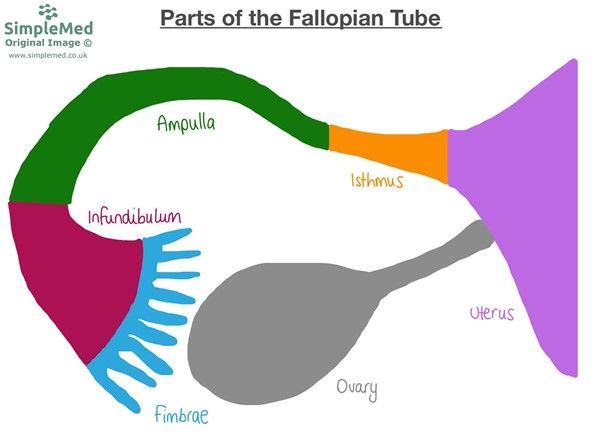
Diagram - The anatomy of the fallopian tubes
SimpleMed original by Dr. Maddie Swannack
An ectopic pregnancy occurs when the embryo implants in a position that it is not supposed to, that is other than in the uterus. This can be anywhere but is most commonly in the fallopian tube at the ampulla.
The thin fallopian tube is not equipped to grow a fetus. As the embryo implants in the wall of the tube and begins to grow, it can rupture the tube, causing severe internal bleeding. Symptoms generally appear 6 to 8 weeks after the last normal period, or much later if the pregnancy is not in the tube.
Initially, ectopic pregnancy might present with vague symptoms like abdominal pain and vaginal bleeding. However, it does not always cause symptoms, and an atypical presentation (symptoms that do not fit the usual pattern) is common. Once rupture has occurred, pain is very common, and the bleeding can rapidly lead to shock (too little blood reaching the body’s tissues), hypotension and tachycardia (a fast heart rate). Ectopic pregnancy can also present with shoulder tip pain. This happens when blood irritates the diaphragm, causing referred pain (pain felt away from where the problem is). The pain is felt in the dermatome (the area of skin supplied by one spinal nerve root) of the phrenic nerve roots (C3, C4, and C5).
Consequences of ruptured ectopic pregnancy can be severe. Damage to the fallopian tube is often not recoverable, leading to difficulty in future conceptions and an increased risk of recurrent ectopic pregnancies. An ectopic pregnancy cannot be saved. Rupture can also lead to the death of the mother if the internal bleeding is severe or untreated.
Ectopic pregnancy can be rapidly life threatening, so it is an emergency. It should be considered and ruled out in anyone who could be pregnant and has abdominal pain or other symptoms, even if the symptoms are vague. The first test is a pregnancy test, which detects beta human chorionic gonadotrophin (β-hCG), a hormone made in pregnancy. A transvaginal ultrasound scan (a scan using a probe placed in the vagina) is then used to find where the pregnancy is.
The gonads in the female are called the ovaries. The ovaries are the storage and maturation site for the oocyte (egg cell). They also produce oestrogen and progesterone. They do this under the control of the pituitary gonadotrophins (hormones from the pituitary gland that act on the ovaries and testes): luteinising hormone (LH) and follicle stimulating hormone (FSH).
Like the testicles, the ovaries develop from the mesonephric ridge (a ridge of tissue on the back wall of the abdomen in the embryo), and descend through the abdomen under the pull of the gubernaculum. However, unlike the testicles, the ovaries stop their descent in the pelvis because the developing uterus gets in the way.
There are three main parts in the ovary:
- Medulla - the medulla is the inner part of the ovary and is the site of neurovascular structures (nerves and blood vessels) inside the ovary. Its function is to supply nutrients through the blood to the cortex.
- Cortex - the cortex is the outer part of the ovary and is largely composed of connective tissue called stroma. Within the stroma are thousands of follicles (an oocyte surrounded by a layer of follicular cells).
- Epithelium - the surface of the ovary is covered by simple cuboidal epithelium (a single layer of cube-shaped cells). This is traditionally called the germinal epithelium. Despite the name, the egg cells are not in this layer: they sit in the follicles of the cortex.
It is also important to note that the ovaries are not covered by the visceral peritoneum like the rest of the organs in the abdomen. The visceral peritoneum surrounds the fallopian tubes, but not the ovaries (see drawing below for explanation). This means that technically an egg could miss the fallopian tube, and as the ovaries are not encased in peritoneum, this egg would be released into the peritoneal cavity. If this egg is fertilised, it could implant in the peritoneal cavity instead of the uterus, causing a dangerous ectopic pregnancy.

Diagram - A cartoon of the visceral peritoneal coverings of the female internal reproductive organs. It shows how the uterus and most of the fallopian tubes are covered by the visceral peritoneum. It also shows that the ovaries (orange) and the fimbriae of the fallopian tubes (pink) are not covered by the visceral peritoneum. They therefore sit inside the peritoneal cavity, because the parietal peritoneum (the layer lining the abdominal wall) stays attached to the abdominal wall
SimpleMed original by Dr. Maddie Swannack
Ovarian Cysts - cysts can form on the ovaries and are most commonly small in size. Most are benign (not cancer). They usually occur naturally and go away within a few months without treatment. A cyst usually only causes symptoms, such as pain, if it ruptures (splits), is very large, or twists and blocks the blood supply to the ovary. Some cysts need to be removed with surgery.
Polyendocrine Metabolic Ovarian Syndrome (PMOS) - PMOS used to be called polycystic ovary syndrome (PCOS). It is a hormone condition that can affect periods, hair growth, fertility and mood. In adults, it is diagnosed when two of these three features are present, once other causes have been ruled out. The first is irregular ovulation, usually seen as irregular periods. The second is signs of excess androgens (male-type hormones such as testosterone), for example hirsutism (excess body hair) or raised levels on blood tests. The third is polycystic ovaries on ultrasound (20 or more follicles in at least one ovary). It is associated with difficulty getting pregnant.
Ovarian Tumours - most commonly the tumours of the ovaries are epithelial in origin (ovarian adenocarcinoma, a cancer of gland-forming cells). Tumours can also come from germ cells, which can form any tissue. Tumours of this kind are called teratomas. This means that teratomas can sometimes be made up of lots of cell types and may include hair or teeth (mature teratoma). In women, mature teratomas are benign whereas immature teratomas may spread.
The broad ligament is a flat sheet of peritoneum that covers the uterus and fallopian tubes and supports the ovaries. It is wide (hence its name as the ‘broad’ ligament) and runs from the pelvic wall across the internal genitalia and attaches to the other pelvic wall.
It has three divisions:
- Mesometrium - this is the largest portion. It surrounds the uterus and runs sideways to cover the external iliac vessels (the main blood vessels to the leg), forming a fold over them. It also encloses the proximal part of the round ligament of the uterus.
- Mesovarium - this portion is associated with the ovaries. It projects from the broad ligament and attaches to the hilum of the ovary (where its vessels and nerves enter), enclosing the neurovascular bundle that supplies the ovary. It does not enclose the ovary.
- Mesosalpinx - this portion is very small and only covers the fallopian tube.
The broad ligament contains many structures:
- The ovarian and uterine arteries
- The ovarian ligament
- The round ligament of the uterus
- The suspensory ligament of ovary (also known as the infundibulopelvic ligament)
Ligaments Associated with the Ovary
There are two main ligaments that attach to the ovary.
Ovarian Ligament - the ovarian ligament attaches the ovary to the uterus. It is a fibrous band that lies within the broad ligament and joins the uterus just inferior to where the fallopian tubes join. The ovarian ligament is a remnant of the gubernaculum in the female. The round ligament of the uterus makes up the rest of the old gubernaculum and attaches the uterus to the labia.
Suspensory Ligament of Ovary - the suspensory ligament of ovary extends outwards from the ovary to the lateral abdominal wall. It is a fold of the peritoneum, so some sources count it as part of the broad ligament, while others treat it as separate. It contains the ovarian artery, vein, nerve plexus and lymphatics. It is also known as the infundibulopelvic ligament.
Ligaments Associated with the Uterus
There are several ligamentous structures that attach to the uterus. They can be grouped by which part of the uterus they support:
- Superior - broad ligament and the round ligament.
- Middle - the cardinal (transverse cervical), pubocervical and uterosacral ligaments. The cardinal ligaments run from the cervix to the side walls of the pelvis, the pubocervical ligaments to the back of the pubic symphysis, and the uterosacral ligaments to the sacrum.
- Inferior - the structures of the pelvic floor, such as levator ani (the main pelvic floor muscle) and the perineal body (a fibrous knot of tissue in the middle of the perineum). The pelvic floor gives the uterus its main support.
Round Ligament - the round ligament is the remnant of the gubernaculum, which is the fibrous band that guides the ovaries towards the labia. It therefore attaches to the labia majora, passes through the inguinal canal (a passage through the lower abdominal wall in the groin), and attaches to the uterus at the point that the fallopian tubes also join. In pregnancy, the round ligament can be a source of pain due to the increased force placed on the ligament by the expanding uterus.
The gubernaculum is the structure that draws the gonads towards the labioscrotal folds. In males, this guides the testicles into the scrotum. In females, this guides the ovaries towards the labia majora. However, in the female, the developing uterus stops this path, causing the ovaries to remain in the pelvis. This means that the gubernaculum runs from the ovaries to the uterus to the labia majora, forming the ovarian ligament and the round ligament.
The reproductive system of the female is a very vascular structure.
The main arteries are the ovarian artery and the uterine artery, which anastomose (join up) across the uterus. The uterine artery gives rise to helicine (spiral) branches that supply the endometrium. The uterine and ovarian arteries also branch to form the tubal vessels, which supply the fallopian tubes. The uterine artery is a branch of the internal iliac artery, but the ovarian arteries arise directly from the abdominal aorta.
The vagina is supplied by the vaginal arteries which are also branches of the internal iliac arteries.
Venous drainage of the ovaries is achieved by the ovarian veins. The left ovarian vein drains into the left renal vein which then joins the inferior vena cava. The right ovarian vein drains directly into the inferior vena cava.
The uterus drains into the uterine veins via a plexus in the broad ligament. The vagina also drains via a plexus into the vaginal vein. Both then drain into the internal iliac vein.

Diagram - The vascular supply of the female reproductive system
Public Domain Source by Henry Gray: Gray's Anatomy (20th edition) [Public domain]
The lymphatic drainage of the ovaries follows where they first develop, high in the abdomen, before they move down into the pelvis. This means they drain into the para-aortic nodes. This is important because it means that cancer of the ovaries may spread to the para-aortic lymph nodes first.
The lymphatic drainage of the uterus includes the iliac, sacral, aortic and inguinal lymph nodes. The vagina drains into the iliac and inguinal nodes.
Female genital mutilation (or FGM) includes any procedure involving the removal of or injury to the external female genitalia for non-therapeutic indications. It is a practice that is carried out mainly in some communities in Africa, the Middle East and Asia. It has worldwide implications because of global migration.
There are 4 types:
- Clitoridectomy - partial or total removal of the clitoris, or in very rare cases only the prepuce (the fold of skin around the clitoris).
- Excision - partial or total removal of the clitoris and labia minora, with or without removal of the labia majora.
- Infibulation - narrowing of the vaginal opening by creating a covering seal. The seal is made by cutting and repositioning the inner or outer labia, sometimes by stitching, with or without removal of the clitoris.
- Other - all other harmful procedures to the female genitals for non-medical reasons, such as pricking, piercing, cutting, scraping and cauterising (burning).

Diagram - Three of the four types of FGM. Type 4 includes any type of piercing including with jewellery
Public Domain Source by Blatant World [Public domain]
Acute Consequences - haemorrhage, sepsis, HIV or hepatitis infection (from instruments that have not been sterilised) and death.
Chronic Consequences - difficulties during sex or childbirth, chronic pain, menstrual problems (painful periods and difficulty passing menstrual blood), urinary outflow obstruction and post-traumatic stress disorder (PTSD).
Legality
FGM is illegal in the UK, and performing it carries a prison sentence of up to 14 years. It is also illegal to perform re-infibulation (sewing the cut edges closed again after childbirth to recreate a small vaginal opening) after deinfibulation (an operation to open a type 3 seal), even if the patient asks for it. This ban does not cover routine repair of tears to the perineum after childbirth.
In England and Wales, regulated health and social care professionals and teachers have a legal duty to report FGM to the police if a girl under 18 tells them she has had FGM, or if they see physical signs that appear to show it. This duty does not apply to women aged 18 or over, or to girls who are at risk or only suspected of having had FGM. In those cases, local safeguarding procedures (the local process for protecting people from harm) should be followed.
Edited by: Dr. Ben Appleby and Dr. Thomas Burnell
Reviewed by: Dr. Marcus Judge
- 11089