
Thanks to our friends at the Leicester University Medical School Student Hub for putting this together — don't forget to like and subscribe to the Leicester Medical School channel if you found this useful!
During any examination in an OSCE it is important to understand the pathology and reasoning behind each of the signs and symptoms elicited, even if the patient being examined is 'normal'. This article explains how to perform a shoulder examination and the key findings you should look for, showing you what each sign means and what conditions it may indicate.
The shoulder is examined using the standard musculoskeletal framework of look, feel, move and special tests. Because the shoulder is the most mobile joint in the body, much of its stability depends on the soft tissues — particularly the rotator cuff — rather than on bony congruity, so the examination is geared towards localising whether a problem lies in the joint, the cuff, the subacromial space or the acromioclavicular joint.
Look (Inspection)
Inspect both shoulders systematically from the front, the side and behind, always comparing one side with the other.
From the front, look for:
- Scars — suggesting previous surgery such as rotator cuff repair, stabilisation or joint replacement.
- Asymmetry or deformity — a step deformity at the acromioclavicular joint suggests ACJ dislocation, while loss of the normal rounded deltoid contour ('squaring' of the shoulder) suggests anterior glenohumeral dislocation.
- Swelling or erythema — which may indicate effusion, infection or inflammatory arthritis.
- A visible 'Popeye' deformity — a bulge in the upper arm caused by distal retraction of the muscle belly after rupture of the long head of biceps.
From the side, assess the patient's posture and the contour of the shoulder, looking for a thoracic kyphosis or a protracted ('rounded') shoulder, both of which alter the position of the scapula and can contribute to impingement.
From behind, look for muscle wasting. Wasting of the deltoid may follow axillary nerve injury, while wasting of the supraspinatus and infraspinatus fossae of the scapula suggests a chronic rotator cuff tear or suprascapular nerve pathology.
Ask the patient to push against a wall with both hands to test for scapular winging. The scapula lifts away from the chest wall when the serratus anterior is weak, most commonly due to a long thoracic nerve palsy.
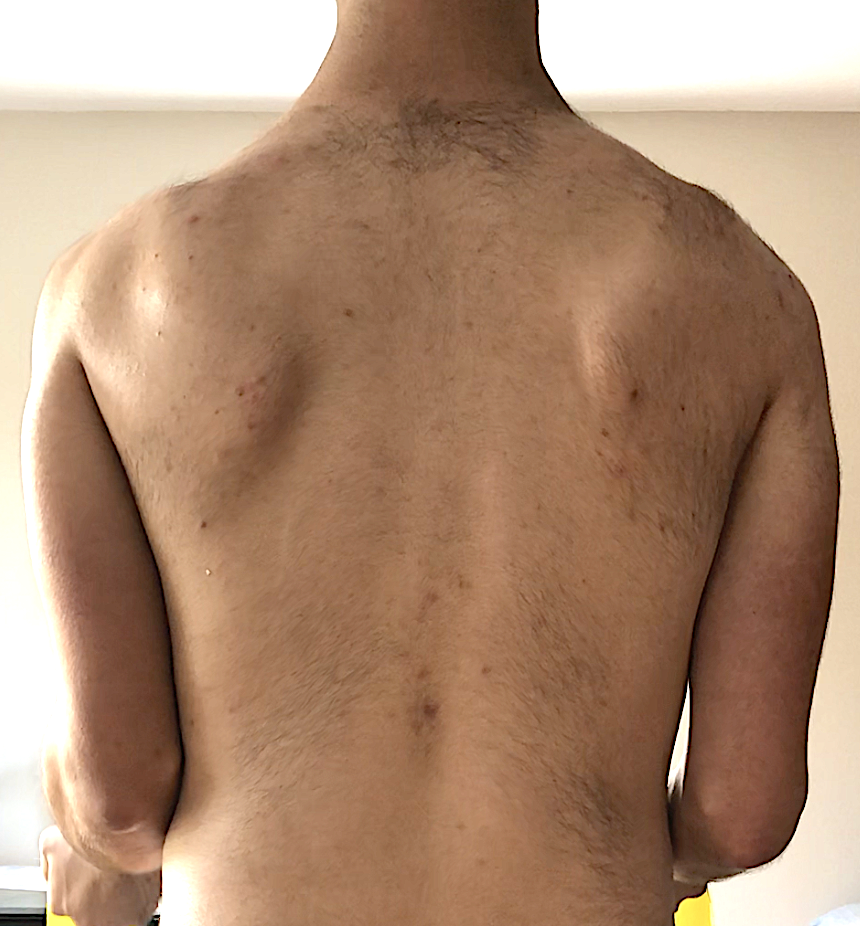
Image - Winging of the scapula, where the medial border lifts away from the chest wall. This indicates weakness of serratus anterior, classically from a long thoracic nerve palsy
Creative commons source by Lukelahood [CC BY-SA 4.0 (https://creativecommons.org/licenses/by-sa/4.0)]
Feel (Palpation)
Before palpating, ask again about pain and watch the patient's face throughout. First assess temperature by running the back of your hand over both shoulders and comparing sides — increased warmth suggests active inflammation, infection (septic arthritis) or crystal arthropathy.
Then palpate the bony and soft-tissue landmarks in a logical sequence, starting medially and working laterally:
- Sternoclavicular joint — tenderness or swelling here may reflect dislocation or arthritis.
- Clavicle — palpate along its length for tenderness or a step suggesting a fracture.
- Acromioclavicular joint (ACJ) — localised tenderness or a prominent step here points to ACJ arthritis or disruption.
- Acromion and coracoid process.
- Greater tuberosity of the humerus and the subacromial space — tenderness over the subacromial region is typical of subacromial impingement or rotator cuff disease.
- Head of humerus and the surrounding muscle bulk.
The scapular spine and borders should also be palpated posteriorly. Localising the point of maximal tenderness is one of the most useful steps in distinguishing ACJ pathology from rotator cuff or glenohumeral problems.
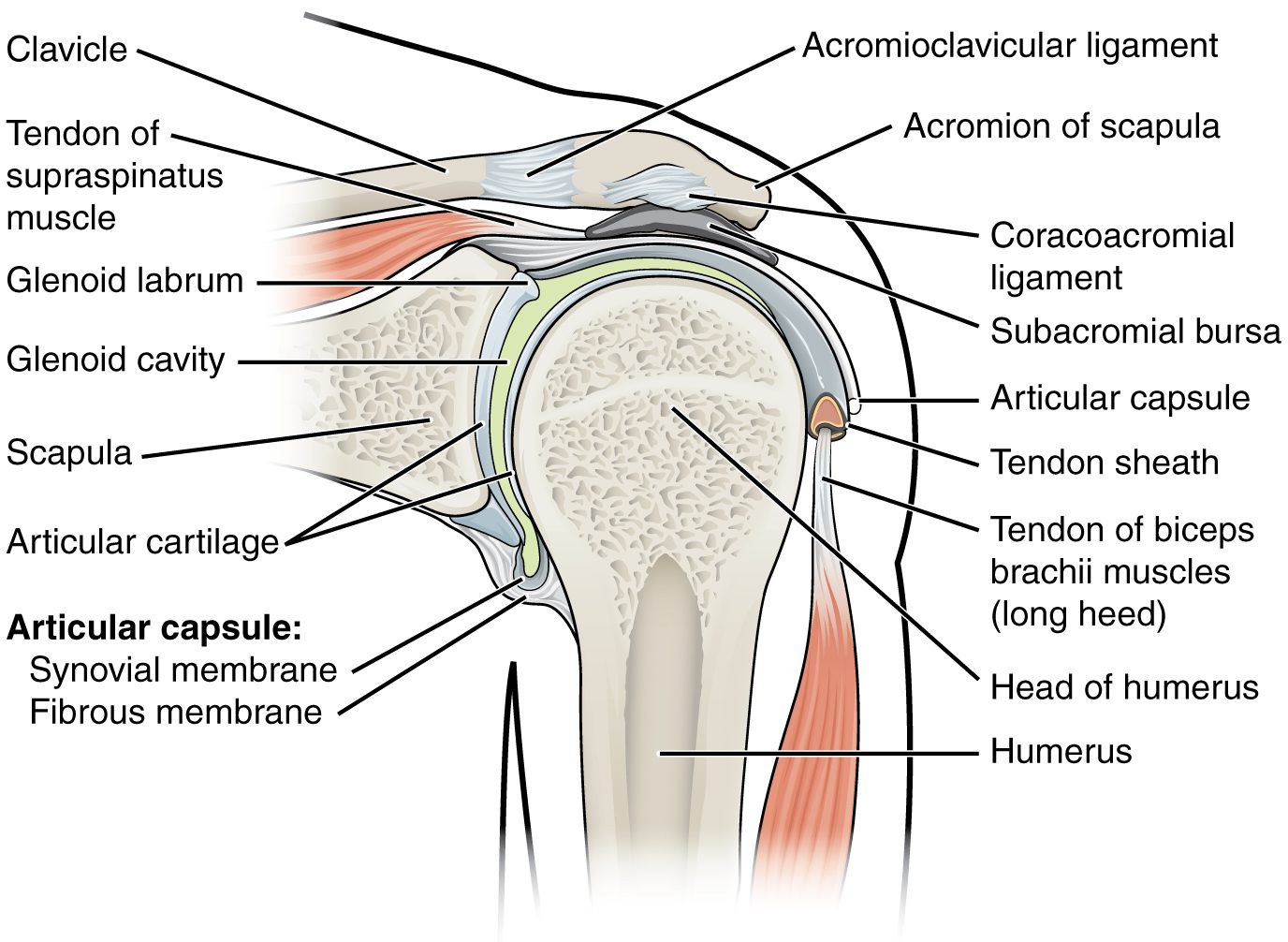
Image - The bony anatomy of the shoulder, showing the glenohumeral joint, the acromioclavicular joint, the clavicle and the acromion — the key landmarks palpated during examination
Creative commons source by OpenStax College [CC BY 3.0 (https://creativecommons.org/licenses/by/3.0)]
Special Tests – Rotator Cuff
The rotator cuff is made up of four muscles — supraspinatus, infraspinatus, teres minor and subscapularis — which together stabilise the humeral head within the shallow glenoid and initiate and control movement. Each special test isolates one part of the cuff so that a weak or painful response localises the lesion.
- Supraspinatus – 'empty can' (Jobe's) test: ask the patient to abduct the arms to 90° in the plane of the scapula, with the thumbs pointing down as if emptying a can, then resist as they push up. Pain or weakness suggests supraspinatus tendinopathy or tear, as this position isolates and stresses the supraspinatus.
- Infraspinatus and teres minor – resisted external rotation: with the elbows flexed to 90° and tucked in, ask the patient to push their hands outwards against resistance. Weakness indicates a problem with the infraspinatus/teres minor, the main external rotators.
- Subscapularis – Gerber's lift-off test: ask the patient to place the back of the hand against the lower back and then lift it away from the back against resistance. The subscapularis is the principal internal rotator, so an inability to lift off suggests subscapularis dysfunction or rupture. The belly-press test (pressing the palm into the abdomen while keeping the elbow forward) is an alternative for patients who cannot reach behind the back.
The drop arm test assesses the integrity of the cuff as a whole: passively abduct the arm to 90° and ask the patient to lower it slowly. If the arm drops suddenly or the patient cannot control the descent, this suggests a large rotator cuff (typically supraspinatus) tear, as the cuff can no longer support the weight of the arm.

Image - The four rotator cuff muscles (supraspinatus, infraspinatus, teres minor and subscapularis), each of which is isolated by a specific special test
Creative commons source by InjuryMap [CC BY-SA 4.0 (https://creativecommons.org/licenses/by-sa/4.0)]
Special Tests – Impingement
Impingement tests reproduce compression of the rotator cuff and subacromial bursa beneath the coracoacromial arch, and are positive in subacromial impingement syndrome.
- Neer's test: stabilise the scapula with one hand, then passively flex (forward elevate) the patient's internally rotated arm. Pain as the arm is raised indicates impingement, because this manoeuvre drives the greater tuberosity and supraspinatus tendon against the underside of the acromion.
- Hawkins–Kennedy test: flex the shoulder and elbow to 90°, then internally rotate the shoulder by lowering the forearm. Pain on internal rotation suggests impingement, as the supraspinatus tendon is forced against the coracoacromial ligament.
A positive painful arc on abduction (see above) supports the same diagnosis. Impingement is often associated with a painful but full passive range and normal strength, which helps distinguish it from a complete cuff tear.
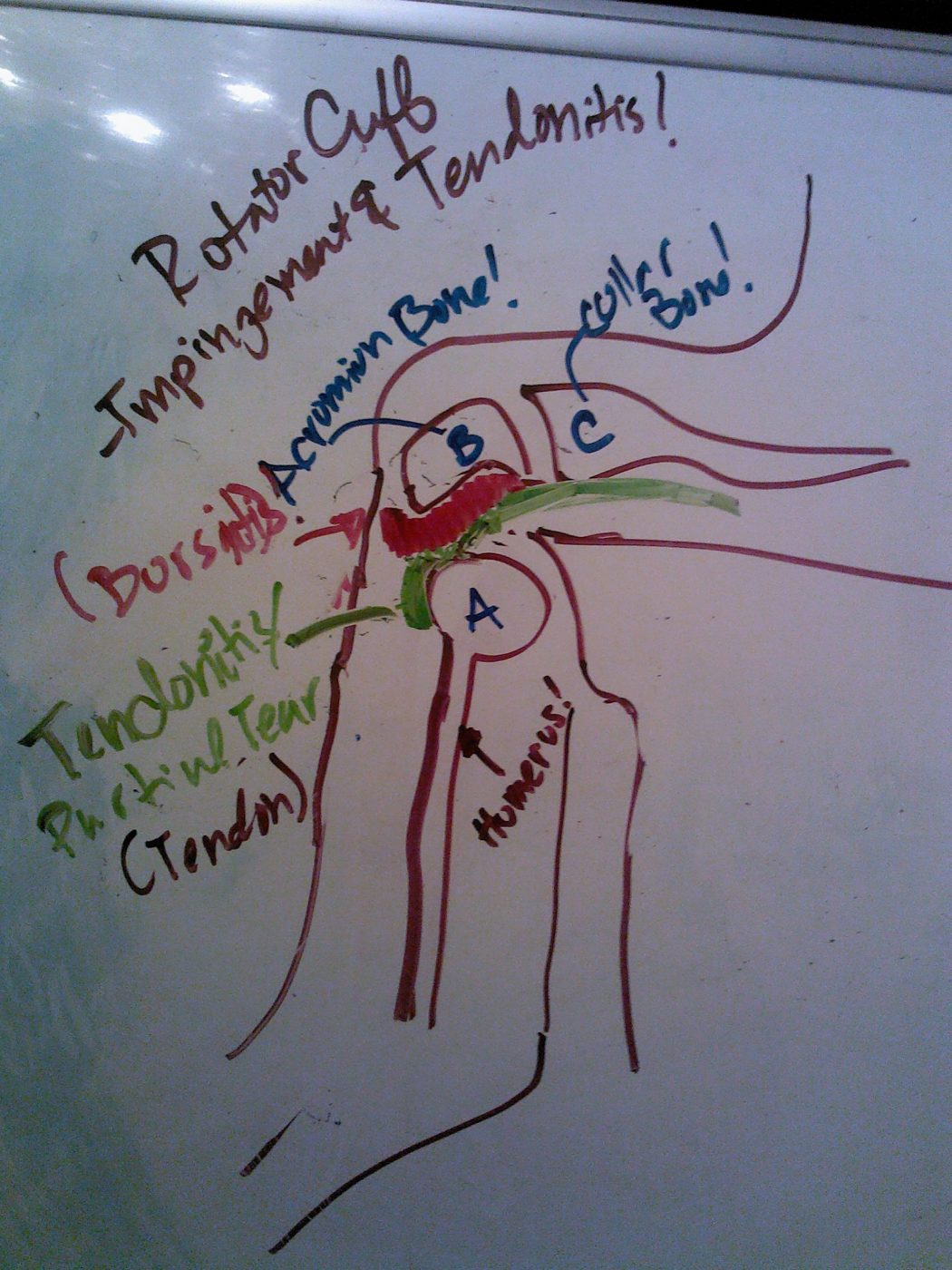
Image - Subacromial impingement, where the supraspinatus tendon and subacromial bursa are compressed beneath the acromion, producing a painful arc and positive Neer's and Hawkins tests
Creative commons source by LA323 [CC BY-SA 3.0 (https://creativecommons.org/licenses/by-sa/3.0)]
Neurovascular Assessment
Because shoulder problems and their treatment can affect surrounding nerves and vessels, complete the examination with a brief neurovascular check of the upper limb.
Assess sensation over the 'regimental badge' area on the lateral upper arm, which is supplied by the axillary nerve. This nerve is vulnerable in anterior shoulder dislocation and surgical neck of humerus fractures, so reduced sensation here is an important finding.
Confirm intact distal pulses (radial pulse) and adequate capillary refill in the fingers to ensure the limb is well perfused, and check gross power and sensation in the rest of the arm and hand.
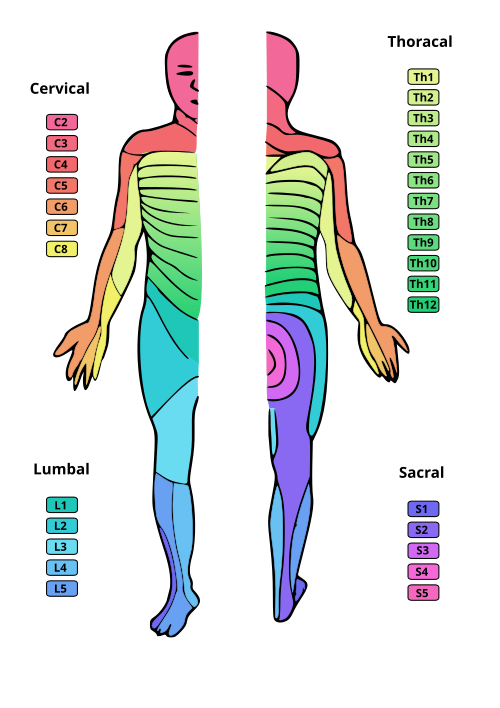
Image - Sensory dermatomes of the upper limb. The 'regimental badge' over the lateral upper arm corresponds to the C5 dermatome and axillary nerve territory, which is tested after shoulder dislocation
SimpleMed original
- 294