
Next Lesson - Muscles of the Forearm
Core
There are 27 bones in the hand, which all interact with each other to allow for complex movements in the hand. There are some striking similarities when comparing the bones in the hand with those in the feet - especially when considering arrangement. The bones can be compartmentalised into three categories:
- Carpals
- Metacarpals
- Phalanges
There are eight, irregularly shaped bones. They articulate to allow for correct positioning of the fingers. When analysing the arrangement, the bones can be placed into rows:
In the proximal row, moving lateral to medial:
- Scaphoid
- Lunate
- Triquetrum
- Pisiform
In the distal row, moving lateral to medial:
- Trapezium
- Trapezoid
- Capitate
- Hamate
The distal row of carpal bones articulates with the metacarpals, whilst the scaphoid and lunate bones in the proximal row form the wrist joint with the radius (the ulna is separated from the carpal bones by an articular disc).
These bones can be difficult to remember. A mnemonic to remember this is: 'Some lovers try positions that they cannot handle'.
Like in the foot, where there are five metatarsals, there are five metacarpals in the hand; one for each digit. The base is most proximal, whilst the head is most distal. The bases of the metacarpals articulate with the carpal bones, whilst the heads articulate with the proximal phalanges to form the metacarpophalangeal joint.
There are three phalanges in each digit (with the exception of the thumb, which only has two). These articulate with each other via interphalangeal joints, whilst the proximal phalanx articulates with its respective metacarpal via metacarpophalangeal joints.
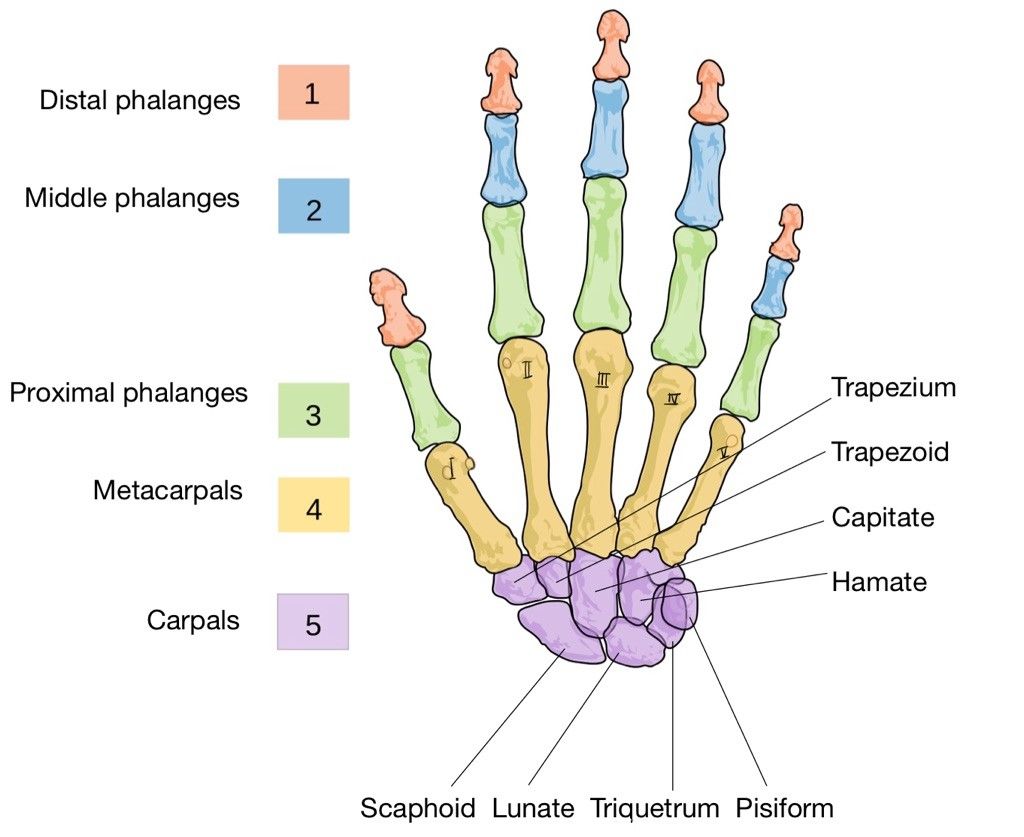
Diagram - Illustrates the arrangement of bones in the left hand
Creative commons source by Mariana Ruiz Villarreal (LadyofHats) and Kolossos, edited by Dr. Sachin Sudhakaran [CC BY-SA 4.0 (https://creativecommons.org/licenses/by-sa/4.0)]
For Pathologies and Conditions of the Hand, check out our articles on Conditions of the Hand.
Reviewed by: Dr. Thomas Burnell
Edited by: Dr. Maddie Swannack
- 9707