
Next Lesson - The Lymphatic System
Core
Regeneration allows replacement of damaged tissue through cell replication and growth of tissues. Regeneration can be incomplete, leaving the tissue different from the original in structure or function. Tissues can regenerate completely after injury if there is:
- An intact connective tissue scaffold (the supporting framework of connective tissue that cells grow along)
- A population of stem cells
If the injury is too extensive, or the harmful cause persists then complete regeneration will not be able to occur. The tissue is instead repaired with a scar, formed by the process of organisation. Organisation takes place through healing by primary or secondary intention (two patterns of wound healing, explained below).
The ability of a tissue to regenerate depends on the stem cell population, which are cells that can differentiate and replace cells that have been lost to injury or normal senescence (ageing and wearing out). They are present in small, discrete populations. For example, they are found in the basal layer of the epidermis (the deepest layer of the outer skin), or at the bottom of intestinal crypts (small pits in the lining of the gut).

Diagram - The bottom of intestinal crypts where stem cells are found. The stem cells can divide and differentiate to replace lost cells of the intestinal epithelium.
Creative commons source by STEMCELL Technologies Inc [CC BY-SA 4.0 (https://creativecommons.org/licenses/by-sa/4.0)]
In the classical model, a stem cell undergoes mitosis. One daughter remains as a stem cell. The other differentiates, often through an immature progenitor stage (an intermediate, partly specialised cell), to produce a mature cell. This is asymmetric replication (the two daughter cells are different). Not every division is asymmetric. Some populations, such as intestinal stem cells, maintain self-renewal (making new stem cells) and produce differentiated cells through balanced symmetric divisions (both daughter cells take the same fate).
Stem cells can be classified according to how many types of other cells they can differentiate into.
- Unipotent
- Only able to differentiate into one type of cell.
- For example, stem cells in the basal layer of the epidermis.
- Multipotent
- Able to produce several types of differentiated cells.
- For example, haematopoietic (blood-forming) stem cells in bone marrow.
- Totipotent
- Able to differentiate into any type of cell, including the tissues that support the embryo, such as the placenta (extra-embryonic tissue).
- For example, the zygote and early embryonic cells.
Cells can be organised into 3 different groups depending on their proliferative activity (how readily they divide). This matters because tissues whose cells divide readily regenerate best. The groups are:
- Labile (continuously dividing)
- These cells are short lived, and can easily be replaced by replication and maturation of stem cells.
- This means these tissues have a high reproductive capacity.
- For example, epithelial cells (such as those in the gastrointestinal tract).
- Stable (resting, but able to divide when needed)
- These cells normally have a slow rate of cell replication.
- However, they can divide rapidly when required.
- Hepatocytes and renal tubular cells are examples of stable cells.
- Permanent (not dividing)
- These cells are unable to undergo effective replication.
- Few or no stem cells are present, so lost cells are generally not replaced by the same type of cell.
- Neurones and cardiac muscle cells (myocytes) are examples of permanent cells.
Regeneration can take place in tissues made of labile or stable cells when tissue damage isn’t extensive. The presence of stem cells makes this possible, as they can divide and differentiate to replace the lost cells.
Cell to cell communication occurs via chemical messengers, which include local mediators such as growth factors (these act on nearby cells) and hormones (these travel in the blood to distant cells). It also occurs by direct cell-cell or cell-stroma contact (contact with the stroma, the supporting tissue around the cells). This communication allows control of regeneration.
Local Mediators
Growth factors are a type of local mediator, and are important in regeneration and fibrous repair. Growth factors are polypeptides (chains of amino acids). Many growth factors, or their receptors, are encoded by proto-oncogenes (normal genes that can cause cancer if they are altered). They act in an autocrine (acting on the cell itself that secretes the growth factor) or paracrine (acting on cells a short distance away) manner. They stimulate or inhibit cell proliferation (cells multiplying). They do this by binding to specific receptors, which alters gene transcription.
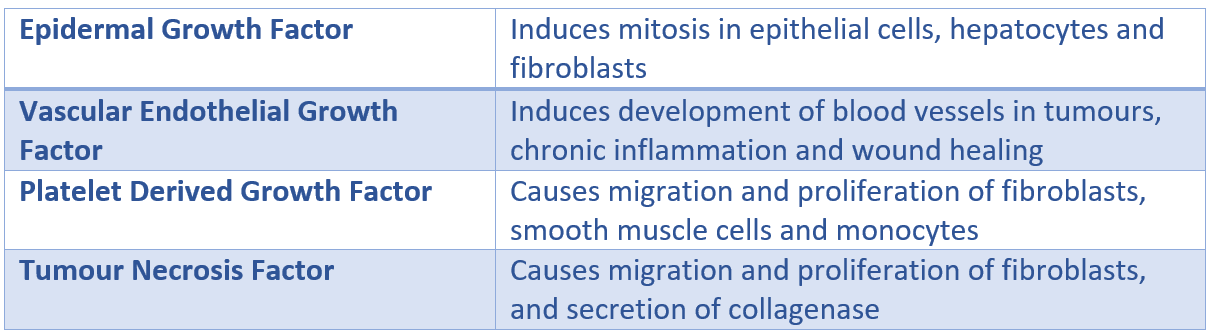
Table - shows some of the different growth factors in the body and their effect
SimpleMed original by Dr. Emily Smith
Contact Inhibition
Cells will continue to replicate until they are in contact with other cells, which triggers a signal to stop proliferation, a process known as contact inhibition. Contact inhibition stops cells piling up on top of each other. There are proteins called adhesion molecules which bind cells to each other (cadherins) or to extracellular matrix (integrins).
Whilst regeneration involves the growth of a tissue back to its normal state, organisation is the process by which specialised tissues that have suffered damage undergo fibrous repair to form a scar. Organisation requires collagen, which is synthesised by fibroblasts and myofibroblasts (fibroblasts that can contract). Depending on the extent of the tissue damage, organisation can take place by either primary or secondary intention, but the general process remains the same. The main steps are haemostasis (stopping the bleeding), inflammation, formation of granulation tissue, and then scar formation and maturation:
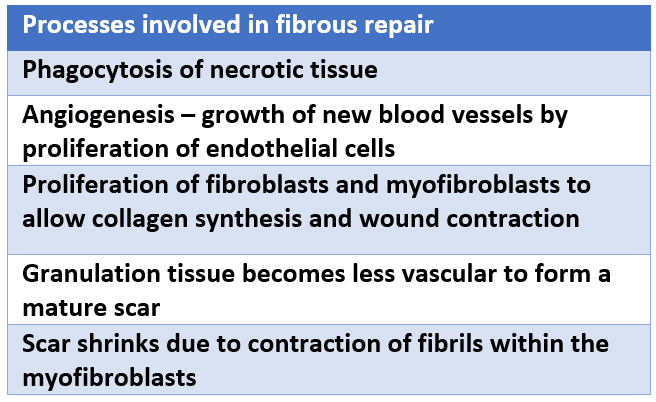
Table - The processes in fibrous repair from initial injury to the formation of a scar.
SimpleMed original by Dr. Emily Smith
The formation of granulation tissue is part of the process of organisation. Granulation tissue (new connective tissue rich in small blood vessels) fills in the gap that is initially left by the damage to tissue. Angiogenesis (formation of new blood vessels) occurs within the granulation tissue, and the new capillaries provide oxygen, nutrients and cells required to repair the damage.
Granulation Tissue Cells
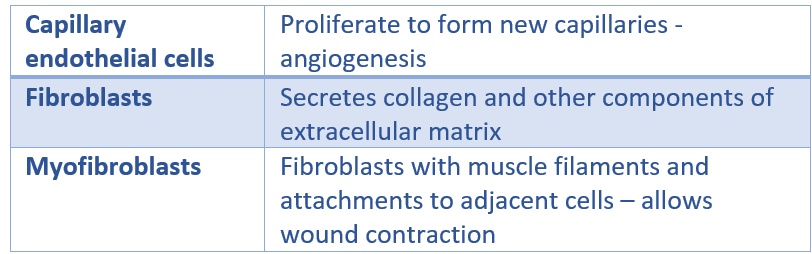
Table - The different cells found in granulation tissue
SimpleMed original by Dr. Emily Smith
Histology of granulation tissue can be seen in the image below:

Image - The histology of granulation tissue in an infected wound. There are many blood vessels and immune cells.
Creative commons source by Patho [CC BY-SA 4.0 (https://creativecommons.org/licenses/by-sa/4.0)]
Healing by primary intention can occur in clean, non-infected wounds with opposed edges (edges that lie together, for example a sutured surgical cut). These wounds result in the death of a limited number of epithelial and connective tissue cells, and disruption of the basement membrane (the thin supporting layer beneath the epithelium).
- Haemostasis: occurs within seconds to minutes. Severed arteries contract, and the space fills with blood. A scab forms which seals off the wound from the outside world to prevent entry of bacteria.
- Inflammation: occurs within minutes to hours. Neutrophils appear at the edges of the wound to clear bacteria and debris.
- Migration of cells: occurs after 48 hours. Macrophages phagocytose (engulf) dead neutrophils and secrete cytokines (chemical signals between cells). These cytokines attract fibroblasts and endothelial cells (the cells lining blood vessels). Spurs of epithelial cells (small buds of surface cells growing in from the wound edge) are also present. These deposit components of the basement membrane.
- Regeneration: occurs around day three. Granulation tissue invades the space. There is also proliferation of epithelial cells to thicken the epidermis, which leads to the scab falling off. Angiogenesis continues.
- Early scarring: occurs within 7 to 10 days. Fibroblasts in the granulation tissue proliferate and deposit collagen fibres to form a scar.
- Scar maturation: the scar is now a mass of fibrous tissue with collagen fibres, few cells and few vessels. Capillaries disappear over time, which means old scars may appear white, although this can vary based on factors such as the depth of the wound, infection, and individual healing responses.
Healing by Secondary Intention
Healing by secondary intention occurs in wounds with tissue loss, separated edges or infected wounds. The wounds are filled by abundant granulation tissue, which builds up from the base of the wound. The same processes occur as in healing by primary intention, however, there is a more intense inflammatory process, and considerable wound contraction. Myofibroblasts contract the wound, and the scar continues to remodel as collagen is reorganised. The scar’s final size and shape depend on the original wound, its location and the tension in the nearby tissue. It does not necessarily match the original wound outline.

Diagram - The process of healing by primary and secondary intention and how the processes differ from each other
SimpleMed original by Dr. Emily Smith
Factors Affecting Regeneration and Repair
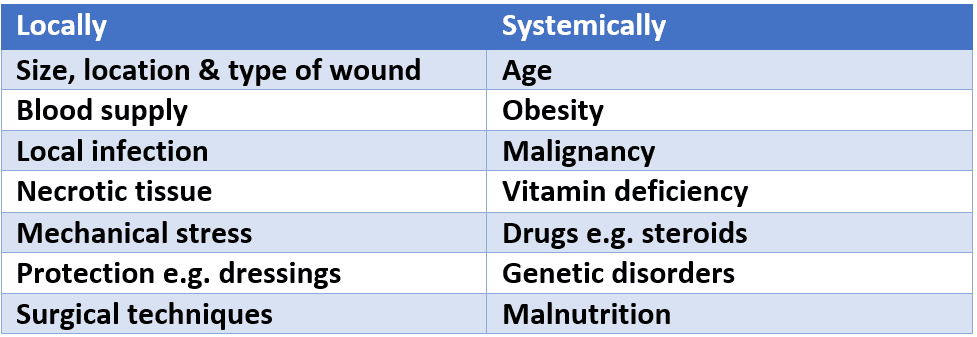
Table - The factors affecting regeneration and repair
SimpleMed original by Dr. Emily Smith
Collagen gives scars their strength, so defects in collagen synthesis (the making of collagen) weaken scars and slow healing. Two examples are scurvy and Ehlers-Danlos syndrome.
Scurvy:
- Caused by a vitamin C deficiency. Vitamin C is required for hydroxylation (adding hydroxyl groups to amino acids) of procollagen (the precursor of collagen), which stabilises the three-stranded (triple helix) structure of collagen.
- Scurvy causes poor wound healing, and people tend to bleed due to fragile capillaries.
- Also, because the collagen in scars is constantly being turned over, people who develop scurvy are at risk of old scars reopening due to the inability to replace the collagen.
Ehlers-Danlos Syndrome:
- This is a group of inherited conditions (there are 13 types) that affect connective tissue. In many types, faults in the genes for collagen, or for the enzymes that process it, cause collagen fibres to lack tensile strength (the ability to resist being pulled apart).
- People with Ehlers-Danlos syndrome often have hyperextensible (stretchy) and fragile skin, and hypermobile joints (joints that move further than normal). The features vary between types.
- Some types also cause poor wound healing, and many people are predisposed to joint dislocation.
- In some subtypes, particularly the vascular type, this condition can cause rupture of the colon or large arteries.
Complications of Fibrous Repair
Insufficient fibrosis:
- This can result in wound dehiscence (the wound splitting open), hernias (organs or tissue pushing through a weak area of the body wall) or ulceration.
Formation of adhesions (fibrous bands between or around structures):
- Can compromise organ function, for example by causing bowel obstruction (a blockage of the bowel).
Loss of function:
- Due to replacement of specialised parenchymal cells (the working cells of an organ) by scar tissue.
- For example, scar tissue formed after a myocardial infarction (heart attack) cannot contract like myocytes (heart muscle cells).
Excess scar contraction:
- Can cause obstruction of structures, including blood vessels, which can lead to further complications.
Overproduction of collagen:
- Results in a keloid scar.
- Keloid scars don’t regress (shrink back), and they grow beyond the margins of the original wound.
- Hypertrophic scars (raised scars that stay within the wound margins) usually regress.
- Excision (cutting out) of a keloid scar is associated with a high risk of recurrence (the keloid growing back), particularly if performed without adjuvant therapy (extra treatment alongside surgery, such as steroid injections or radiotherapy).

Image - A Keloid scar
Creative commons source by Micheal Rodger [CC BY-SA 4.0 (https://creativecommons.org/licenses/by-sa/4.0)]
Edited by: Dr. Bethany Turner
Reviewed by: Dr. Thomas Burnell and Dr. Marcus Judge
- 19609