
Next Lesson - Psychosis
Core
This article will focus on disorders of mood, including depression, mania, hypomania, and bipolar disorder.
Depression is a condition of low mood that affects 5% of adults worldwide (source).
Doctors diagnose depression using diagnostic criteria. NICE points to two sets: ICD-11 (the World Health Organization’s International Classification of Diseases, 11th revision) and DSM-5 (the American Psychiatric Association’s Diagnostic and Statistical Manual of Mental Disorders, 5th edition). ICD-11 needs low mood or loss of interest, most of the day and nearly every day, for at least 2 weeks, plus other symptoms. DSM-5 needs at least 5 symptoms in the same 2-week period, and at least one must be low mood or loss of interest or pleasure.
The older ICD-10 criteria (the 10th revision of the same classification) use 3 core symptoms. A diagnosis needs at least 2 of them for about 2 weeks, plus at least 2 further psychological or physical symptoms. The 3 ICD-10 core symptoms of depression are:
- Low mood
- Lack of energy
- Lack of enjoyment or interest in things the patient would usually enjoy (also known as anhedonia)
Depression is also associated with a number of ‘biological’ or ‘somatic’ symptoms:
- Reduced sleep or insomnia, usually characterised by early morning waking
- Hypersomnia - increased sleep
- Reduced appetite
- Psychomotor retardation - slowing of movement and thinking
- Reduced libido (sex drive)
Unfortunately, the precise causes of most mental illnesses have not been identified at this time. However, a collection of risk factors has been identified, and if multiple are present simultaneously, this can increase the risk of mental illness. These can be categorised into three types. Predisposing factors are things the patient cannot change. Perpetuating or maintaining factors are things in the patient’s life now that encourage mental illness. Precipitating factors are events that ‘push’ the patient into mental illness.
Predisposing Factors:
- Genetics - a family history of depression makes it more likely
- Childhood experiences - abuse, loss of a parent, bullying
Perpetuating Factors:
- Stressful job or unemployment
- Financial strain
- Substance misuse
- Relationship difficulties
- Housing uncertainty
Precipitating Factors:
- Life events often related to loss - death of a loved one, end of a relationship, declining physical health
Adjustment Reactions vs Depression
It is important to differentiate an adjustment reaction from clinical depression. Both can follow a stressful life event. The event may be the precipitating factor for depression AND may also cause an adjustment reaction.
An adjustment reaction (also called adjustment disorder) is distress and emotional disturbance that usually interferes with daily life. It follows a significant life change or a stressful life event, such as bereavement, separation or failing to reach a cherished goal. It has fluctuating symptoms including feelings of anger and frustration. Low mood and anxiety can also occur. There are no particular disturbances to sleep, appetite or energy levels.
Clinical depression is a condition of low mood, lack of energy and lack of enjoyment that comes on more gradually and must last for a period of 2 weeks or more. Lack of sleep (insomnia), poor appetite and lack of libido are common.
If an adjustment reaction persists and there are symptoms of depression present, the reaction may have triggered the development of depression.
The table below describes the symptoms of both, to show the differences between these two conditions.
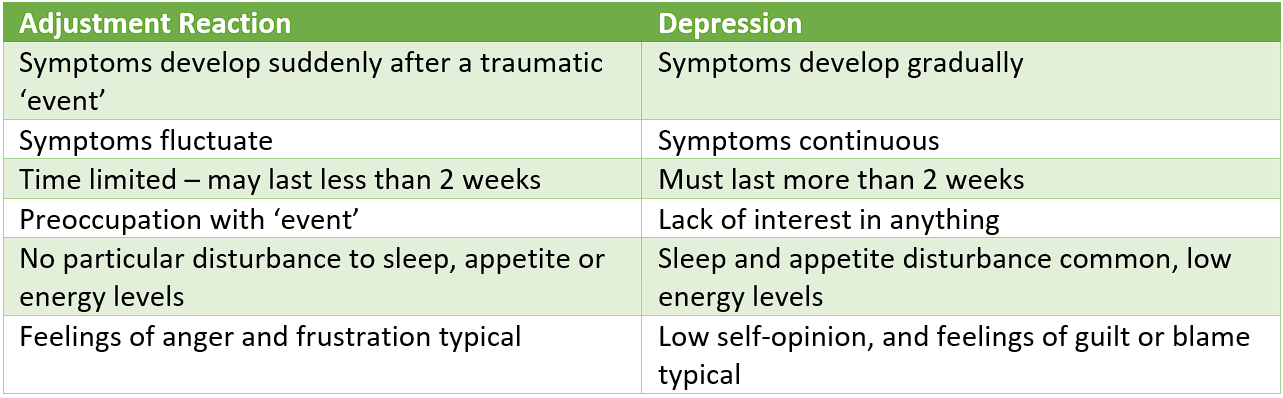
Table - The differences between adjustment reaction and clinical depression. Here “event” means a stressful life event, which need not be a traumatic one.
There are many physical illnesses that can present similarly to depression, and some can occur alongside it. It is therefore important to consider them when assessing a patient. Examination and investigations depend on clinical judgement, especially if a physical cause is suspected. Examples include:
- Hormone disturbances such as thyroid dysfunction
- Deficiency of vitamins such as vitamin B12
- Kidney disease
- Alcohol and drug misuse
Mania and hypomania are conditions which both involve elevated mood. Mania must be present for at least 1 week (or any duration if hospitalisation is required), whereas hypomania must be present for at least 4 days (DSM-5 criteria). In studies from the mid-1970s to 2000, the rate of mania was between 4 and 16 in 1000 people, or 0.4% to 1.6% (source).
Besides elevated mood, symptoms include:
- Increased energy
- Pressure of speech (fast rate of speech)
- Reduced sleep
- Flight of ideas - a thought disorder in which thoughts change topic very quickly
- Loss of social inhibitions
- Inflated or grandiose self-esteem
Hypomania is considered to be a less severe version of mania. The main differentiating features are that mania causes marked functional impairment (difficulty coping with work, relationships or daily life) and may include psychotic symptoms such as hallucinations (sensing things that are not there) or delusions (fixed false beliefs). Hypomania does not cause severe impairment and does not include psychotic symptoms.
Bipolar disorders involve episodes of mania or hypomania, with the depressive history helping distinguish the subtypes. The two main subtypes are bipolar I and bipolar II. The DSM-5-TR criteria (the current text revision of the American Psychiatric Association’s DSM-5) set different episode requirements for each.
Bipolar I requires at least one manic episode; major depression is common but is not required. Bipolar II requires at least one hypomanic episode and at least one major depressive episode, with no history of mania. Episodes must meet diagnostic criteria and not be better explained by substances or another medical condition.
Bipolar disorder is relatively common in the UK. In a 2014 UK survey, 2.0% of the people surveyed (about 2 in 100) screened positive for bipolar disorder. A positive screening result is not a diagnosis (source). The NHS has a patient overview of bipolar disorder.
The DSM-5-TR subtype requirements can be summarised as follows:
- Bipolar I - At least one manic episode; a depressive episode is not required
- Bipolar II - At least one hypomanic episode and one major depressive episode, with no manic episode
Structures Involved in Mood Disorders
There are three main structures in the brain that are thought to be involved in mood disorders.
The first system is the limbic system, a collection of structures that sits close to the corpus callosum (the band of nerve fibres joining the two halves of the brain) in the centre of the brain. The main functions of the limbic system are the management of emotion, motivation and memory. It is therefore thought to play a role in mood and anxiety disorders. For more information on the limbic system, please see our article on Anxiety and Anxiety Disorders.
There is some debate around which structures should be included in the limbic system, but the most common components are:
- Amygdala - involved in fear and emotional memory
- Hippocampus - involved in forming long-term memories
- Cingulate Gyrus - helps combine attention and emotion
- Fornix - a bundle of nerve fibres carrying signals from the hippocampus
- Hypothalamus
- Thalamus
The frontal lobe has many different functions, including executive function (planning, decision making and controlling behaviour), personality, attention, memory and mood. It is also connected to the limbic system. The frontal lobe impacts a large number of psychiatric conditions. For more information on the frontal lobe and its functions, please see our article on Topography of the Nervous System.
The basal ganglia are a group of structures found deep within the brain. These structures are closely related to the limbic system, and there is some crossover with structures being classified in both systems.
The functions of the basal ganglia can be broadly categorised into motor functions (movement) and psychological functions (involving emotion, cognition (thinking and learning) and mood). Dysfunction of the basal ganglia can therefore lead to movement disorders such as Parkinson’s Disease or Huntington’s Disease (for more information, please see our article on Movement Disorders). Changes in the basal ganglia have also been found in psychological disorders such as mood disorders.
Neurotransmitters are vital for the brain’s function, and chemical imbalances in the levels of neurotransmitters can be a contributor to mood disorders.
Noradrenaline has effects on the brain related to mood, behaviour and memory functions. It is produced in the locus coeruleus (a small cluster of nerve cells) in the brainstem and transported into the cortex.
Serotonin has effects on the brain related to sleep, impulse control, appetite and mood. It is produced in the raphe nuclei (clusters of nerve cells) of the brainstem, and is transported to the cortex and the limbic system.
Dopamine is particularly active in the basal ganglia, and therefore has effects related to motor function and mood, especially in the pathways relating to reward.
There are other neurotransmitters that are involved in mood disorders, such as Acetylcholine, GABA (gamma-aminobutyric acid, the brain’s main inhibitory neurotransmitter) and Glutamate (its main excitatory neurotransmitter), but their effects are beyond the scope of this article.
See our article on neurotransmitters for more information.
Selective serotonin reuptake inhibitors (SSRIs) inhibit the serotonin transporter, reducing neuronal serotonin reuptake (the nerve cell taking released serotonin back in). Serotonin noradrenaline reuptake inhibitors (SNRIs) reduce reuptake of both serotonin and noradrenaline. These actions alter neurotransmitter signalling; clinical improvement develops over weeks. A response to treatment does not establish that an individual's depression was caused by a deficiency of either transmitter.
One idea (a hypothesis, not yet proven) is that mania involves overactive dopamine signalling. Typical (first-generation) antipsychotics (drugs used to treat psychosis and mania) like haloperidol are dopamine receptor antagonists. Antagonists block the receptor, so dopamine has less effect.
Second-generation antipsychotics (also called atypical antipsychotics) act on serotonin receptors as well as dopamine receptors. Risperidone, olanzapine and quetiapine are antagonists at both. Aripiprazole is different. It is a dopamine D2 partial agonist, which means that it activates the receptor, but less strongly than dopamine does. It also has partial agonist and antagonist actions at serotonin receptors. For acute mania, NICE guideline CG185 offers haloperidol, olanzapine, quetiapine or risperidone.
There is also a class of drug called mood stabilisers, which includes lithium. These drugs are very effective in bipolar disorder to prevent severe episodes of mania or depression, and try to stabilise the mood.
One important thing to consider when prescribing to patients with bipolar disorder is that giving antidepressants can induce a manic episode. For this reason, antidepressants are used with caution in bipolar disorder and with careful monitoring. Antidepressant monotherapy (an antidepressant given on its own) should be avoided in patients with a history of manic episodes or a diagnosis of bipolar disorder. If mania or hypomania develops in a person taking an antidepressant, CG185 advises considering stopping the antidepressant.
For moderate or severe bipolar depression in a person not already taking a drug for their bipolar disorder, CG185 offers fluoxetine (an antidepressant) combined with olanzapine, or quetiapine on its own. Olanzapine alone or lamotrigine alone are alternatives.
Edited by: Dr. Ben Appleby
Reviewed by: Dr. Thomas Burnell and Dr. Marcus Judge
- 764