
Next Lesson - Mood Disorders
Core
Anxiety is defined as a feeling of worry, nervousness, or unease about something with an uncertain outcome.
Symptoms of anxiety can include:
- Palpitations (awareness of your own heartbeat, often fast or pounding)
- Sweating
- Trembling or shaking
- Dry mouth
- Difficulty breathing or hyperventilation (fast, deep breathing)
- Chest pain or discomfort
- Nausea or abdominal ‘fluttering’
- Feelings of dizziness, light-headedness or faintness.
Feelings of anxiety were essential to survival for human ancestors. However, too much anxiety impairs performance because it is distracting. Exams are a good example today: some anxiety helps to focus the mind, but too much anxiety hinders rather than helps.
This can be shown in the Yerkes-Dodson law seen below:
This image shows the relationship between performance and arousal (how alert and stimulated a person is, shown here as anxiety level).
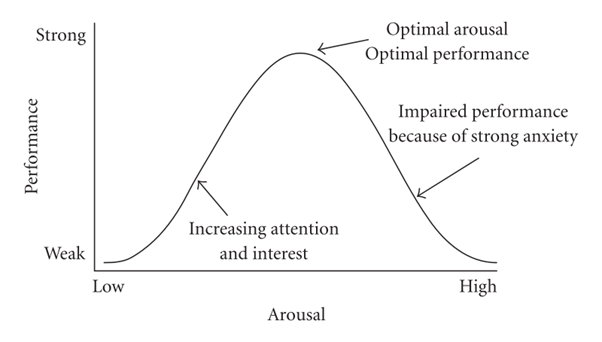
Diagram - The Yerkes-Dodson Law
Licensed under Creative Commons, Source.
While anxiety may feel unhelpful in many situations today, these adaptations offered an evolutionary advantage to ancestors that had to escape life-threatening situations. The body assists this escape through the stress response.
The limbic system is a collection of structures that sit medially in the brain, on the border of the cerebral cortex and the subcortical structures (structures lying below the cortex) known as the diencephalon (the deep part of the brain that contains the thalamus and hypothalamus). It is responsible for many different systems that help regulate emotions and motivations, especially those related to survival, such as sexual behaviours, hunger, and anxiety. It also contributes to higher cortical functions (functions of the cerebral cortex), such as learning and memory.
Which structures in this region are included in the limbic system is a point of contention, so this is a list of structures most often included:
Amygdala - an almond shaped collection of cells located in the temporal lobe that is particularly involved in anxiety and fear.
Hippocampus - the hippocampus is mainly involved in memory, particularly the conversion of short-term memories into long-term memories. Bilateral damage to the hippocampi would therefore cause anterograde amnesia, a condition where new long-term memories of personal experiences cannot be formed.
Cingulate Gyrus - found superior to the corpus callosum (the band of nerve fibres that joins the two halves of the brain) in the medial portion of the brain. This structure is involved in both emotion and memory.
Fornix - a bundle of fibres responsible for transmitting information from the hippocampus to the mammillary bodies (small round structures at the base of the brain), with onward connections to the thalamus.
Hypothalamus - through interactions with the pituitary gland, the hypothalamus can influence many things in the body through the release of hormones into the bloodstream. The hypothalamus also plays a key role in the regulation of the autonomic nervous system.
Thalamus - a large mass of grey matter cells which make up the main relay portion of the brain for both sensory and motor signals.
Other structures that can be considered part of the limbic system but have not been included in this list are the parahippocampal gyrus (the cortex next to the hippocampus), the septal nuclei (small groups of nerve cells deep in the brain, near the midline) and the mammillary bodies.
This image shows the different structures that make up the limbic system.
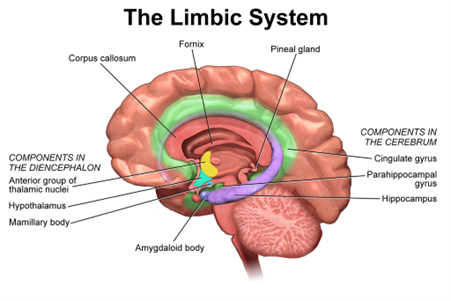
Diagram - The Limbic System
Source illustration: BruceBlaus / Blausen.com staff (2014), source, CC BY 3.0.
In a particularly anxiety-inducing situation, the limbic system and the cortex work together to prompt the hypothalamus. The hypothalamus in turn activates the motor system (the nerve pathways that control movement of the body’s muscles) and the sympathetic nervous system, which produces the ‘fight or flight’ response. Sympathetic activation widens the blood vessels supplying muscles, increasing their blood supply.
This diagram shows the process of prompting the motor system and the sympathetic nervous system in response to anxiety.
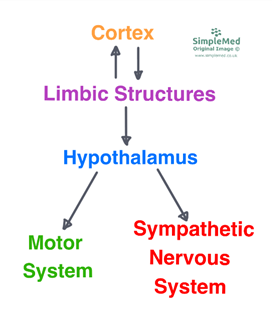
Diagram - The Stress Response
SimpleMed original by Dr. Maddie Swannack
The stress response can be split into three phases:
Alarm
The initial prompting of fear in a human will cause activation of the sympathetic nervous system, releasing noradrenaline. Adrenaline is released from the adrenal medulla (the inner part of the adrenal gland), and cortisol (known as the stress hormone) from the adrenal cortex (the outer part of the adrenal gland). This gives the initial burst to run away or fight the stressor.
Resistance
Adrenaline has a half-life (the time taken for its level to fall by half) of 2-3 minutes, meaning the high levels of adrenaline in the blood from the alarm response do not last long. Cortisol has a much longer half-life, allowing the maintenance of the stress response if needed.
Exhaustion
Prolonged stressful situations result in continued cortisol release. Cortisol helps to release glucose (sugar) for energy and breaks down protein, including muscle. Over time, high cortisol levels can therefore lead to muscle wasting, suppression of the immune system and hyperglycaemia (high blood sugar).
The stress response can therefore become a problem if the stress is not something that is quickly escapable, like stress in the modern world.
Several neurotransmitters influence anxiety disorders, including noradrenaline. The two covered here are serotonin and GABA (gamma-aminobutyric acid).
GABA is the main inhibitory neurotransmitter in the brain (it reduces nerve activity), and reduced GABA-mediated inhibition is thought to contribute to anxiety disorders. Benzodiazepines (sedating drugs such as diazepam) increase GABA transmission in the brain, so can help reduce anxiety. However, they can cause dependence, so NICE advises against them for generalised anxiety disorder (GAD) except as a short-term measure in a crisis.
Serotonin receptors exist on the hippocampus, so increasing serotonin in the limbic system through Selective Serotonin Reuptake Inhibitors (SSRIs) can lead to a reduction of anxiety.
Anxiety disorders are a collection of psychiatric disorders where the predominating feature is a feeling of anxiety. There are many different types.
Physical Conditions that Present Similarly to Anxiety Disorders
A number of medical conditions can present similarly to anxiety disorders and so they should be looked for when anxiety is first assessed, and again if it does not respond to treatment. Examples include:
- Hyperthyroidism (an overactive thyroid gland)
- Hypoglycaemia (low blood sugar)
- Anaemia
- Cushing’s syndrome (too much cortisol, most often from steroid medicines)
- Intoxication with or withdrawal from alcohol
- Excess caffeine intake
Risk Factors for Anxiety Disorders
Anxiety disorders have a number of risk factors, that can be classified into predisposing, precipitating and perpetuating factors. These groups overlap, so one factor can fit more than one group:
Predisposing
Predisposing factors are factors that make a person more vulnerable to developing anxiety. They accumulate to increase the likelihood of anxiety, and some of them, such as genetics, the patient cannot change. Examples include:
- Genetics
- Childhood upbringing, especially parental demands for high achievement
- Living alone
Precipitating
Precipitating factors are factors that exist in the patient’s life that, combined with predisposing factors, encourage the presentation of anxiety at that point. Examples include:
- Chronic illness
- Relationship problems
- Unemployment
Perpetuating
Perpetuating factors are factors that encourage the persistence of anxiety disorders once they are already established. They are often seen as barriers to successful treatment. Examples include:
- Chronic illness
- Living alone
- Negative thinking that perpetuates anxiety - for example, specific worries about others noticing the patient’s anxiety.
Generalised Anxiety Disorder (GAD)
GAD is a condition characterised by symptoms of anxiety present most days for a period of months that is causing some impairment of function. The anxiety may be generalised (‘free floating’) or specific (for example related to family, finances, school / work). It may also be associated with other physical symptoms such as muscle tension, restlessness, sweating, irritability, or sleep disturbance.
A 2007 survey estimated that about 4 in 100 adults in England had GAD, and estimates vary between studies (source).
GAD treatment follows stepped care (starting with the mildest effective treatment and moving up if needed): education and active monitoring, then low-intensity psychological support (for example, guided self-help with a trained practitioner) if needed. With marked impairment or an inadequate response, offer a choice of high-intensity CBT (cognitive behavioural therapy, a talking therapy that changes unhelpful thoughts and behaviours) or applied relaxation (a technique for relaxing the muscles when anxiety starts), or medication, according to preference. If medication is chosen, offer an SSRI. Consider sertraline (an SSRI) first, as it is the most cost-effective. Warn people under 30 that SSRIs are associated with an increased risk of suicidal thinking and self-harm in a minority of people, and see them within 1 week of starting. Benzodiazepines are reserved for short-term crisis use.
Panic disorder is a condition characterised by a history of repeated attacks of intense subjective fear (fear that the person feels very strongly) that come on rapidly, resulting in persistent anxiety about further attacks occurring.
It can be hard to assess, because the patient is often not having a panic attack when they see the GP, but a diagnosis can be made from the history alone. Panic disorder can be associated with agoraphobia, which is a fear of situations where escape might be difficult or help might not be available if things go wrong (for example, travelling on public transport or visiting a shopping centre). People avoid these situations to try to prevent a panic attack.
It is especially important with panic disorders to rule out physical causes of the symptoms of a panic attack. Hyperthyroidism, hypoglycaemia, myocardial infarction (heart attack), focal epilepsy (seizures that start in one part of the brain), withdrawal from substances, and vestibular disorders (inner ear balance problems) such as Meniere’s disease can all cause separate episodes of symptoms that look like a panic attack.
Discuss treatment choices for panic disorder according to severity, preference and previous response. For mild to moderate illness, offer self-help (written or online materials, with or without support from a practitioner). For moderate to severe illness, consider CBT. Consider an antidepressant instead if the disorder is long-standing or if psychological treatment has been declined or has not helped; an SSRI is usually offered first. Benzodiazepines, sedating antihistamines and antipsychotics (drugs used mainly to treat psychosis, a mental state in which a person loses touch with reality) should not be prescribed for panic disorder.
Social phobia (also called social anxiety disorder) is a fear of being around other people and having to interact with them. It is often linked to a fear of being watched and criticised. Many people experience some degree of social anxiety, such as mild nervousness before playing in a concert or speaking to a crowd. Social phobia is considered to be an exaggerated version of normal social anxiety. It becomes a disorder when the fear interferes with everyday life, and the person often avoids situations where they would have to interact with others.
Again, this can be a difficult condition to diagnose as patients suffering with social phobias are less likely to present to their GP to talk about their condition. Management starts with individual CBT that has been specifically developed for social anxiety disorder. If a person declines CBT, offer CBT-based supported self-help. If they would rather have drug treatment, offer an SSRI (escitalopram or sertraline). Drug treatment is also considered alongside CBT when CBT has only partly worked. There is also some evidence that exposure therapy (gradual, repeated facing of the feared situation) can help. However, without treatment social anxiety disorder often persists and may become a lifelong problem. (source)
A phobia is an overwhelming and debilitating fear relating to a very specific object, place, situation, feeling or animal. The symptoms of anxiety occur only when in proximity to the source of the phobia, or in severe cases, they may occur only if thinking about the source.
Treatment for specific phobia can include supported self-help and therapist-delivered CBT, with gradual, repeated exposure central to overcoming avoidance. Choose the approach according to preference, impact and response. CBT can be used whatever the level of impairment.
Obsessive compulsive disorder (OCD)
Obsessive compulsive disorder is a psychiatric disorder that is present for at least two weeks, and it is made up of two parts:
- Obsessions are unwanted, intrusive thoughts, images or urges that repeatedly enter the person’s mind. They cause the patient distress. An example of an obsession may be intrusive images where the patient sees themselves stabbing someone.
- Compulsions are repetitive behaviours that the patient feels driven to perform to reduce the power that the obsessions appear to have. An example of a compulsion relating to the obsession above may be having to leave and re-enter the kitchen 7 times before touching a knife.
The management of OCD depends on the severity of the effect that the condition has on the patient day to day. For mild impairment, offer low-intensity CBT that includes exposure and response prevention (ERP), for example brief CBT with structured self-help materials. For moderate impairment, offer a choice of an SSRI or more intensive CBT with ERP. For severe impairment, offer an SSRI and CBT with ERP together. ERP is a type of therapy that helps patients face their obsessions without carrying out the matching compulsion.
Post-Traumatic Stress Disorder (PTSD)
Post-traumatic stress disorder may develop after exposure to intensely terrifying or threatening events. It is characterised by the following, lasting more than one month:
- Re-experiencing - vivid, intrusive memories, flashbacks (feeling as though the event is happening again) or nightmares that often involve more than one sensory modality (sense, such as sight, sound or smell) and are associated with strong emotions.
- Avoidance - both of actively thinking about the event, and avoidance of situations that might accidentally prompt remembrance.
- Hypervigilance - enhanced startle reactions (jumping or being very alarmed at sudden noises) and persistently mistaking benign things as a threat.
PTSD vs Acute Stress Reaction
A brief acute stress reaction can begin immediately after trauma and may settle over hours or days. This is distinct from acute stress disorder, a formal diagnosis in DSM-5-TR (the Diagnostic and Statistical Manual of Mental Disorders, 5th edition, text revision), which requires a specified symptom pattern lasting three days to one month.
PTSD can occur with or without an initial acute stress reaction, and not every acute stress reaction progresses into PTSD.
Dissociative symptoms (feeling detached from yourself or the world) can occur after trauma and in PTSD, so they cannot be used on their own to tell an acute stress reaction from PTSD. Assess the symptom pattern, duration and functional impact.
PTSD symptoms can start soon after trauma or emerge later. Persistent re-experiencing, avoidance and a heightened sense of threat warrant assessment.
Risk Factors
Examples of events that are associated with PTSD include war, serious accidents, sexual assault, trauma related to health experiences such as childbirth or intensive care admission. Exposure to events like these increases the risk of PTSD, but not everyone who is exposed to trauma develops it.
Other risk factors for PTSD include:
- First responders - by definition, first responders are more likely to be exposed to traumatic events.
- Previous psychiatric disorders increase the risk of PTSD.
- About 1 to 2 in 100 women develop PTSD after giving birth. (source)
- Military personnel have additional risk factors:
- Increased duration of combat exposure
- Poor social support, including after deployment
Management
The first step to managing PTSD is providing information and support, including information on peer support groups if the patient feels they may help.
Adults with a diagnosis of PTSD should be offered individual trauma-focused CBT, which is CBT that works directly on the memories and meaning of the trauma. A specific type of therapy called Eye Movement Desensitisation and Reprocessing (EMDR) was developed for PTSD. NICE advises offering EMDR to adults who present more than 3 months after a non-combat-related trauma, and considering it between 1 and 3 months after the trauma if the person prefers it. NICE advises considering venlafaxine or an SSRI such as sertraline (both types of antidepressant) if the person prefers drug treatment, and reviewing it regularly. Antipsychotics such as risperidone (drugs used mainly to treat psychosis) are considered only alongside psychological therapies, for adults with disabling symptoms that have not responded to other treatments, and are started and reviewed by a specialist.
Edited by: Dr. Marcus Judge
Reviewed by: Adrian Judge
- 818