
Next Lesson - Inborn Errors of Metabolism and Newborn Screening
Core
Bases, Nucleosides and Nucleotides
Nucleotide metabolism is easier if three nested names stay distinct. A base is the nitrogenous ring alone. A nucleoside is base plus sugar (ribose in RNA-related molecules, deoxyribose in DNA-related ones). A nucleotide is a nucleoside carrying one, two or three phosphate groups, classically named mono-, di- or triphosphate (for example AMP, ADP, ATP). The phosphates store transferable energy and create the activated forms used in polymerisation and many biosynthetic transfers.
The major purine bases are adenine and guanine. The major pyrimidine bases are cytosine, uracil and thymine. In nucleic acids those bases pair in familiar ways, but for this lesson the chemical hierarchy matters more than base-pairing tables: free base, nucleoside, then nucleotide. Once that scaffold is fixed, pathways become stories about where the ring is built, how the sugar-phosphate is supplied, and what happens when a base is recycled or discarded.
PRPP and Two Supply Routes
Ribose 5-phosphate from the pentose phosphate pathway can be activated to 5-phosphoribosyl-1-pyrophosphate (PRPP). PRPP is the activated ribose donor that appears at almost every important junction in nucleotide supply. De novo routes use PRPP when they construct a full nucleotide from small precursors. Salvage routes use PRPP when they reattach a free base to the sugar-phosphate scaffold.
De novo synthesis is expensive. Multiple high-energy phosphate bonds and several amino-acid-derived carbons and nitrogens are committed before a usable purine nucleotide appears. That cost is justified when pools must expand, as in growing cells, but it is wasteful if free bases are already available from nucleic-acid turnover. Salvage conserves both energy and material: the cell reuses the base and spends far less than a full de novo campaign. The teaching spine of this article follows from that economic fact. Building from scratch is costly, so cells salvage when they can; classic disease mechanisms appear when salvage or disposal fails.
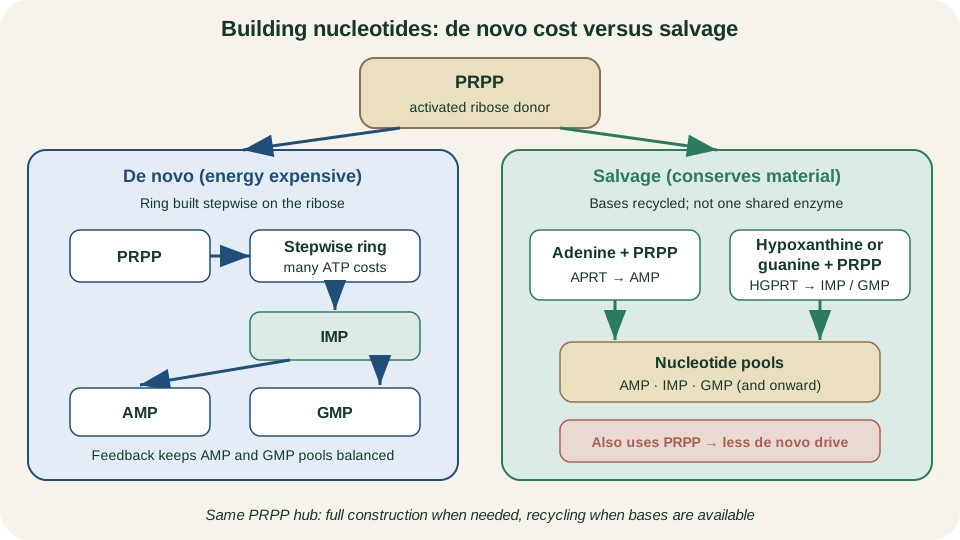
Same PRPP hub: de novo builds rings at high energy cost; APRT and HGPRT recycle bases by different chemistry.
SimpleMed original educational diagram
Purine De Novo to AMP and GMP
Purine de novo synthesis starts with PRPP and builds the double ring stepwise while the ribose is already in place. The first committed steps consume glutamine-derived nitrogen and other precursors; intermediate names are less important at survey level than the logic. The pathway converges on inosine monophosphate (IMP), the parent purine nucleotide that still lacks the final base identity of adenine or guanine.
From IMP the map branches. One branch forms AMP; the other forms GMP. Those branches are not independent free-for-alls. Feedback from the end products slows early de novo flux when pools are full, and cross-talk between the AMP and GMP arms helps keep the two purine families in useful proportion for DNA, RNA and energy carriers. Students should remember PRPP to IMP to AMP or GMP with balanced feedback, not a memorised ladder of every intermediate enzyme.
Amino-acid nitrogen feeds these constructions, so nucleotide supply sits next to the wider nitrogen economy developed in Protein and Amino Acid Metabolism. The practical link is that de novo purine synthesis is a nitrogen-using biosynthetic programme, not a closed circle detached from protein and amino-acid handling.
Salvage: APRT and HGPRT
Salvage does not mean one universal recycling enzyme. Adenine phosphoribosyltransferase (APRT) transfers the ribose phosphate from PRPP onto adenine, forming AMP. Hypoxanthine-guanine phosphoribosyltransferase (HGPRT, also written HPRT) uses hypoxanthine or guanine plus PRPP to form IMP or GMP respectively. The chemistries are related in spirit but distinct in substrate: adenine follows APRT; hypoxanthine and guanine follow HGPRT.
Salvage has a dual benefit. First, free bases that would otherwise be lost are recovered into the nucleotide pool. Second, because salvage consumes PRPP, less PRPP remains to drive de novo synthesis. When salvage is efficient, de novo flux can fall; when salvage is impaired, PRPP tends to accumulate and push more traffic through the expensive de novo route. That reciprocal relationship is the mechanistic hinge used later for HGPRT deficiency.
Disposal to Urate and Handling
Not every purine base is salvaged. Excess purines enter a disposal sequence that, in humans, ends at urate, the deprotonated form of uric acid that predominates at physiological pH. Adenine-family material commonly passes through hypoxanthine. Guanine-family material joins at xanthine. Xanthine oxidoreductase (often taught as xanthine oxidase in its oxidase form) catalyses two successive oxidations: hypoxanthine to xanthine, then xanthine to urate. Those two enzyme steps are the final shared map for purine nitrogen leaving the salvageable pool.
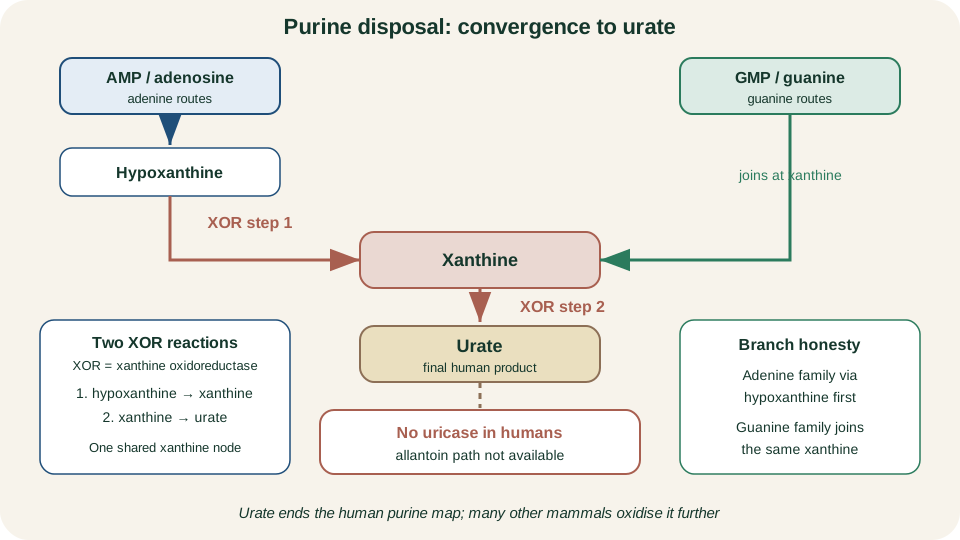
Adenine routes meet at hypoxanthine; guanine joins at xanthine; two xanthine oxidoreductase steps yield urate, and humans lack uricase.
SimpleMed original educational diagram
Many other mammals carry uricase (urate oxidase) and can oxidise urate further toward allantoin. Humans lack functional uricase, so urate is the terminal purine product that must be excreted or else it accumulates and can deposit in tissues. That evolutionary detail is why human plasma urate is higher than in uricase-competent species and why urate handling becomes clinically visible.
Urate handling is not a simple filter-and-forget story. Most renal handling occurs in the proximal tubule. Filtered urate meets transporters that reabsorb and secrete, so net urinary excretion is the balance of filtration plus opposing reabsorption and secretion rather than filtration alone. Intestinal disposal also removes a meaningful fraction of daily urate. Under-excretion at the kidney therefore raises plasma urate even when production is not increased, and over-production can overwhelm disposal even when the tubule is competent. Keep both limbs in mind: how much urate is made, and how much net leaves via kidney and gut.
Pyrimidine Contrast
Pyrimidine de novo synthesis reverses the construction order used for purines. The pyrimidine ring is assembled first, reaching orotate, and only then is the ring attached to PRPP to form orotidine monophosphate (OMP) and, after decarboxylation, uridine monophosphate (UMP). UMP supports formation of UTP and CTP and feeds deoxynucleotide branches used in DNA synthesis. The ring-first logic is the contrast students should be able to draw from memory.
Carbamoyl phosphate synthetase II (CPS II) supplies the first committed nitrogen step of pyrimidine synthesis in the cytosol. It must not be confused with mitochondrial CPS I of the urea cycle. Same family name, different compartment, different physiological job. Cytosolic CPS II belongs to nucleotide manufacture; mitochondrial CPS I belongs to nitrogen disposal as urea.
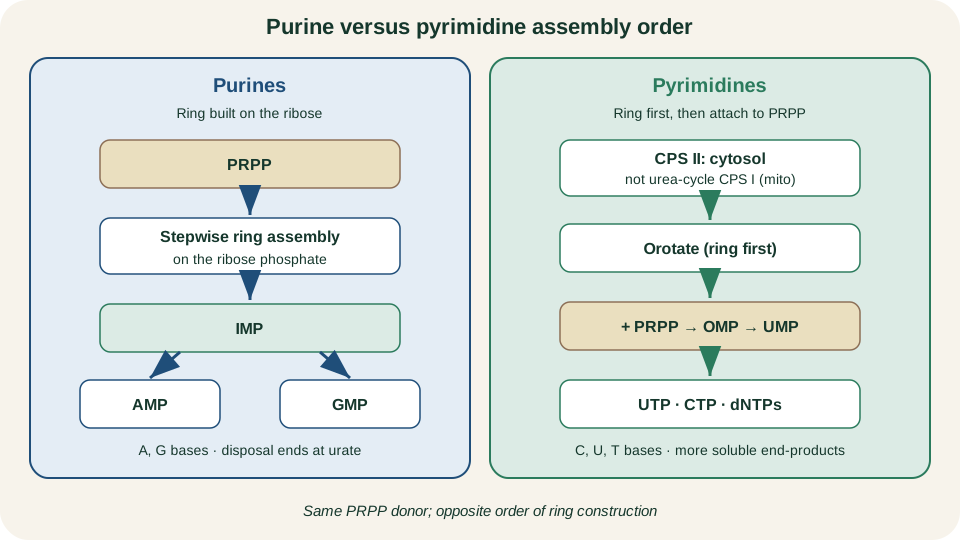
Purines build the ring on PRPP; pyrimidines build orotate first with cytosolic CPS II, then attach the ring to PRPP.
SimpleMed original educational diagram
Pyrimidine catabolism also differs in outcome. Breakdown yields more water-soluble products (for example beta-alanine and related small molecules, depending on the base) rather than a poorly soluble terminal product analogous to urate. That contrast explains why clinical teaching about crystal disease clusters around purine disposal, not pyrimidine disposal, at this stage of the curriculum.
When Salvage or Disposal Fails
Four short mechanism examples show the map under stress. They are illustrations, not a disease catalogue or treatment guide.
HGPRT deficiency (Lesch-Nyhan spectrum). Severe deficiency prevents efficient salvage of hypoxanthine and guanine. PRPP is consumed less by salvage, so more is available to drive de novo synthesis and, ultimately, urate production. Hyperuricaemia follows that pathway. It does not explain the neurological and behavioural phenotype: milder HGPRT defects can cause urate over-production without the full phenotype, whose neural mechanism remains incompletely understood.
Gout. Sustained urate supersaturation permits monosodium urate crystals to deposit in joints and soft tissues. Plasma urate may rise through increased production, reduced net excretion, or both. These are separate levers on the same endpoint.
Tumour lysis. Rapid death of many tumour cells releases nucleic acids. Their purines increase traffic through hypoxanthine and xanthine to urate, potentially outpacing salvage and excretion.
Xanthine oxidoreductase inhibition. Allopurinol, its active metabolite oxypurinol, and febuxostat inhibit the final two reactions. They reduce new urate formation from hypoxanthine and xanthine. They do not remove urate already present in plasma or tissues.
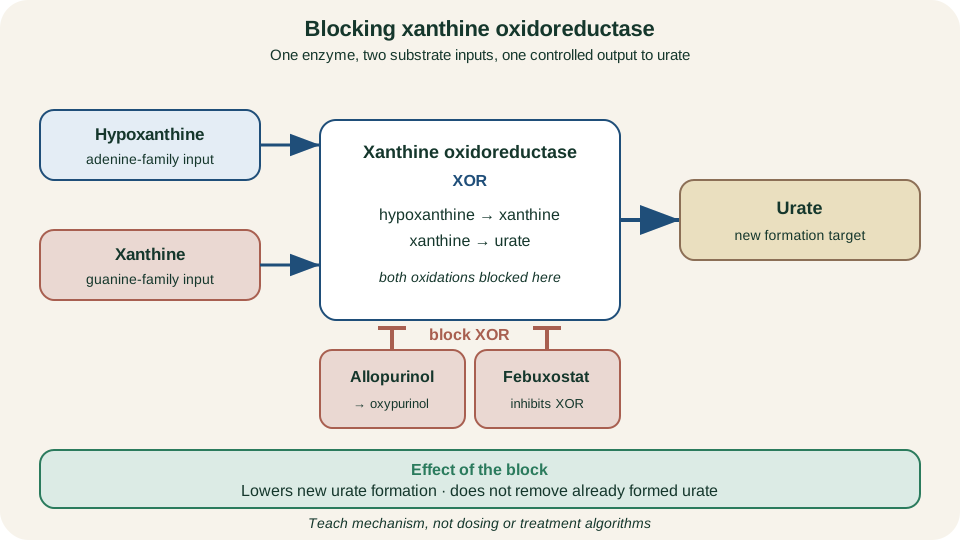
Allopurinol/oxypurinol and febuxostat block xanthine oxidoreductase, lowering new urate formation rather than clearing existing urate.
SimpleMed original educational diagram
Close the loop. Bases, nucleosides and nucleotides name the chemical hierarchy. PRPP is the activated ribose hub that makes de novo expensive and salvage economical. Purines build rings on PRPP to IMP, then AMP and GMP; salvage recovers adenine, hypoxanthine and guanine through APRT and HGPRT. Disposal converges on urate in humans and is handled by proximal-tubule transport plus intestinal loss. Pyrimidines reverse construction order with cytosolic CPS II and avoid a urate-like terminal product. When salvage or the final xanthine oxidoreductase steps fail or are blocked, the same map predicts over-production, crystal risk or reduced new urate formation without inventing a second biochemistry.
Reviewed by: Dr. Marcus Judge
- 130