
All done here! Check out our other subjects!
Core
The Question Comes Before the Platform
A genetic test is not a neutral search for anything unusual. It is an experiment built around a clinical question. Before selecting a platform, define who is being tested, what phenotype or family history creates the question, which kind of variant could explain it, and how the answer could change understanding or care. The sample, target and resolution then follow.
This order matters because every method has blind spots. A test designed to find a single-nucleotide change may miss a balanced chromosome rearrangement. A genome-wide copy-number test may miss a one-base substitution. Even broad sequencing can leave repeat expansions, methylation changes, mosaic variants or poorly covered regions unresolved. More data are not automatically a better answer: wider analysis increases interpretation burden and the chance of unrelated or uncertain findings.
A negative result therefore means that no reportable cause was found within the regions, variant types and knowledge available to that test. It does not prove that the condition is non-genetic. Precise phenotyping and a three-generation family history improve both test selection and later interpretation.
Diagnostic, Predictive and Carrier Testing
A diagnostic test investigates a person who has relevant features. Its task is to explain an existing phenotype. A predictive test asks whether an unaffected person has inherited a known familial pathogenic variant associated with future disease risk. It is usually targeted to that familial variant, not a fresh search through every gene. A carrier test asks whether a usually unaffected person carries a recessive or X-linked disease-associated variant that may affect reproductive risk.
These categories describe purpose rather than laboratory machinery. The same sequencing chemistry could diagnose a child, test an adult relative predictively, or identify carrier status. The implications change because the person, prior probability and decision change. Predictive testing also raises a meaningful option not to know future risk. Carrier results concern the tested person, their reproductive partner and possible children without implying that the carrier has the recessive condition.
Screening is different again. It offers a test to a defined population to estimate who has a higher chance of a condition and may benefit from diagnostic assessment. A screen separates lower-chance from higher-chance groups; it does not convert probability into certainty.
Choose a Resolution
A karyotype is a low-resolution, genome-wide image of chromosome number and structure. It can show aneuploidy and large structural changes, and it retains positional information needed to recognise balanced translocations. A chromosomal microarray samples DNA across the genome at much higher resolution to identify gains and losses. It does not ordinarily detect balanced rearrangements because no DNA amount has changed, and it is not a sequence test.
Sequencing reads nucleotide order. Targeted testing may examine one known familial variant or one gene. A gene panel examines several genes that can produce a similar phenotype, focusing interpretation and usually reducing unrelated findings. Exome sequencing surveys protein-coding regions, roughly one per cent of the genome, while genome sequencing has broader reach. Broad data may still be filtered through a virtual panel so that only genes relevant to the clinical question are analysed.
The ladder is not a ranking from old to good. A suspected balanced rearrangement may make karyotyping more informative than a sequence panel. A child with unexplained developmental differences may need copy-number analysis or broader sequencing. A relative seeking predictive testing for a known variant may need only a narrow targeted assay. The laboratory mechanisms remain in Molecular Techniques for Medics; here the transferable rule is to match expected variant scale and type to test capability.
For the underlying distinction between sequence variants, deletions, duplications and mosaic change, review Introduction to Gene Mutation. That variant model defines the target; this resolution ladder selects the method able to detect it.
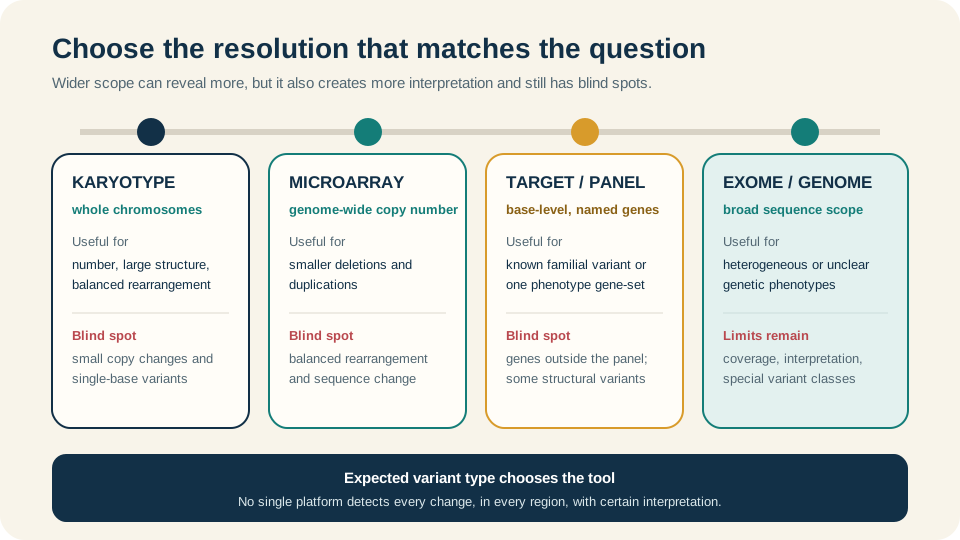
Broader is not automatically better: choose the narrowest method that can answer the biological question without missing the expected variant type.
SimpleMed original educational diagram
Antenatal Screening and Diagnosis
The antenatal pathway makes the screening-diagnosis distinction visible. The combined test integrates ultrasound and maternal blood markers with background information to estimate the chance of trisomy 21, 18 or 13. A higher-chance result is not a fetal diagnosis. It opens a decision point: no further testing, a more accurate screening test, or invasive prenatal diagnosis.
Non-invasive prenatal testing, or NIPT, analyses cell-free DNA in maternal blood, much of which comes from the placenta. It is a stronger screening test for the targeted trisomies, but remains a screen because placental DNA is an imperfect proxy for the fetus and biological or technical discordance can occur. A higher-chance NIPT result therefore requires diagnostic confirmation before an irreversible decision.
Chorionic villus sampling obtains placental tissue; amniocentesis obtains amniotic fluid containing fetal cells. Both are invasive sampling procedures that enable diagnostic chromosome or genetic testing chosen for the question. The relevant comparison is not simply earlier versus later. It includes sample source, test scope, procedural risk, possible uncertainty and what each person would do with the information. Choosing no further test is a valid informed choice.
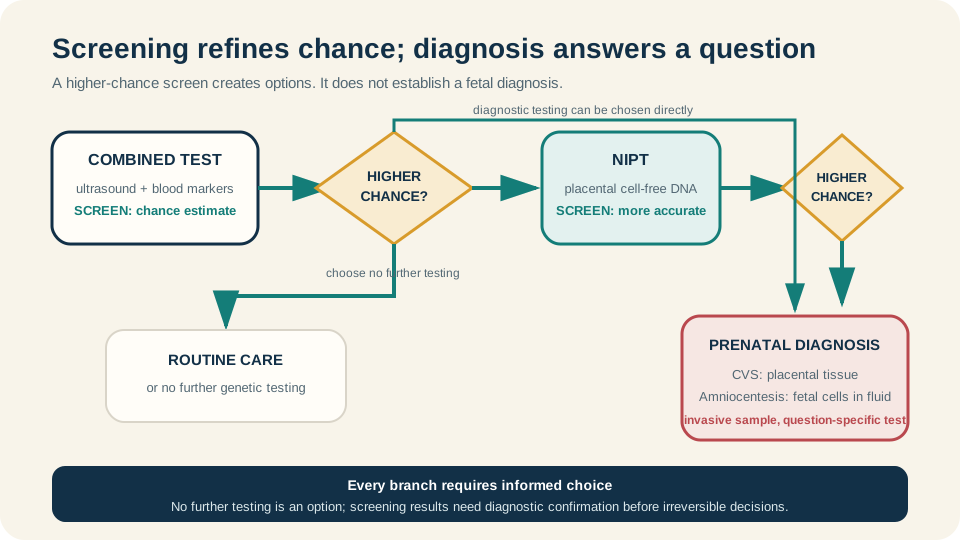
Screening refines chance; CVS or amniocentesis supplies material for a diagnostic test. Each branch remains a choice.
SimpleMed original educational diagram
Newborn Blood-spot Screening
In England, newborn blood-spot screening is offered around day five for ten rare but serious conditions in which early recognition can improve outcome. A few drops of heel-prick blood are placed on a card. The programme uses condition-specific biochemical, immunological and genetic steps; it is not routine whole-genome sequencing.
The language protects against overinterpretation. A result may report no condition suspected, carrier status, or a condition suspected. A screen-positive result triggers timely confirmatory testing and specialist assessment rather than establishing the diagnosis alone. A screen-negative result reduces risk only for the conditions and markers covered. Screening succeeds when a defined population, useful test and effective early intervention form one pathway, not merely because a technology can measure DNA.
From Variant to Classification
Finding a difference from a reference sequence is only the start. Clinical scientists combine population frequency, predicted molecular effect, functional evidence, segregation through a family, whether a variant arose de novo, and whether the gene and phenotype fit. The ACMG/AMP framework uses five tiers: pathogenic, likely pathogenic, variant of uncertain significance, likely benign and benign.
A VUS is not a weak positive. It means evidence is insufficient to decide whether the variant causes disease. It should not alone change treatment, screening or predictive cascade testing. Relatives may sometimes be studied to gather segregation evidence, but that investigation is different from using the VUS to classify them as at risk. As population data, functional evidence or family observations accumulate, a variant can be reclassified. The uncertainty belongs in the result rather than being hidden from the person receiving it.
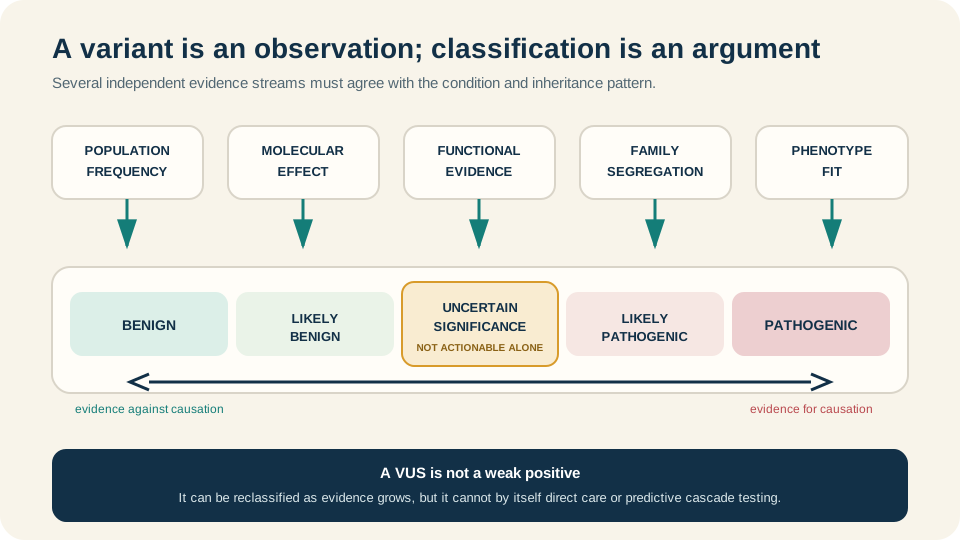
Classification integrates several evidence streams. A VUS marks insufficient evidence and is not a clinical instruction.
SimpleMed original educational diagram
Recurrence Risk Belongs to a Family
Once a causative result is established, the unit of interpretation expands from one person to a pedigree. For an autosomal recessive condition with both parents confirmed as carriers, each pregnancy has a one-in-four chance of an affected child. For an autosomal dominant pathogenic variant in a heterozygous parent, each child has a one-in-two chance of inheriting the variant. Those probabilities restart for every pregnancy.
Inheritance probability is not always disease probability. Reduced penetrance means some people who inherit a pathogenic variant do not develop the associated phenotype; variable expressivity changes its severity or features. A variant apparently arising de novo usually lowers recurrence risk for siblings, but parental germline mosaicism can leave a small residual risk even when parental blood tests are negative. The exact estimate must combine the molecular result, inheritance pattern, parental testing, pedigree and current condition-specific evidence.
A confirmed familial pathogenic variant can enable cascade testing: targeted testing of relatives whose position in the pedigree puts them at risk. Testing the affected person first is usually most informative because it identifies what a negative result in a relative must actually exclude.
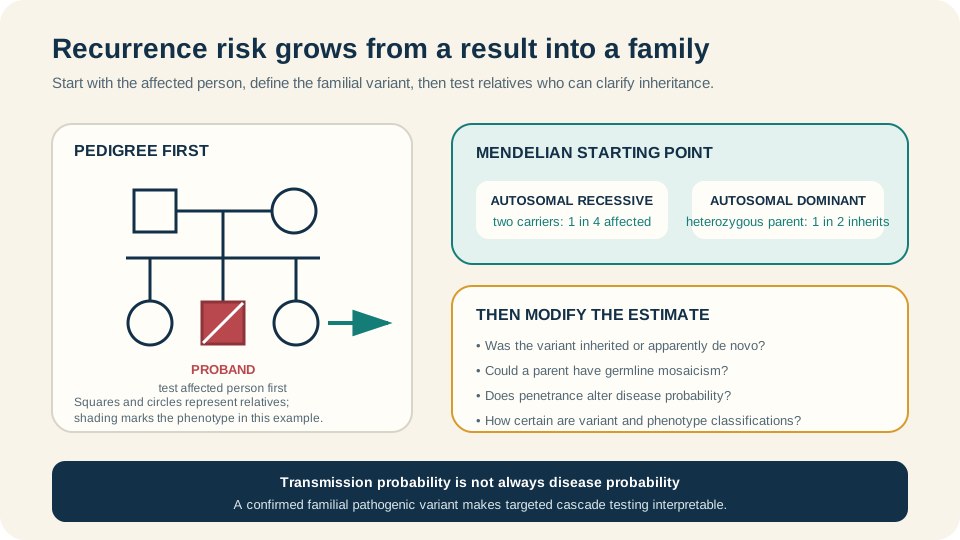
A Mendelian fraction begins the estimate; parental status, penetrance, mosaicism and test certainty make it personal.
SimpleMed original educational diagram
Counselling, Consent and Choice
Genomic counselling connects laboratory information to a person's values without directing the decision. Before testing, the conversation should cover the question, possible results, limitations, uncertain or incidental findings, implications for relatives, data use and whether the result could change options. Consent must be informed and voluntary, and the decision recorded. A person can decline or defer testing and still receive care.
Non-directive does not mean emotionally neutral or silent. It means explaining probabilities clearly, checking understanding, exploring what different outcomes would mean, and supporting the person's decision without steering them towards the clinician's preferred reproductive or predictive choice. Some people value certainty; others exercise a right not to know a future risk. Wider sequencing may reveal carrier status, an unrelated disease risk or an unexpected family relationship, so these possibilities belong before the sample is taken.
Results require the same discipline. A pathogenic classification must fit the phenotype and inheritance. An uninformative result must not become false reassurance. A VUS must remain uncertain. Because relatives share DNA but have separate autonomy and confidentiality, communicating family implications can be both scientifically important and ethically difficult.
The complete reasoning chain is: define the question, choose the resolution, anticipate every result category, interpret it in the phenotype and pedigree, then support an informed choice. That is why counselling is not an appendix to testing. It is the process that turns genomic data into responsible knowledge. Genetics is complete here; revisit the full Genetics subject or explore other subjects.
Reviewed by: Dr. Marcus Judge
- 139