
Visual Acuity OSCE Assessment
During any examination in an OSCE it is important to understand the pathology and reasoning behind each of the signs and symptoms elicited, even if the patient being examined is 'normal'. This article explains how to perform a visual acuity assessment and the key findings you should look for, showing you what each step means and what conditions it may indicate.
Visual acuity is a measure of the eye's ability to resolve fine detail, and it reflects the function of the central retina (the macula and fovea), the optical media (cornea, lens and vitreous) and the visual pathway as far as the visual cortex. A formal acuity measurement is one of the most important pieces of information in ophthalmology, as it both quantifies the patient's vision and helps localise where in the visual system a problem lies.
Introduction
Gather the necessary equipment before you begin: a Snellen chart (or a 3 metre logMAR chart) positioned at the correct distance, an occluder to cover each eye, a pinhole occluder, a near vision reading chart, a set of Ishihara plates and a pen torch. Having everything to hand makes the assessment slick and avoids breaking the flow of the examination.
Wash your hands and don personal protective equipment if appropriate.
Introduce yourself to the patient and ensure to mention your grade e.g. 3rd year medical student/junior doctor/consultant.
Confirm the patient's details taking 3 points of identification usually; full name, date of birth and NHS/hospital number.
Obtain consent for the examination, ensuring to explain what the assessment will entail in patient-friendly language – that you would like to test how well they can see using a chart of letters.
Ask whether the patient is experiencing any pain or visual symptoms before you begin.
Position the patient seated at the correct testing distance from the chart (usually 6 metres), and ensure the room is well lit.
Critically, ask whether the patient normally wears distance glasses or contact lenses. Visual acuity should be tested with the patient's usual distance correction worn, as the purpose of the test is to measure their best corrected vision rather than an uncorrected refractive error. If the patient has forgotten their glasses, you can still obtain a meaningful result by testing through a pinhole, which largely corrects for refractive error.
General Inspection
Before formally testing, take a moment for a general inspection of the patient and the bedside. Look for visual aids such as glasses or a magnifier, and note whether the patient uses a white cane or is accompanied by a guide dog, both of which suggest significant pre-existing visual impairment.
Observe the patient's behaviour and how they orientate to you and to objects in the room. A patient who turns their head to one side to look at you may be relying on an area of preserved peripheral vision to compensate for central loss, while obvious difficulty navigating the room suggests poor overall vision.
Note any obvious ocular abnormalities such as a squint (strabismus), ptosis (drooping eyelid), a cloudy cornea, or a red eye, as these can all affect acuity. Finally, assess whether the patient appears comfortable or is in distress – acute painful visual loss is a red flag requiring urgent senior review.
Distance Visual Acuity (Snellen Chart)
Distance visual acuity is most commonly measured using a Snellen chart, which displays rows of letters that decrease in size as you move down the chart. The chart is designed so that each row corresponds to the distance at which a person with normal vision should be able to read those letters.
Position the patient 6 metres from the chart. If space is limited, many clinics use a mirror to create an effective 6 metre path within a smaller room.
Ask the patient to cover one eye (traditionally with an occluder or the palm of their hand, taking care not to press on the eye) and to read down the chart, identifying the lowest line they are able to read. Always test each eye separately, conventionally starting with the right eye, and then test both eyes together.
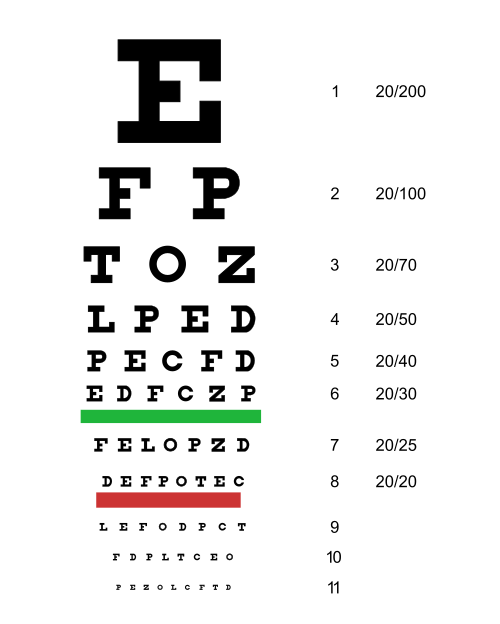
Image - A standard Snellen chart. The letters become progressively smaller down the chart, with each row labelled by the distance at which a normally-sighted person can read it
Creative commons source by Jeff Dahl [CC BY-SA 3.0 (https://creativecommons.org/licenses/by-sa/3.0)]
Visual acuity is recorded as a fraction. The numerator is the distance the patient is from the chart in metres (usually 6), and the denominator is the number printed beside the lowest line the patient could read – this represents the distance at which a normally-sighted person could read that same line.
For example, an acuity of 6/6 means the patient can read at 6 metres what a normally-sighted person reads at 6 metres – this is normal vision (equivalent to 20/20 in imperial units). An acuity of 6/60 means the patient can only read at 6 metres what a normally-sighted person could read from 60 metres, indicating significantly reduced vision. The larger the denominator, the worse the vision.
When recording acuity, you should note how many letters were missed on the last line read. If the patient reads the 6/6 line but gets two letters wrong, this is recorded as 6/6 (-2). If the patient misses more than two letters on a line, you should record the line above as their acuity. Always document whether vision was unaided (UA), with glasses, or with a pinhole (PH).
Reduced Visual Acuity
If the patient is unable to read even the top line of the Snellen chart at 6 metres (the large single letter, corresponding to 6/60), you should work through a series of steps to quantify the remaining vision. Each step assesses a grosser level of visual function than the last.
First, reduce the distance. Walk the patient closer to 3 metres and ask them to read the top line again; if successful this is recorded as 3/60. If still unsuccessful, move to 1 metre (recorded as 1/60). Reducing the distance increases the angular size of the letter on the retina, so a patient with poor but not absent vision may be able to resolve it closer up.
If the patient still cannot read the top line at 1 metre, assess progressively cruder visual function in the following order:
- Counting Fingers (CF) – hold up a number of fingers about 1 metre from the patient and ask them to count them. This tests whether the patient can resolve large, high-contrast shapes.
- Hand Movements (HM) – if they cannot count fingers, wave your hand and ask whether they can detect the movement. This tests for the most basic perception of motion.
- Perception of Light (PL) – if they cannot detect hand movements, shine a pen torch towards the eye and ask whether they can see the light. A patient who can perceive light is recorded as PL; one who cannot is recorded as No Perception of Light (NPL), which indicates complete blindness in that eye.
This stepwise grading is clinically important because it distinguishes, for example, a patient with a dense cataract (who typically retains light perception and may even perceive its direction) from a patient with complete retinal or optic nerve failure (who has no perception of light at all).
Pinhole Test
If the patient's visual acuity is worse than 6/6, you should repeat the test with the patient looking through a pinhole occluder. The pinhole is a small aperture that allows only a narrow central beam of light to reach the retina.
Because the pinhole admits only those rays travelling close to the visual axis, it removes the effect of refractive error by reducing the blur circle on the retina, in much the same way that narrowing the aperture on a camera increases the depth of field. The reasoning behind the test is therefore to determine why the vision is reduced.
If the patient's acuity improves with the pinhole, this strongly suggests an uncorrected refractive error (such as myopia, hypermetropia or astigmatism) – in other words, the patient simply needs glasses or an updated prescription. If the acuity does not improve with the pinhole, this suggests the cause is not refractive and instead points to pathology of the eye or visual pathway, such as cataract, macular degeneration, diabetic retinopathy or optic neuropathy. This single, quick test is therefore a powerful way of separating refractive from organic causes of visual loss.
Near Visual Acuity
Near vision is assessed separately from distance vision because the two rely on different optical processes. While distance acuity tests the relaxed eye, near vision additionally depends on the eye's ability to accommodate – to increase the converging power of the lens to focus on close objects.
Near acuity is tested using a near vision reading chart (such as a Jaeger chart or a standardised reading card) held at a comfortable reading distance, usually around 30–40 centimetres. If the patient normally uses reading glasses, these should be worn for the test. Ask the patient to read the smallest paragraph of text they are able to, again testing each eye in turn.
Reduced near vision with preserved distance vision is characteristic of presbyopia, the age-related loss of accommodation caused by stiffening of the lens, which typically becomes noticeable from the mid-forties. Difficulty with both near and distance vision instead suggests a more generalised problem with the optical media or retina. Testing near vision is also valuable when distance testing is impractical, for example in a patient confined to bed.
Colour Vision (Ishihara Plates)
Colour vision can be assessed using Ishihara plates. Each plate displays a circle made up of coloured dots, within which dots of a contrasting colour form a number or shape. The figure is easily seen by people with normal colour vision but is difficult or impossible to identify for those with a red-green colour deficiency.
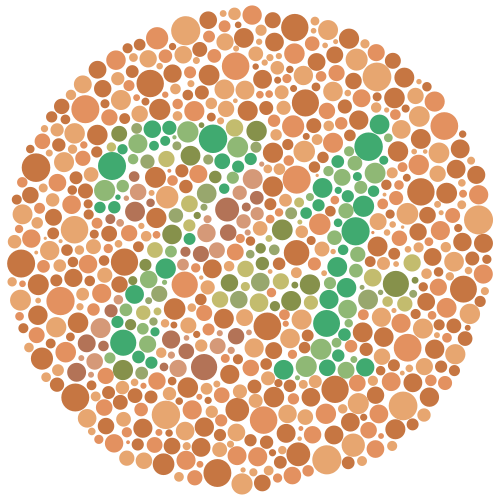
Image - An Ishihara test plate. A person with normal colour vision sees the embedded number clearly, whereas someone with a red-green deficiency may be unable to distinguish it
Public Domain source by Shinobu Ishihara [Public domain]
To perform the test, ensure good lighting and test each eye separately with the patient wearing any usual reading correction. The first plate is a test plate that does not assess colour vision – it can be read by everyone, including those who are colour blind, and confirms that the patient has adequate contrast sensitivity and acuity to undertake the test. If the patient can read the test plate, work through the remaining plates in turn, asking them to identify the number on each, and document the number of plates read correctly out of the total (for example 13/13).
Acquired colour vision defects are clinically significant. A reduction in colour vision – particularly the loss of red saturation (red desaturation) – is an early and sensitive sign of optic nerve disease such as optic neuritis, which is strongly associated with multiple sclerosis. Inherited red-green colour deficiency, by contrast, is common (affecting around 1 in 12 men due to its X-linked inheritance) and is usually a lifelong, non-progressive finding rather than a sign of acute disease.
Completing the Examination
Thank the patient and wash your hands.
Summarise your findings, clearly documenting the acuity for each eye (and both together), whether correction or a pinhole was used, the near vision result and the colour vision score.
To complete the assessment, suggest performing a full examination of the eyes and vision, including assessment of the visual fields, pupillary reflexes (looking in particular for a relative afferent pupillary defect as further evidence of optic nerve disease) and eye movements. If the patient describes distortion of central vision, an Amsler grid is a useful bedside test – the patient fixates on a central dot and reports any wavy, blurred or missing squares, which can reveal early macular pathology such as age-related macular degeneration.
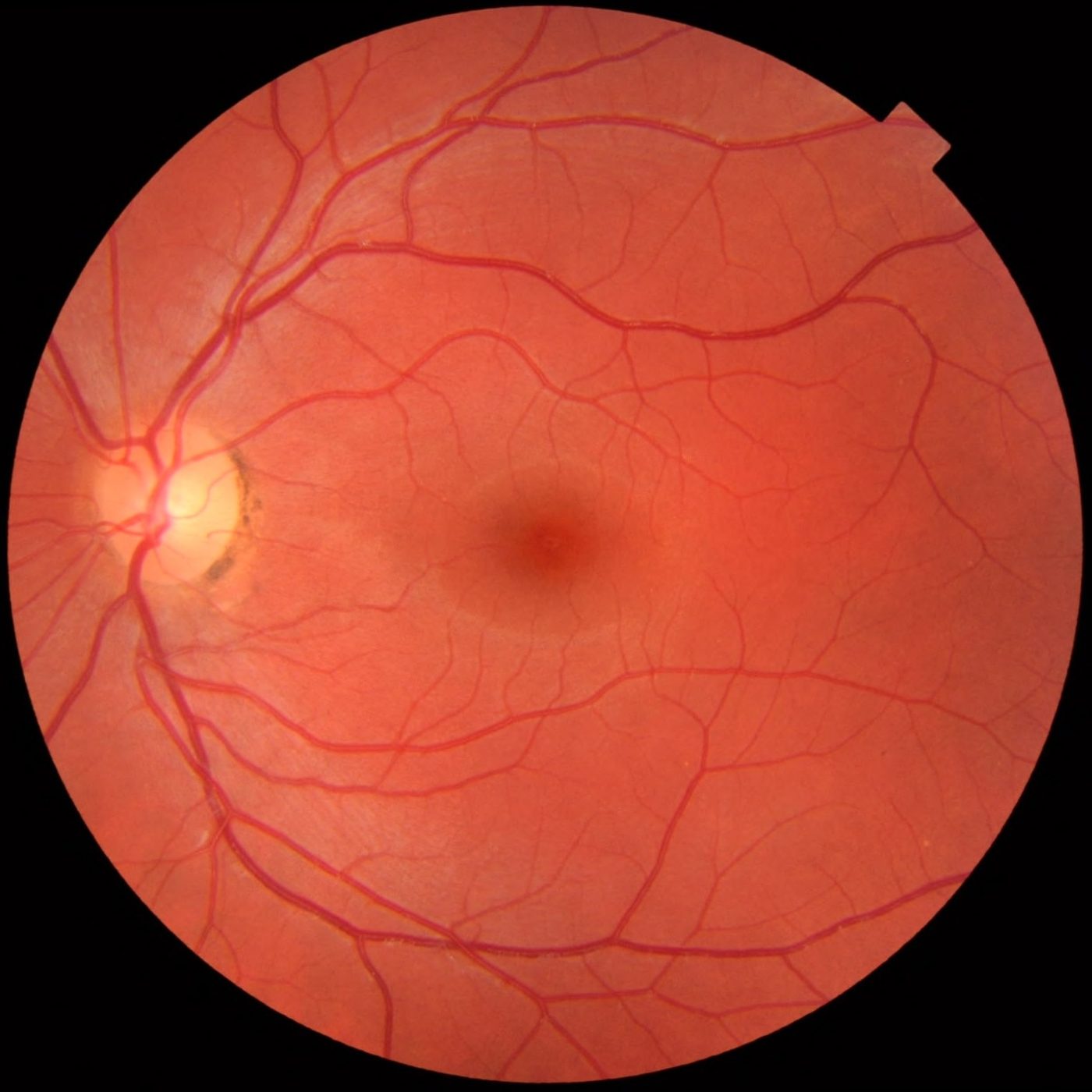
Image - A normal fundus as seen on fundoscopy. Reduced acuity that does not improve with a pinhole should prompt a careful look at the optic disc, macula and retinal vessels for a structural cause
SimpleMed original image, credit 'SimpleMed original'
You should also offer fundoscopy to examine the optic disc, macula and retina, and where appropriate a slit-lamp examination and measurement of intraocular pressure. Consider relevant bedside tests that may explain reduced vision, in particular a blood pressure reading (hypertensive retinopathy) and a capillary blood glucose or HbA1c (diabetic retinopathy), and arrange retinal photography where available for documentation and screening. Any patient with new, unexplained or acute visual loss should be discussed with the ophthalmology team, as timely referral can be sight-saving.
- 4