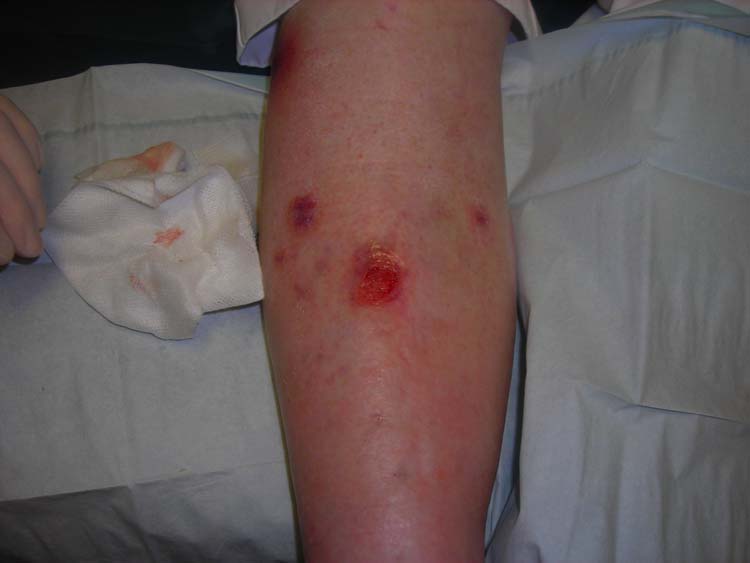
Varicose Vein OSCE Examination
During any examination in an OSCE it is important to understand the pathology and reasoning behind each of the signs and symptoms elicited, even if the patient being examined is ‘normal’. This article explains how to perform a varicose vein examination and the key findings you should look for, showing you what each sign means and what conditions it may indicate.
Varicose veins are dilated, tortuous superficial veins that develop when the one-way valves of the leg veins become incompetent, allowing blood to reflux and pool under gravity. This examination is fundamentally an assessment of the superficial venous system, the deep venous system and the perforating veins that connect them, and of the chronic skin changes that arise from sustained venous hypertension.
Introduction
Wash your hands and don personal protective equipment if appropriate.
Introduce yourself to the patient and ensure to mention your grade e.g. 3rd year medical student/junior doctor/consultant.
Confirm the patient’s details taking 3 points of identification usually; full name, date of birth and NHS/hospital number.
Obtain consent for the examination, ensuring to explain what the examination will entail. Explain that you will need them to stand up for much of the examination, as varicose veins fill and become most apparent when the patient is upright.
Expose the patient’s legs fully from the groin down, ideally with the patient in underwear so that the saphenofemoral junction in the groin can be assessed. Maintain the patient’s dignity throughout.
Ask the patient if they have any pain anywhere before you begin, and ask whether their legs are currently painful, aching or itchy.
General Inspection
Begin with a general inspection of the patient and the bedside. Look at the patient’s overall comfort and whether they appear to be in any distress. Note their body habitus, as obesity is a major risk factor for varicose veins because raised intra-abdominal pressure impairs venous return from the legs.
Look around the bedside for objects that give clues to the underlying problem or its management, such as compression stockings, compression bandaging, wound dressings, or mobility aids. The presence of dressings may point towards an active venous leg ulcer.
Inspection of the Legs
Inspect the legs with the patient standing, as this allows the veins to fill under gravity and makes varicosities far more obvious than when the patient is lying down. Walk around the patient so that you inspect the front, sides and back of both legs, including the popliteal fossa behind the knee.
It can be helpful to ask the patient to point out the veins that trouble them before you start, as this directs your attention and demonstrates a patient-centred approach to the examiner.
Identify the distribution of any varicose veins, as this helps localise the underlying incompetence:
- Varicosities along the medial aspect of the thigh and calf typically follow the great (long) saphenous vein, which drains into the femoral vein at the saphenofemoral junction in the groin.
- Varicosities over the posterior and lateral calf typically follow the small (short) saphenous vein, which drains into the popliteal vein at the saphenopopliteal junction behind the knee.
Also note any smaller intradermal vessels, as these reflect milder venous disease and can accompany frank varicosities:
- Thread veins (telangiectasia, ‘spider veins’) – fine red or purple intradermal vessels under 1 mm in diameter.
- Reticular veins – slightly larger bluish-green subdermal veins that do not bulge above the skin.
- Corona phlebectatica (ankle flare) – a fan of dilated small veins around the ankle and instep. It is an early marker of established venous hypertension and a poor-prognosis sign for progression to ulceration.
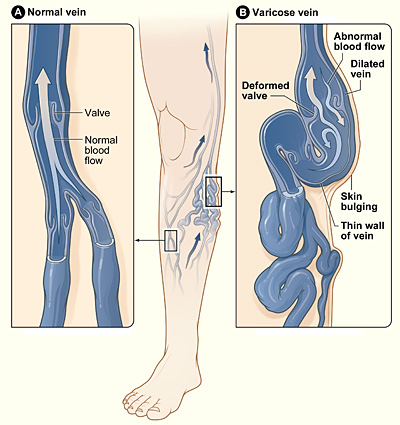
Image - Dilated, tortuous varicose veins of the lower leg. Note how the veins follow the course of the superficial venous system
Creative commons source by the National Heart Lung and Blood Institute [Public domain]
Look for the chronic skin changes of venous insufficiency, which reflect long-standing venous hypertension and are typically most marked around the medial gaiter area (the lower third of the leg above the medial malleolus):
- Haemosiderin staining – orange-brown patches of pigmentation. High venous pressure forces red blood cells out of the capillaries; as they break down, the iron-containing pigment haemosiderin is deposited in the skin.
- Venous (varicose) eczema – itchy, dry, scaly and inflamed skin. Venous hypertension drives fluid into the tissues, and stasis triggers a local inflammatory response.
- Lipodermatosclerosis – hardened, tight, indurated skin caused by inflammation and fibrosis of the subcutaneous fat. In advanced disease the leg can take on the classic ‘inverted champagne bottle’ appearance, with a narrow, fibrosed lower leg above a swollen calf.
- Atrophie blanche – white, atrophic, scar-like patches surrounded by pigmentation, representing areas of skin that have healed after micro-injury.
- Venous ulceration – typically shallow ulcers with sloping edges over the medial malleolus (gaiter area), the end-stage consequence of chronic venous hypertension.
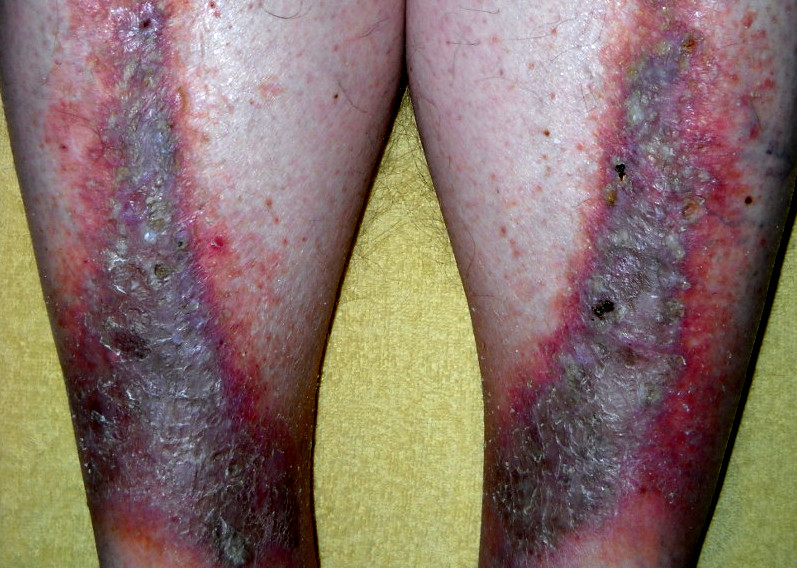
Image - Venous (varicose) eczema with associated pigmentation, a sign of chronic venous hypertension
Creative commons source by Cardiologist61 [Public domain]
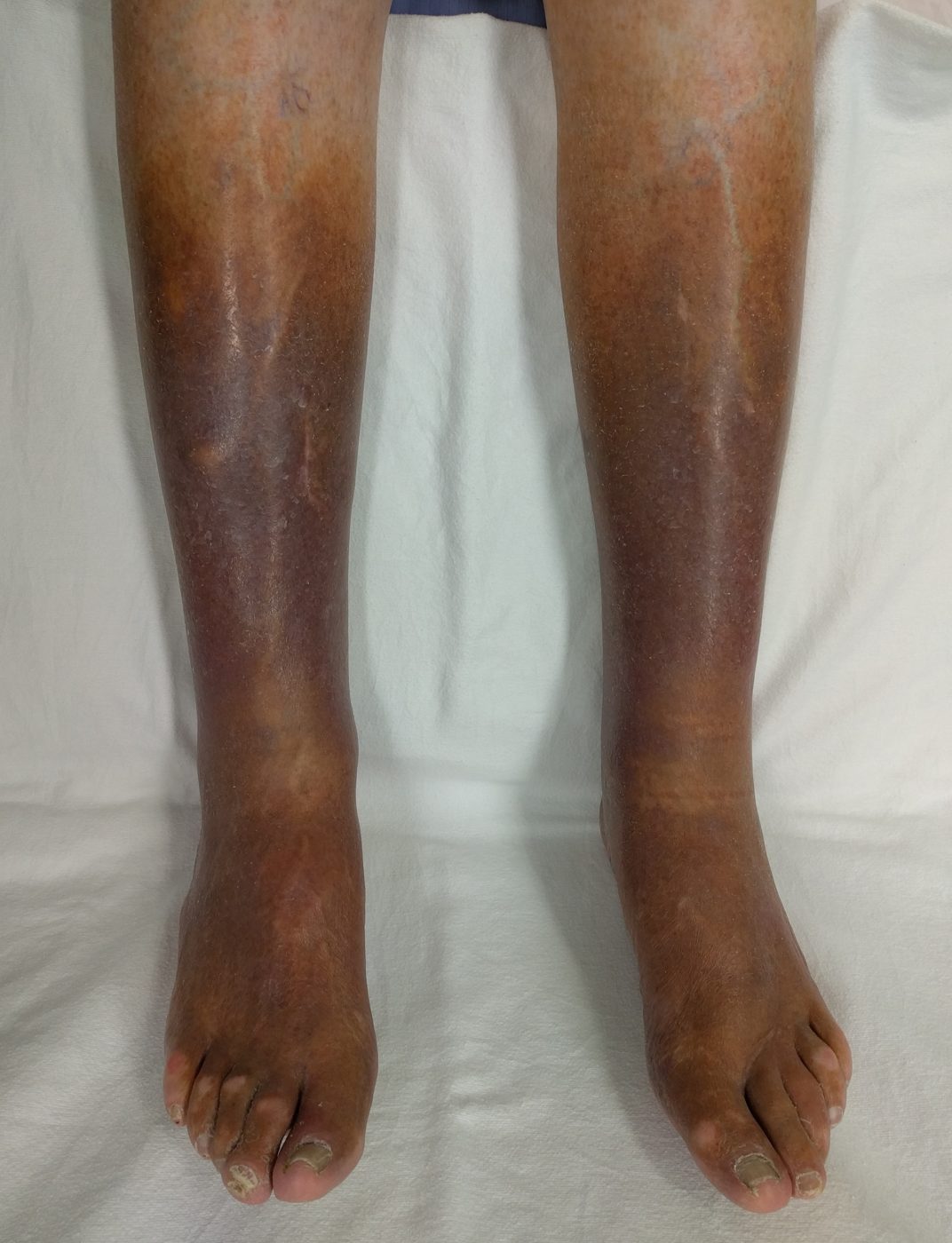
Image - Chronic venous insufficiency with haemosiderin staining and lipodermatosclerosis of the lower leg
Creative commons source by James Heilman, MD [CC BY-SA 4.0 (https://creativecommons.org/licenses/by-sa/4.0)]
Finally, look carefully for any scars from previous varicose vein surgery (for example in the groin, the popliteal fossa or along the line of the saphenous veins), as these point towards recurrent disease, and inspect for any healed or active ulcers.
Palpation
Always ask the patient again about pain before you touch the legs.
Palpate along the varicosities to assess their temperature and tenderness. A hard, warm, tender, erythematous vein suggests superficial thrombophlebitis (inflammation and clotting within a superficial vein). Hardness within a vein may also represent a thrombosed varicosity.
Assess the texture of the surrounding skin for the induration of lipodermatosclerosis, which feels firm and bound-down compared with normal soft subcutaneous tissue.
Check for pitting oedema by pressing firmly over the medial malleolus or shin for a few seconds and watching for an indentation. Oedema reflects fluid leaking into the tissues as a result of venous hypertension, although you should remember that bilateral leg oedema has many other causes, such as heart failure, hypoalbuminaemia and chronic kidney disease.
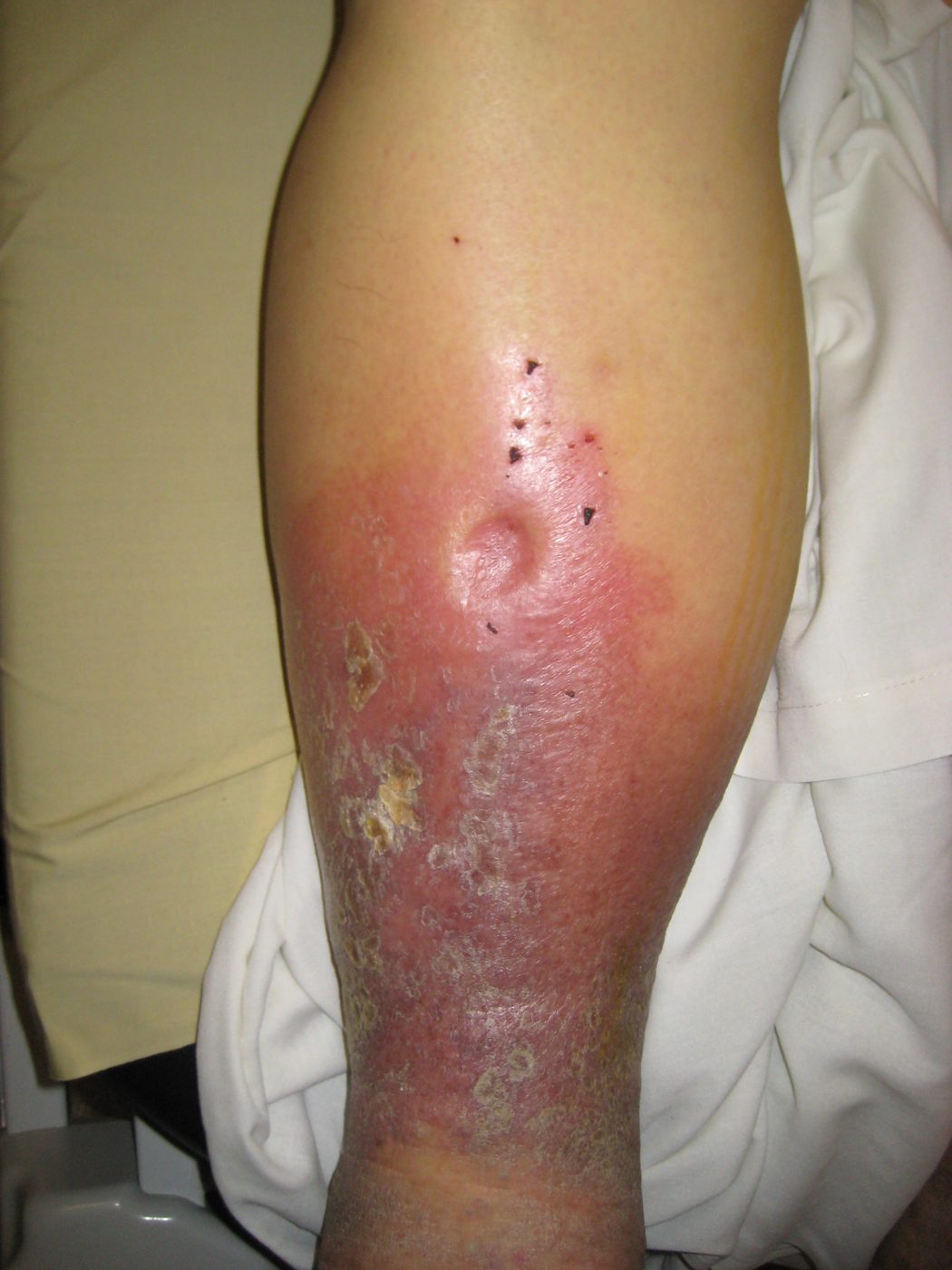
Image - Pitting oedema, demonstrated by the indentation that remains after firm pressure is released
SimpleMed original
Palpate the saphenofemoral junction (SFJ), located approximately 2–4 cm below and lateral to the pubic tubercle. A soft, compressible lump at the SFJ that disappears on lying down may be a saphena varix (a dilatation of the great saphenous vein at its termination).
Cough Impulse Test
Place your fingers over the saphenofemoral junction (2–4 cm below and lateral to the pubic tubercle) and ask the patient to cough.
A palpable thrill or impulse transmitted to your fingers suggests incompetence of the valve at the saphenofemoral junction. Coughing raises intra-abdominal pressure, and if the SFJ valve is incompetent this pressure is transmitted down the great saphenous vein and felt as an impulse. A particularly prominent, palpable cough impulse is also a feature of a saphena varix, which can be mistaken for a femoral hernia – an important distinction, as both present as a lump in the groin.
Tap Test
The tap test assesses whether the valves along a segment of vein are competent or incompetent.
Place one finger over the saphenofemoral junction and the fingers of your other hand over a distal varicosity lower down the leg. Gently tap the distal varicosity and feel for a transmitted impulse at the SFJ.
If an impulse is felt at the SFJ, this suggests that the valves in the intervening segment of vein are incompetent, allowing the pressure wave to travel up the column of blood. In a healthy vein, competent valves interrupt this column and no impulse is transmitted. The test can also be performed in the opposite direction – tapping proximally and feeling distally for a downward-transmitted impulse, which is an even clearer marker of valvular incompetence.
Trendelenburg and Tourniquet Tests
These tests aim to localise the level of venous incompetence, which is important for planning treatment.
With the patient lying down, lift the leg to around 15–20o and milk the blood out of the superficial veins towards the groin to empty them.
Next, occlude the superficial venous system at the saphenofemoral junction. If you do this with firm finger pressure the manoeuvre is called the Trendelenburg test; if you use a tourniquet instead it is called the tourniquet test. The two are otherwise identical in principle.
Ask the patient to stand while you maintain the pressure or keep the tourniquet in place, and observe the veins:
- If the varicosities remain collapsed while pressure is applied at the SFJ, the site of incompetence lies at or above the SFJ. When you then release the pressure and the veins rapidly fill from above, this confirms saphenofemoral junction incompetence.
- If the varicosities fill rapidly despite pressure at the SFJ, there must be an additional incompetent valve below the level of occlusion (for example an incompetent perforating vein).
The tourniquet test can be repeated at progressively lower levels down the leg – mid-thigh, above the knee, below the knee – until the level at which the veins are controlled is identified. The point below which the veins start to fill localises the incompetent valve or perforator.
Perthes’ Test
Perthes’ test assesses the patency and competence of the deep venous system, which is crucial because varicose vein surgery is only safe if the deep veins are working – the deep system carries the bulk of venous return.
With the patient standing, apply a tourniquet to the upper thigh to occlude the superficial veins, then ask the patient to walk or repeatedly rise onto tip-toes for a minute or so to activate the calf muscle pump.
- If the superficial varicosities empty and become less distended, the deep veins and perforators are competent, and the calf pump is successfully draining blood from the superficial system into a patent deep system.
- If the varicosities remain full or become more distended and painful, this suggests deep venous obstruction or incompetence, meaning the superficial veins should not be stripped as they may be providing important collateral drainage.
Auscultation
Auscultate over any prominent or unusually large varicosities using the diaphragm of your stethoscope.
A bruit (a continuous whooshing sound) over a varicosity is abnormal and raises the suspicion of an underlying arteriovenous malformation or fistula, in which high-pressure arterial blood flows directly into the venous system. This is an uncommon but important cause of varicose veins, particularly in younger patients or where the distribution is atypical.
Handheld Doppler
A handheld Doppler probe is often available at the bedside and gives a quick assessment of valve competence at the major junctions. Place the probe over the saphenofemoral junction (or the saphenopopliteal junction for a posterior calf varicosity) and squeeze the calf to drive blood upwards.
You should hear a single ‘whoosh’ as blood flows up the vein. A second whoosh on release, as blood refluxes back down through an incompetent valve, indicates venous reflux at that junction. This is a useful screening manoeuvre, but the definitive test for mapping reflux remains venous duplex ultrasound.
Peripheral Pulses
Although varicose veins are a venous problem, it is essential to assess the arterial supply of the legs, because compression therapy (the mainstay of treatment for venous disease and venous ulcers) can cause tissue ischaemia and harm if there is significant peripheral arterial disease.
Palpate the lower limb pulses in both legs:
- Femoral pulse – at the mid-inguinal point.
- Popliteal pulse – deep in the popliteal fossa behind the knee.
- Posterior tibial pulse – behind and below the medial malleolus.
- Dorsalis pedis pulse – on the dorsum of the foot, lateral to the extensor hallucis longus tendon.
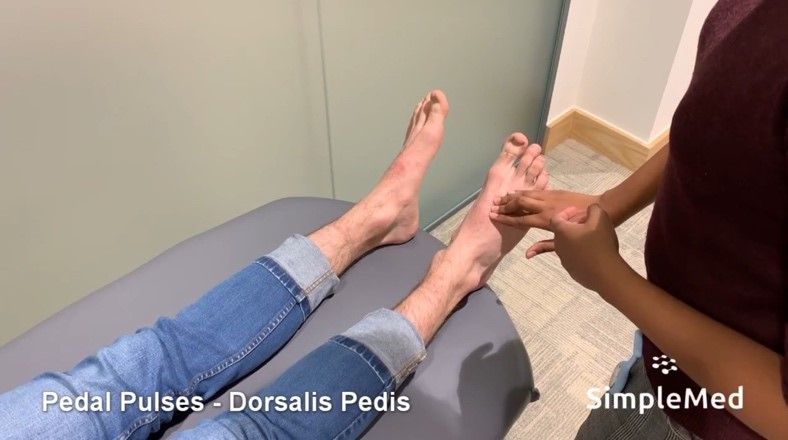
Image - Palpating the dorsalis pedis pulse on the dorsum of the foot, lateral to the extensor hallucis longus tendon
SimpleMed original
Absent or weak pedal pulses suggest co-existing peripheral arterial disease and would prompt formal assessment with an ankle-brachial pressure index (ABPI) before any compression bandaging is applied.

Image - A venous leg ulcer. Arterial supply must be confirmed with an ABPI before compression therapy is used to treat venous ulceration
Creative commons source by Jonathan Moore [CC BY 3.0 (https://creativecommons.org/licenses/by/3.0)]
Completing the Examination
Thank the patient and allow them to redress, then wash your hands.
Summarise your findings, commenting on the distribution of the varicosities, the presence of any skin changes or ulceration, and the results of the special tests localising the level of incompetence.
To complete the examination, suggest performing a full abdominal examination (to exclude a pelvic or abdominal mass causing venous obstruction), a digital rectal examination if a pelvic cause is suspected, and measuring the ankle-brachial pressure index (ABPI) to assess the arterial supply before any compression therapy.
The key bedside and definitive investigation is a venous duplex ultrasound, which directly demonstrates the sites of reflux, confirms the patency of the deep venous system and helps exclude a deep vein thrombosis, guiding decisions about treatment such as endothermal ablation, foam sclerotherapy or surgery.
- 3