
During any examination in an OSCE it is important to understand the pathology and reasoning behind each of the signs and symptoms elicited, even if the patient being examined is ‘normal’. This article explains how to perform an upper limb neurological examination and the key findings you should look for, showing you what each sign means and what conditions it may indicate.
The upper limb neurological examination is fundamentally an exercise in localisation. By systematically assessing tone, power, reflexes, coordination and sensation, you are trying to work out where in the nervous system a problem lies – whether that is the brain, the spinal cord, a nerve root, the brachial plexus, a peripheral nerve, the neuromuscular junction or the muscle itself. The single most useful distinction to keep in mind throughout is between an upper motor neurone (UMN) lesion and a lower motor neurone (LMN) lesion, as almost every finding below points towards one or the other.
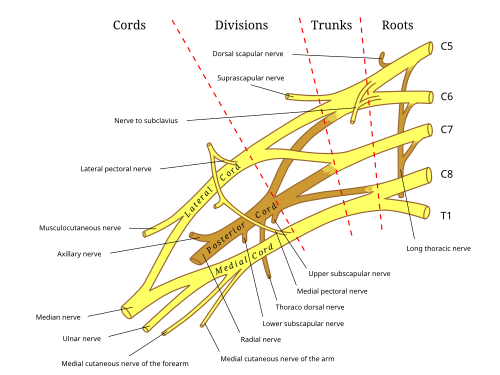
Image - The brachial plexus, formed from the C5–T1 nerve roots. Almost all motor and sensory supply to the upper limb arises from this network, so a sound knowledge of its anatomy underpins localisation during the examination
Public domain source by Captain-n00dle / MissMJ, after Gray’s Anatomy [Public domain]
Sensation
Sensory testing maps the patient’s deficits onto the dermatomes (areas of skin supplied by a single nerve root) and peripheral nerve territories, and assesses the different sensory pathways within the spinal cord. Different modalities travel in different tracts, so testing each one helps localise the lesion:
- Fine touch, vibration and proprioception travel in the dorsal columns.
- Pain (pin-prick) and temperature travel in the spinothalamic tracts, which cross the midline at the level of entry into the cord.
Always start by demonstrating the stimulus on a neutral area such as the sternum so the patient knows what to expect, then test with their eyes closed, comparing left and right at equivalent points as you work down each dermatome.
- Light touch – dab the skin gently with a wisp of cotton wool (do not stroke).
- Pin-prick – use a disposable neurological pin to test the spinothalamic pathway.
- Vibration – place a vibrating 128 Hz tuning fork on a bony prominence, starting distally at a finger interphalangeal joint and moving proximally if sensation is impaired. Loss of vibration sense is an early sign of peripheral neuropathy and of dorsal column disease.
- Proprioception (joint position sense) – hold the sides of the patient’s distal interphalangeal joint and move it up or down, asking them to identify the direction with their eyes closed.
The upper limb dermatomes worth knowing are:
- C5 – the lateral upper arm over the deltoid (the ‘regimental badge’ area).
- C6 – the thumb and radial forearm.
- C7 – the middle finger.
- C8 – the little finger.
- T1 – the medial forearm at the elbow.
The pattern of sensory loss is diagnostic. A dermatomal pattern suggests a radiculopathy; loss in a single peripheral nerve territory suggests a mononeuropathy (for example, loss over the thumb, index and middle fingers in carpal tunnel syndrome); and a symmetrical ‘glove’ distribution suggests a peripheral neuropathy, such as in diabetes mellitus.
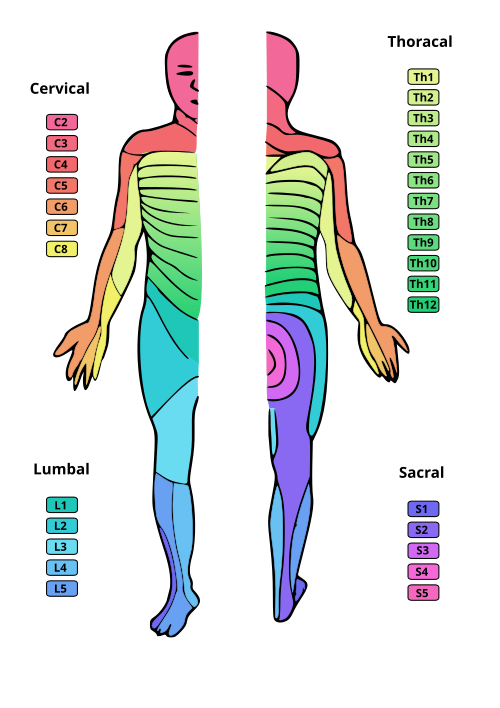
Image - A dermatome map showing the areas of skin supplied by each spinal nerve root. In the upper limb, sensory loss following the C5–T1 dermatomes points towards a nerve root problem (radiculopathy)
Public domain source by Ralf Stephan [Public domain]
- 227