
During any examination in an OSCE it is important to understand the pathology and reasoning behind each of the signs and symptoms elicited, even if the patient being examined is ‘normal’. This article explains how to perform a thyroid status examination and the key findings you should look for, showing you what each sign means and what conditions it may indicate.
The aim of a thyroid status examination is not simply to inspect the gland itself, but to work out whether the patient is hyperthyroid, hypothyroid or euthyroid (clinically normal). Thyroid hormones (T3 and T4) set the metabolic ‘tempo’ of almost every tissue, so an excess or deficiency produces signs throughout the body – in the hands, eyes, skin, neck and reflexes. Keeping the underlying physiology in mind helps the cluster of signs make sense rather than being a list to memorise.
Hands and Arms
Ask the patient to hold their hands out in front of them and inspect them carefully, as the hands carry several useful thyroid signs.
Look at the skin of the palms. Palmar erythema (reddening of the palms) can be a feature of thyrotoxicosis due to the increased peripheral blood flow that accompanies a high metabolic rate. Feel the temperature and moisture of the hands: warm and sweaty palms suggest hyperthyroidism, whereas cool and dry skin is more in keeping with hypothyroidism.
Inspect the nails. Onycholysis, separation of the nail from its bed, can accompany thyrotoxicosis but is not specific to it. Look for thyroid acropachy, a rare manifestation of autoimmune thyroid disease strongly associated with Graves’ disease. It combines soft-tissue swelling of the digits, digital clubbing and periosteal new bone formation. The bone changes are demonstrated on imaging, not by inspection alone. Acropachy usually accompanies thyroid eye disease and thyroid dermopathy and can occur after treatment when thyroid function is normal or low.
Assess for a fine tremor by placing a sheet of paper across the backs of the patient’s outstretched hands and watching for it to oscillate. A fine tremor reflects the enhanced sensitivity to adrenergic signals of thyrotoxicosis and is one of the more reliable peripheral signs.
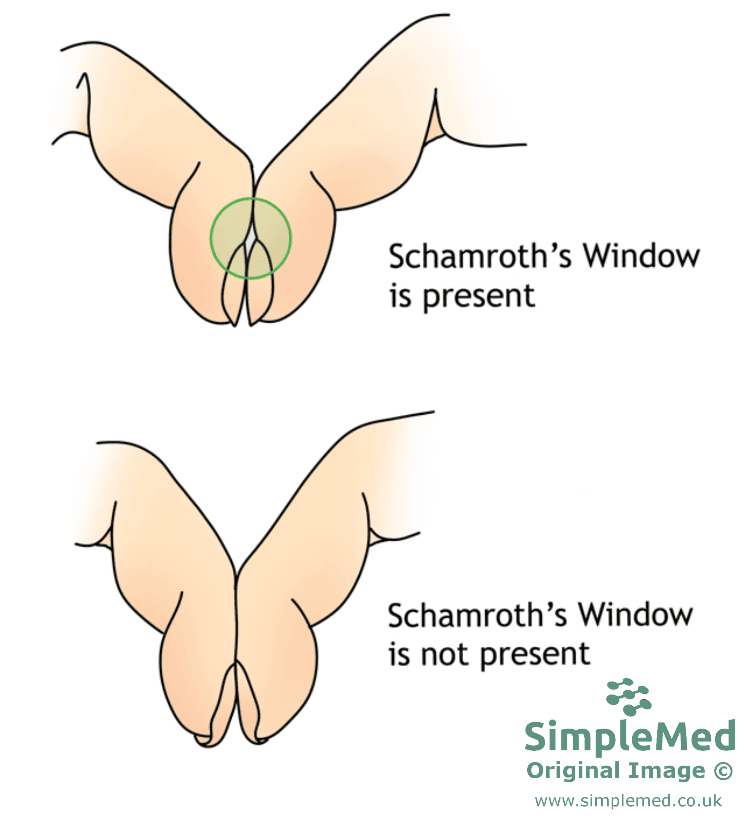
Image - Schamroth’s window is present in the upper example and absent in the lower example, illustrating a bedside sign of digital clubbing. Thyroid acropachy can include true clubbing together with digit swelling and periosteal new bone formation; this diagram does not show the bone changes or establish their cause.
SimpleMed original
Take the radial pulse and assess its rate and rhythm. A tachycardia (rate above 100 bpm) supports hyperthyroidism, while a bradycardia (rate below 60 bpm) supports hypothyroidism. Crucially, check whether the rhythm is irregularly irregular, as thyrotoxicosis is an important and reversible cause of atrial fibrillation that should always be excluded.
Face and Eyes
Inspect the face first. Dry, coarse skin, a puffy appearance and loss of the outer third of the eyebrows are associated with hypothyroidism. By contrast, the skin in thyrotoxicosis may appear flushed and sweaty.
The eyes are the most important part of this section because several eye signs are specific to Graves’ disease rather than to thyroid hormone levels in general. In Graves’ disease, autoantibodies stimulate inflammation and the deposition of glycosaminoglycans in the orbital tissues and extraocular muscles, pushing the eye forwards and restricting its movement.
Inspect the eyes from the front and from the side for exophthalmos (also called proptosis), in which the eyeballs protrude forwards out of the orbit. This is best appreciated by standing behind the seated patient and looking down over their forehead. Severe proptosis can prevent the eyelids closing fully, risking exposure keratopathy and corneal damage.
Look also for signs of active inflammation: a red, injected conjunctiva and chemosis (conjunctival swelling and oedema) suggest the thyroid eye disease is currently active rather than burnt out, which matters because active disease may respond to immunosuppression.
Look for lid retraction, where the upper eyelid is pulled up so that sclera is visible above the iris, giving a startled appearance (Dalrymple’s sign). This is caused by sympathetic overactivity raising the tone of the superior tarsal (Müller’s) muscle, which helps elevate the upper lid.
Assess eye movements by asking the patient to follow your finger through the cardinal directions of gaze, keeping their head still. Restriction of movement and diplopia (double vision) occur when the inflamed, swollen extraocular muscles can no longer move freely – the inferior and medial recti are most commonly affected. Ask about any pain on eye movement, which can indicate active inflammation.
Test for lid lag (von Graefe’s sign) by asking the patient to follow your finger as you move it slowly from a raised position downwards. In thyrotoxicosis the upper eyelid lags behind the eye as it descends, again because of sympathetic overactivity of the lid retractor.
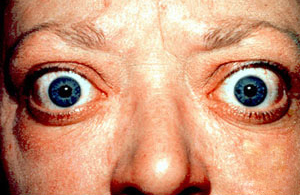
Image - Proptosis and lid retraction in Graves’ disease. The eyeballs are pushed forwards and sclera is visible above the iris, both classic signs of thyroid eye disease
Creative commons source by Jonathan Trobe, M.D., University of Michigan Kellogg Eye Center [CC BY 3.0 (https://creativecommons.org/licenses/by/3.0)]
Neck Inspection
Move to inspect the front of the neck, looking specifically over the region of the thyroid gland, which sits below the thyroid (laryngeal) cartilage. Note any obvious goitre (diffuse or nodular enlargement of the gland), any single lump, and any scars – a thyroidectomy scar is typically a transverse incision low in the neck and tells you the patient may now be on thyroid hormone replacement.
Ask the patient to take a sip of water, hold it in their mouth, and then swallow while you watch the neck. The thyroid gland is enclosed within the pretracheal fascia and is therefore tethered to the larynx, so a thyroid swelling (and a thyroglossal cyst) will move upwards on swallowing. Most other neck lumps, such as lymph nodes, will not move.
Next ask the patient to protrude their tongue while you observe. A thyroglossal cyst is connected to the base of the tongue by the thyroglossal tract and will move upwards when the tongue is poked out, whereas a true thyroid swelling will not. These two dynamic tests together help you decide what a midline neck lump is likely to be.
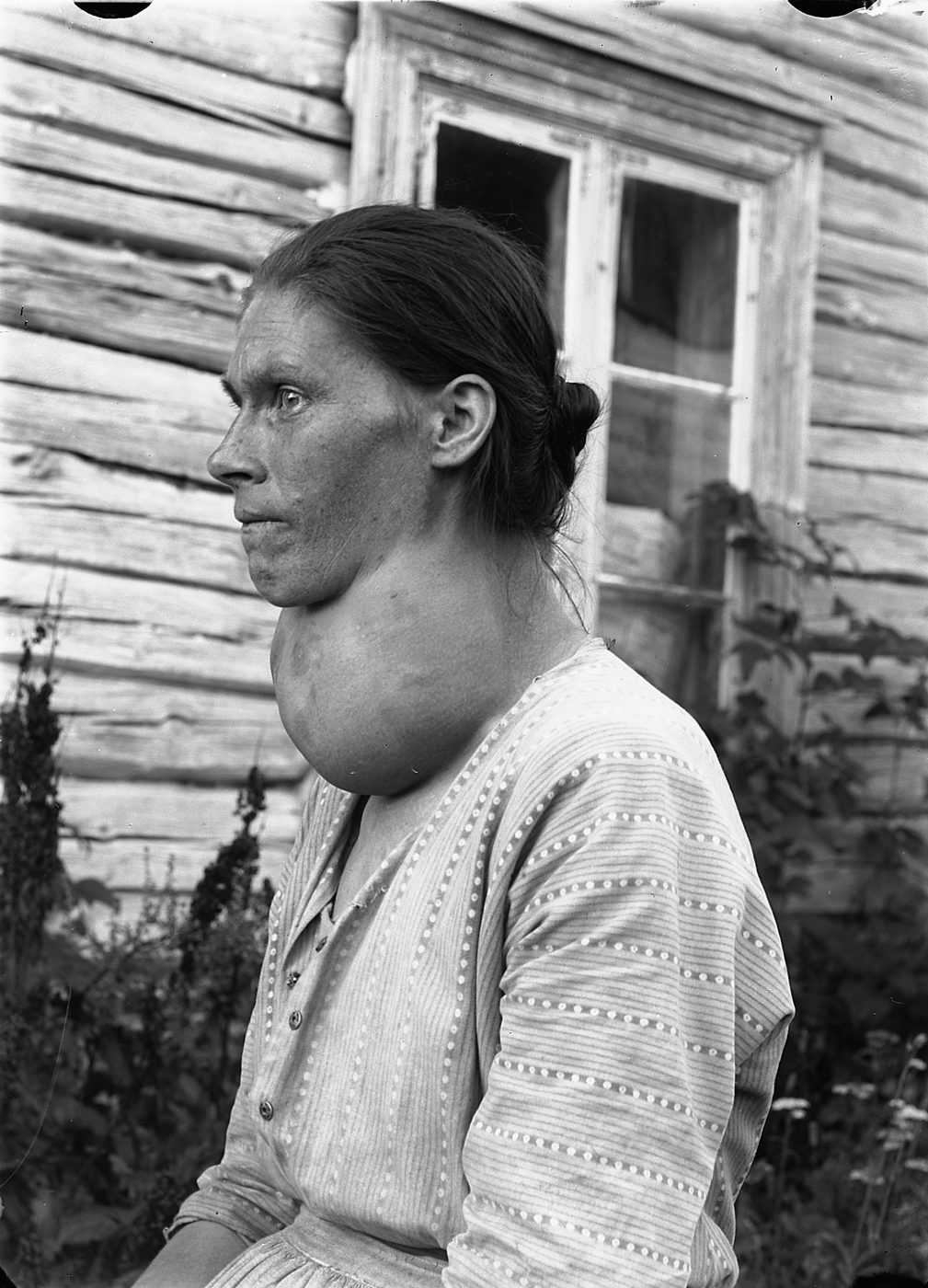
Image - A large goitre. Enlargement of the thyroid gland is visible as a midline swelling in the lower neck that would move upwards on swallowing
Public Domain Source Martin Finborud [Public domain]
Legs and Skin
Inspect the shins for pretibial myxoedema, also called thyroid dermopathy. Accumulated glycosaminoglycans in the skin can produce raised, waxy, discoloured plaques or firm non-pitting thickening over the anterior shins. This is strongly associated with Graves’ disease but is not exclusive to it and does not depend on the current thyroid hormone level. It may persist or occur when thyroid function is normal or low. Distinguish this localised dermopathy from the more generalised skin changes and puffiness of hypothyroidism.
More generally, look at the overall skin and hair. Hypothyroidism causes dry, coarse skin and brittle, thinning hair, while thyrotoxicosis tends to cause warm, moist skin and fine, soft hair.
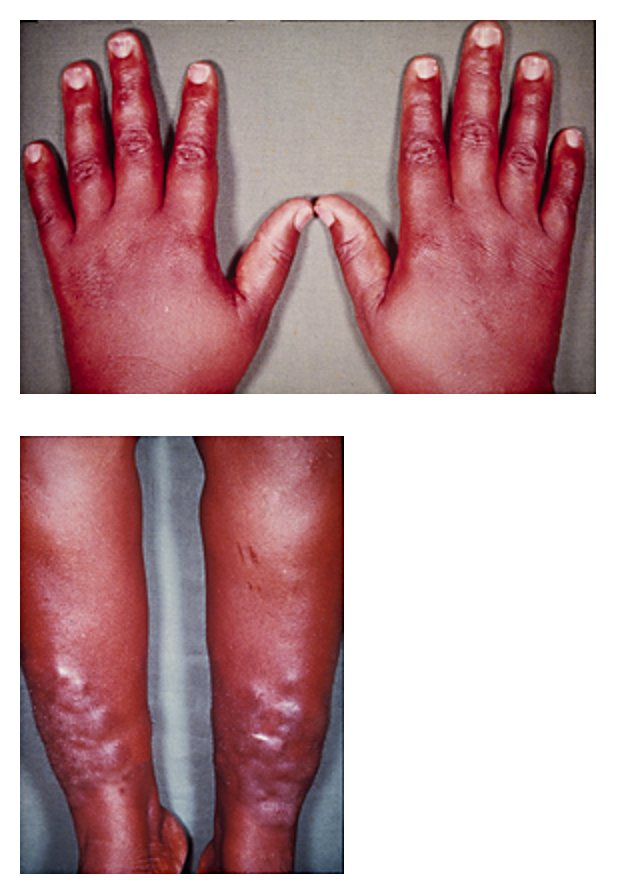
Image - Hand swelling and raised shin lesions in the source photograph of thyroid dermopathy and acropachy. These findings are strongly associated with Graves’ disease and do not establish the current thyroid hormone level. Periosteal bone changes cannot be assessed from this photograph.
Creative commons source by Herbert L. Fred, MD and Hendrik A. van Dijk [CC BY 2.0 (https://creativecommons.org/licenses/by/2.0)]
- 230