Testicular OSCE Examination
During any examination in an OSCE it is important to understand the pathology and reasoning behind each of the signs and symptoms elicited, even if the patient being examined is ‘normal’. This article explains how to perform a testicular examination and the key findings you should look for, showing you what each sign means and what conditions it may indicate.
The testicular examination is an intimate examination, and a great deal of the mark in an OSCE comes from doing it sensitively and professionally. Throughout, maintain the patient’s dignity, explain what you are doing before you do it, and have a chaperone present and documented.
Contents
- Introduction
- General Inspection
- Relevant Anatomy
- Inspection of the Penis, Groin and Scrotum
- Palpation of the Testes
- Palpation of the Epididymis, Cord and Lymph Nodes
- Characterising a Scrotal Lump
- Examination Standing and the Varicocele
- Prehn’s Test
- The Cremasteric Reflex
- Completing the Examination
- Quiz
Introduction
Wash your hands and put on a pair of non-sterile gloves (an intimate examination should always be performed wearing gloves).
Introduce yourself to the patient and ensure to mention your grade e.g. 3rd year medical student/junior doctor/consultant.
Confirm the patient’s details taking 3 points of identification; usually full name, date of birth and NHS/hospital number.
Obtain consent for the examination, ensuring to explain what the examination will entail. As this is an intimate examination, it is essential to offer a chaperone and to document their name and role.
Ask the patient if they are currently in any pain, as the scrotum and testes are very sensitive and certain conditions (such as torsion or infection) make examination acutely tender.
Position the patient lying on the couch and ask them to expose from the waist down. Examination begins with the patient lying supine and is later repeated with the patient standing, as some signs (such as a varicocele) are only apparent when upright. Keep the patient covered with a sheet until you are ready to examine, and only expose the area for as long as necessary.
General Inspection
Begin with a brief general inspection of the patient and the area around the bedside. Look at how comfortable the patient appears – a patient in significant distress or who is restless and unable to get comfortable may be suffering from testicular torsion or severe epididymo-orchitis, both of which can be intensely painful.
Note any obvious scrotal swelling or asymmetry visible from the end of the bed. Assess whether the patient appears systemically unwell (for example flushed or feverish), which may accompany infection such as epididymo-orchitis.
Look around the bedside for relevant objects or clues, such as analgesia, a urinary catheter, or a scrotal support, which may hint at the underlying problem.
Relevant Anatomy
A sound understanding of scrotal anatomy is what allows you to interpret what you feel. The testis produces sperm within its seminiferous tubules and is responsible for testosterone production. Posterolaterally, the epididymis sits like a comma against the testis, storing and maturing sperm before they pass into the vas deferens. The spermatic cord contains the vas deferens, the testicular artery, the pampiniform venous plexus, lymphatics and nerves, running up towards the inguinal canal.
The testis is enveloped by the tunica vaginalis, a remnant of the peritoneum. Fluid can collect within this layer to form a hydrocele. Recognising which structure a lump arises from – the testis itself, the epididymis, or the cord – is the single most important step in working out what a scrotal lump is.
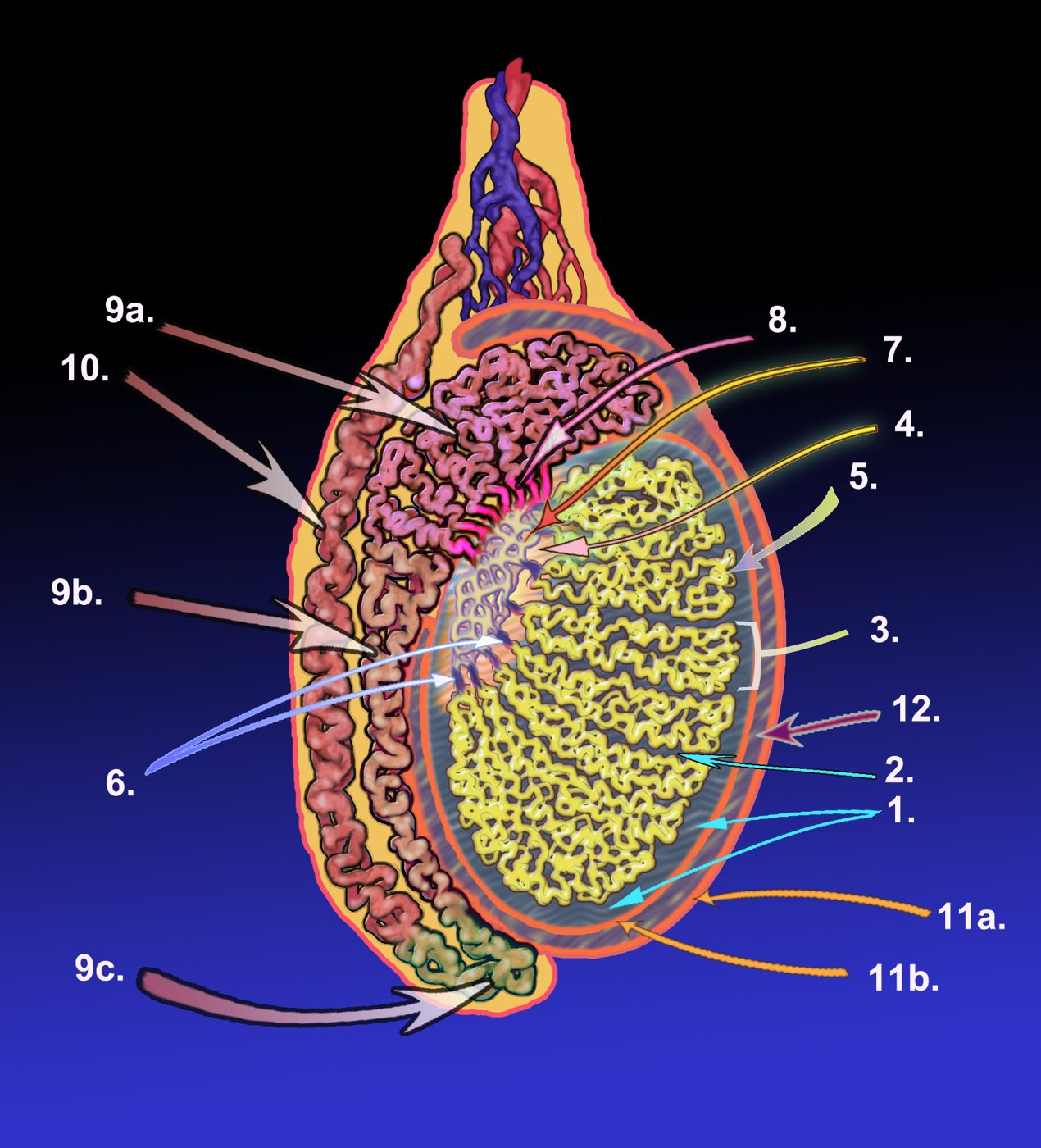
Image - Cross-sectional anatomy of the testis showing the seminiferous tubules, the epididymis lying posteriorly, and the vessels of the spermatic cord entering at the top
Creative commons source by KDS444 [CC BY-SA 3.0 (https://creativecommons.org/licenses/by-sa/3.0)]
Inspection of the Penis, Groin and Scrotum
Begin with the penis, groin and lower abdomen. Inspect the shaft and glans for skin changes, and gently retract the foreskin (if uncircumcised) only if the patient is comfortable doing so, checking the urethral meatus for discharge, ulcers or obvious lesions that may point to a sexually transmitted infection. Scan the groin and lower abdomen for any visible swelling, scars or masses that might represent an inguinal hernia or previous surgery.
Ask the patient to lift the penis upwards so you can clearly inspect the scrotum and surrounding skin. Inspect from the front and then ask the patient to allow you to look at the posterior aspect.
Note the size and symmetry of the two sides of the scrotum. The left testis often sits slightly lower than the right, which is normal. A unilaterally swollen, red and oedematous hemiscrotum suggests an acute process such as epididymo-orchitis or testicular torsion.
Examine the skin for changes. Look for erythema (which may indicate cellulitis, infection, or an underlying inflamed testis), fungal infection in the skin folds, and any ulcers or warts (which may suggest a sexually transmitted infection such as human papillomavirus). Spreading erythema with skin necrosis and a patient who is profoundly unwell should raise the alarm for Fournier’s gangrene, a surgical emergency.
Look at the lie of the testes. A testis that lies horizontally and high in the scrotum (the ‘bell-clapper’ appearance) is a classic feature of testicular torsion.
Look for scars. A scar in the inguinal region may indicate previous inguinal hernia repair or orchidopexy (surgical fixation of the testis), while a scar on the penis may reflect previous circumcision. Finally, note any obvious scrotal lumps or visible dilated veins before you begin to palpate.
Palpation of the Testes
Before palpating, warn the patient that you are about to examine the testes and ask again about pain. Use a gentle bimanual technique: steady the testis with the remaining fingers behind it and roll the body of the testis methodically between your thumbs and index fingers, covering its whole surface. Examine the asymptomatic side first so you have a normal comparison and avoid causing unexpected pain.
For each testis assess its size, shape, consistency and tenderness. A normal testis is smooth, firm and mildly tender when squeezed. A small, soft testis (atrophy) may follow torsion, mumps orchitis, or be related to hypogonadism. An absent testis may indicate an undescended testis or a previous orchidectomy.
The key sign to identify is a hard, irregular, painless lump arising from within the testis itself, which must be considered a testicular tumour until proven otherwise. Testicular cancer most commonly affects men aged 20–40 years and frequently presents with a painless lump and few systemic symptoms, so any such finding warrants urgent referral and ultrasound. A diffusely tender, swollen testis instead points towards an inflammatory cause such as orchitis.
Palpation of the Epididymis, Cord and Lymph Nodes
After examining the body of each testis, move to palpate the epididymis, which lies along the posterolateral border. Determining whether a lump is part of the testis or separate from it is crucial: a lump arising from the epididymis is extra-testicular and far more likely to be benign, whereas a lump within the testis is concerning for malignancy.
A tender, swollen and thickened epididymis suggests epididymitis or epididymo-orchitis, typically caused by sexually transmitted infection in younger men or urinary tract organisms in older men. A smooth, well-defined, fluctuant lump separate from the testis at the head of the epididymis is usually an epididymal cyst (or a spermatocele if it contains sperm); the two cannot be reliably distinguished on examination, and both are benign and tend to transilluminate.
Trace the spermatic cord upwards from the top of the testis towards the superficial inguinal ring. Feel for any thickening or masses. A soft mass of dilated veins that feels like a ‘bag of worms’ is a varicocele (discussed in the standing examination below).
Finally, palpate the inguinal lymph nodes along the groin. The lymphatic drainage of the genitalia is a frequently examined point: the scrotal skin drains to the inguinal nodes, whereas the testis itself drains to the para-aortic nodes high in the abdomen (reflecting its embryological origin). For this reason, palpable inguinal nodes point towards a skin or scrotal wall problem rather than a testicular tumour, and the abdominal para-aortic nodes – not the groin – are where you would expect testicular cancer to spread first.
Characterising a Scrotal Lump
If you find a lump, the marks come from systematically characterising it. The features below allow you to narrow the differential considerably without any imaging.
- Can you get above it? If you can palpate normal cord above the lump, it arises from within the scrotum. If you cannot get above it, the lump may be extending down from the inguinal canal, suggesting an inguinal hernia.
- Is it separate from or part of the testis? A lump within the testis raises concern for malignancy; a lump separate from the testis (e.g. epididymal) is more likely benign.
- Does it transilluminate? Shine a pen torch through the lump in a darkened room. A lump that glows is fluid-filled – typically a hydrocele or an epididymal cyst. A solid mass such as a tumour or a hernia does not transilluminate.
- Is it fluctuant? Steady the lump between two fingers of one hand and press its centre with a finger of the other. A fluid-filled lump bulges outwards at the held edges, confirming fluctuance; this reinforces a cystic diagnosis such as a hydrocele or epididymal cyst, whereas a solid tumour feels uniformly firm and does not fluctuate.
- Is there a cough impulse? A lump that enlarges or is felt to expand on coughing suggests an inguinal hernia or a varicocele.
- Consistency and tenderness: note whether it is soft, firm or hard, smooth or irregular, and whether it is tender (favouring infection) or painless (raising concern for tumour).
A hydrocele is fluid within the tunica vaginalis, presenting as a painless, smooth swelling that transilluminates; the underlying testis may be impossible to palpate when the hydrocele is large. Importantly, a hydrocele can occasionally develop in response to an underlying tumour, so an ultrasound is needed if the testis cannot be felt.
Examination Standing and the Varicocele
At the end of the examination, ask the patient to stand. Standing increases the venous pressure in the scrotum, making certain findings far more obvious, and lets gravity reveal a hernia.
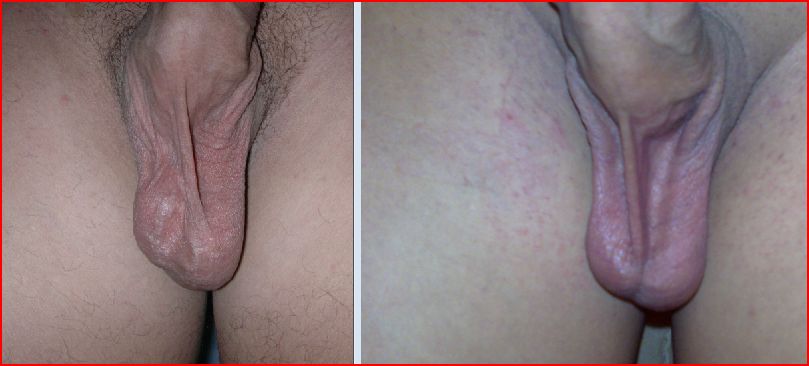
Re-inspect and re-palpate the posterior scrotum. The classic finding to seek is a varicocele – an abnormal dilatation of the veins of the pampiniform plexus caused by venous reflux. It feels like a soft ‘bag of worms’, is more prominent on standing and on coughing (the Valsalva manoeuvre), and characteristically decompresses when the patient lies flat. Varicoceles are far more common on the left, because the left testicular vein drains at a right angle into the left renal vein. For this reason, a right-sided varicocele, or one that does not empty when lying down, should prompt investigation for a retroperitoneal mass obstructing venous drainage.
Also reassess for any swelling that descends on standing or has a cough impulse you cannot get above, which would suggest an inguinal hernia tracking down into the scrotum.
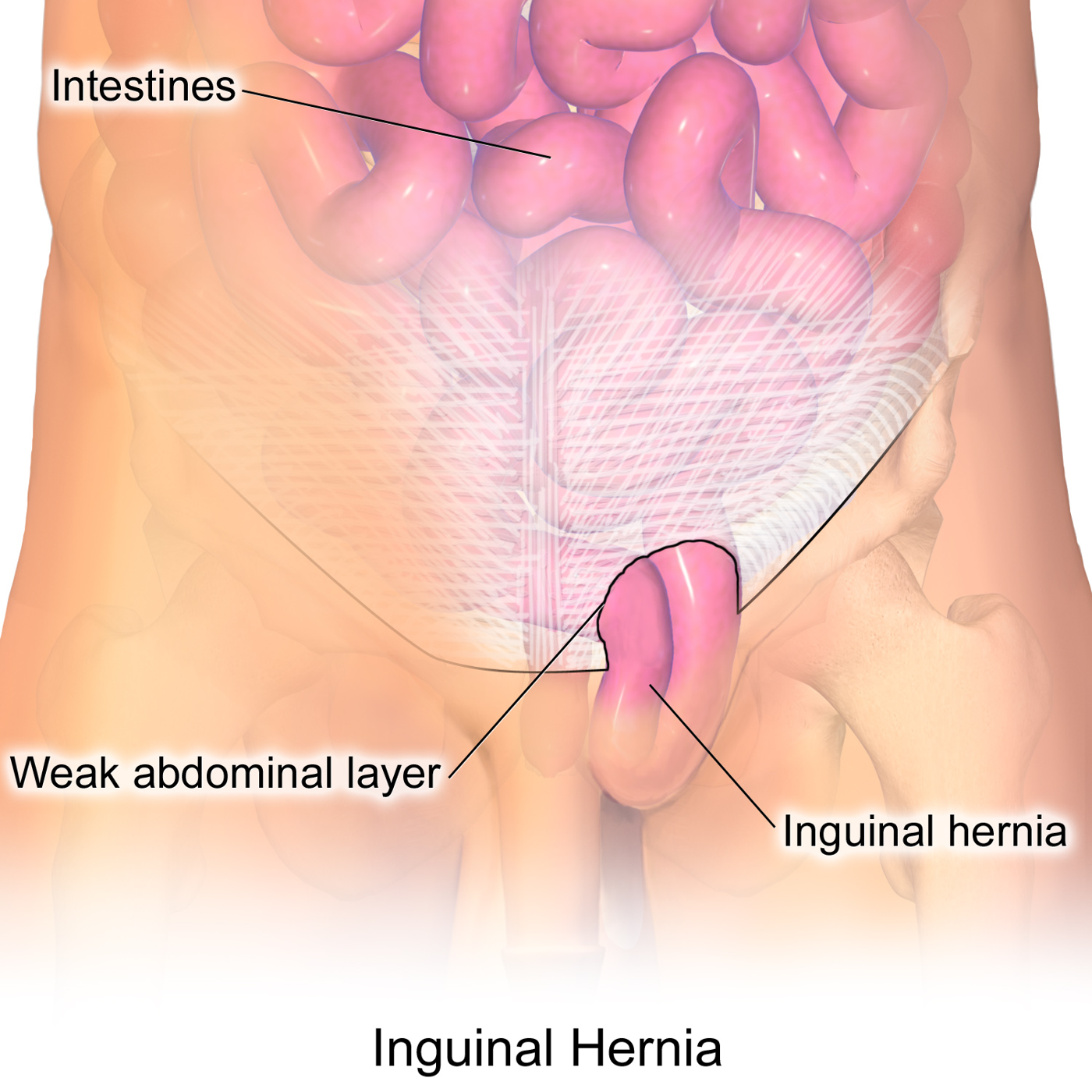
Image - An inguinal hernia can extend down into the scrotum. Unlike a scrotal lump, you cannot get above it and it typically has a cough impulse
SimpleMed original

Image - A varicocele, seen as dilated veins of the pampiniform plexus. It is more prominent on standing and classically described as feeling like a ‘bag of worms’
Public Domain source by Andre75 [Public domain]
Prehn’s Test
In the acutely painful testis, Prehn’s test can help weigh up the two diagnoses that matter most: testicular torsion and epididymo-orchitis. Gently lift and support the affected testis towards the groin and ask the patient what happens to the pain.
If raising the testis eases the discomfort, that is a positive result and leans towards epididymo-orchitis. If elevation makes no difference or worsens the pain, that is a negative result and is more in keeping with torsion.
Treat this sign with caution. It is far from reliable on its own and a reassuring result must never talk you out of torsion when the history and examination are worrying. As with the cremasteric reflex, the safe course is urgent surgical exploration if torsion is suspected, since saving the testis depends on acting within hours.
The Cremasteric Reflex
To elicit the cremasteric reflex, lightly run a finger or orange stick down the inner thigh. In a normal response the cremaster muscle contracts and briefly hitches the testis on the same side upwards. The reflex arc travels through the genitofemoral nerve, so its presence confirms an intact pathway.
An absent cremasteric reflex is associated with testicular torsion, because torsion of the cord disrupts the reflex pathway. However, the reflex should never be relied upon in isolation to rule torsion in or out – a present reflex does not exclude torsion. Torsion remains a clinical diagnosis requiring urgent surgical exploration, and imaging must never delay treatment when suspicion is high.
Completing the Examination
Explain to the patient that the examination is finished and allow them privacy to dress.
Thank the patient, dispose of your gloves, and wash your hands.
Summarise your findings and document the presence of a chaperone.
To complete the examination, state that you would perform an abdominal examination (including the inguinal regions and lymph nodes), examine the external genitalia fully, and take a focused sexual and urological history. Suggest relevant bedside and laboratory investigations: a urine dipstick and urethral swabs if infection is suspected, blood tests, and, where a tumour is a possibility, tumour markers (beta-hCG, alpha-fetoprotein (AFP) and lactate dehydrogenase (LDH)). The key imaging investigation for almost any scrotal lump is an ultrasound scan of the testes, which reliably distinguishes solid from cystic masses and assesses blood flow.
- 3