
Stoma OSCE Examination
During any examination in an OSCE it is important to understand the pathology and reasoning behind each of the signs and symptoms elicited, even if the patient being examined is ‘normal’. This article explains how to perform a stoma examination and the key findings you should look for, showing you what each sign means and what conditions it may indicate.
A stoma is an artificial opening created by bringing a length of bowel (or ureter) onto the surface of the abdomen so that the contents can drain into an appliance. The central skill in this examination is using the characteristics of the stoma – its position, whether it has a spout, the number of lumens, and the nature of its output – to deduce what type of stoma it is and why it was formed. The examination then moves on to identifying the common complications.
Introduction
Wash your hands and don personal protective equipment (an apron and gloves are appropriate, as a stoma examination involves potential contact with bodily fluids).
Introduce yourself to the patient and ensure to mention your grade e.g. 3rd year medical student/junior doctor/consultant.
Confirm the patient’s details taking 3 points of identification usually; Full name, Date of birth and NHS/Hospital number.
Obtain consent for the examination, ensuring to explain what the examination will entail. Many patients are understandably self-conscious about their stoma, so it is important to be sensitive and to maintain their dignity throughout.
Position the patient lying flat (supine) on the bed with the head supported by a single pillow, as this best exposes the abdomen and stoma.
Adequately expose the abdomen from the xiphisternum to the pubic symphysis so that the stoma, the appliance and the surrounding skin can all be inspected. Only expose the patient when you are ready to examine.
Ask the patient if they have any pain anywhere before you begin, and whether they have noticed any recent problems with their stoma, such as bleeding, leakage or a change in output.
General Inspection
Begin by standing back and observing the patient from the end of the bed. Assess whether they look comfortable or are in any distress, and note their general nutritional status. A cachectic or visibly unwell patient may point towards an underlying malignancy or inflammatory bowel disease as the reason the stoma was formed.
Look around the bedside for clues. Spare stoma appliances, adhesive removal sprays and barrier creams suggest a well-established stoma and an independent patient. A nasogastric tube, drains or a catheter suggest the patient is in the early post-operative period. The presence of parenteral nutrition (TPN) may indicate a high-output stoma or short-bowel syndrome.
Inspect any surgical scars on the abdomen. A midline laparotomy scar alongside the stoma is common and indicates open abdominal surgery, while smaller laparoscopic port scars suggest a minimally invasive approach.
Inspecting the Stoma: Site
The site of the stoma is one of the most useful clues to its type, as different parts of the bowel are conventionally brought out in different quadrants of the abdomen.
- A stoma in the left iliac fossa (LIF) is most likely to be a colostomy, as the sigmoid and descending colon sit on the left side of the abdomen.
- A stoma in the right iliac fossa (RIF) is most likely to be an ileostomy (formed from the terminal ileum) or a urostomy (an ileal conduit).
These are conventions rather than absolute rules – the site is interpreted alongside the spout and the output before reaching a conclusion. Note also whether the stoma has been sited away from skin creases, scars and the umbilicus, as poor siting predisposes to leakage and appliance problems.
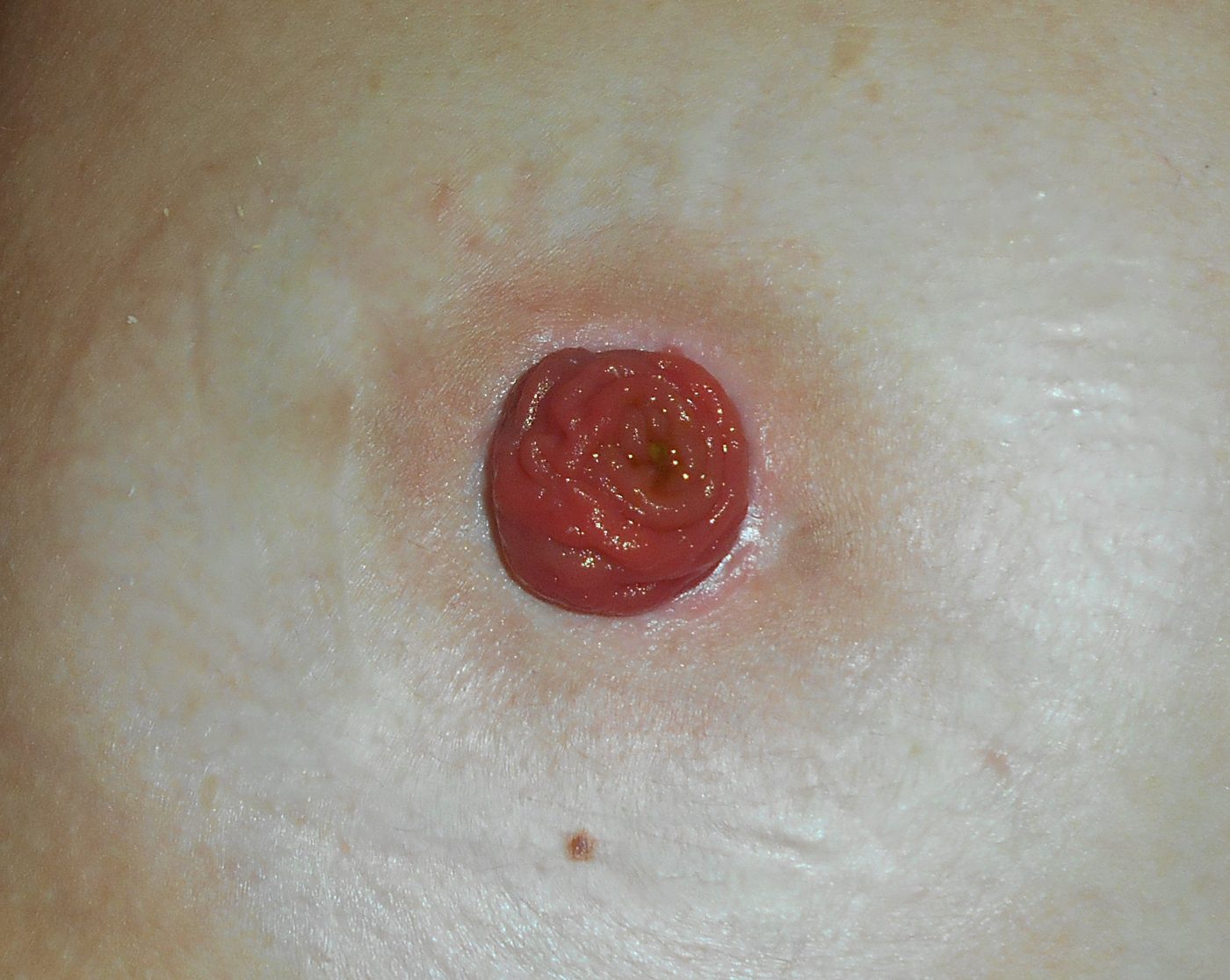
Image - An ileostomy. Note the protruding spout, which lifts the irritant small-bowel contents away from the surrounding skin
Creative commons source by Salicyna [CC BY-SA 4.0 (https://creativecommons.org/licenses/by-sa/4.0)]
Inspecting the Stoma: Spout
Note whether the stoma is flush with the skin or whether it has a protruding spout. This single feature reliably distinguishes a colostomy from an ileostomy, and the reason behind it is important to understand.
An ileostomy is spouted, typically protruding around 2–3 cm above the skin. Small-bowel content is liquid and rich in digestive enzymes, which would rapidly excoriate and ulcerate the surrounding skin if allowed to sit against it. The spout lifts the output clear of the skin and directs it straight into the appliance, protecting the peristomal skin.
A colostomy is flush with the skin (no spout). The output from the colon is more solid and far less enzyme-rich, so it does not damage the skin in the same way, and a spout is not required.
A urostomy is also spouted, for the same reason as an ileostomy – constant contact of urine with the skin causes maceration and irritation.
Inspecting the Stoma: Lumens and Mucosa
Count the number of lumens (openings) visible at the stoma, as this distinguishes an end stoma from a loop stoma.
- A stoma with a single lumen is an end stoma, where the proximal end of the bowel is brought to the surface and the distal bowel has usually been removed or closed off.
- A stoma with two lumens is a loop stoma, where a loop of bowel is brought to the surface and opened, leaving both a functioning (proximal) limb that produces output and a non-functioning (distal) limb. Loop stomas are frequently formed as a temporary measure to defunction and protect a more distal anastomosis or rejoining of the bowel while it heals.
In the early post-operative period a loop stoma may be held in place by a plastic bridge or rod passed under the loop, which stops the bowel retracting into the abdomen before it has adhered. Noting its presence is a useful clue that the stoma is both a loop stoma and relatively recently formed.
Inspect the stoma mucosa itself. A healthy stoma should be pink or red, moist and slightly shiny, reflecting a good blood supply. A dusky, purple or black stoma is a worrying sign of ischaemia and possible necrosis, which may threaten the viability of the bowel. The stoma is normally insensate (it has no somatic pain fibres) and may bleed slightly when touched, which is normal because of its rich superficial vascular supply.
Inspecting the Output (Effluent)
First note the appliance (bag) itself, as it offers further clues. A drainable bag with an open, clip-or-velcro-sealed end is used for the frequent liquid output of an ileostomy, whereas a closed bag that is changed when full is more typical of the formed output of a colostomy. A separate tap or bung outlet indicates a urostomy bag designed to be emptied like a catheter, and a urostomy is often connected to a night-drainage bag. A convex appliance (one with a moulded, protruding flange) is used to push out a flush or retracted stoma and improve the seal, so its presence hints at previous appliance or skin difficulties.
Then inspect the contents of the bag, as the nature of the output (effluent) confirms which part of the bowel the stoma arises from and ties together your earlier findings.
- Ileostomy output is liquid to porridge-like and often green or yellow-brown, because the small bowel has not yet reabsorbed water from the contents. A consistently high-output ileostomy (typically taken as more than around 2,000 mL per day) can cause significant dehydration and electrolyte disturbance, particularly loss of sodium and magnesium.
- Colostomy output is more solid and formed, resembling normal stool, because the colon has reabsorbed water and the output is more distal.
- Urostomy output is urine. Because an ileal conduit is fashioned from a short segment of small bowel, the urine often contains some mucus, which is normal and expected.
Putting these features together allows you to characterise the stoma confidently – for example, a spouted, single-lumen stoma in the right iliac fossa draining liquid contents is an end ileostomy, whereas a flush, single-lumen stoma in the left iliac fossa draining solid faeces is an end colostomy.
Inspecting the Peristomal Skin
Carefully inspect the skin surrounding the stoma (peristomal skin), as this is a frequent source of problems and patient discomfort. Healthy peristomal skin should look the same as the rest of the abdominal skin.
Look for erythema, excoriation or ulceration. This is most commonly caused by leakage of irritant output beneath the appliance, especially with a poorly sited or insufficiently spouted ileostomy. It may also reflect a contact dermatitis to the adhesive, or a fungal (candidal) infection in the warm, moist environment under the appliance.
Note any bruising, retraction of the surrounding skin or signs of infection. Recurrent skin breakdown impairs adhesion of the appliance, creating a vicious cycle of further leakage and further skin damage.
Also look for any fistula opening in the peristomal skin (an abnormal track through which bowel contents discharge onto the surface separate from the stoma itself). Peristomal fistulation is particularly associated with Crohn’s disease and warrants specialist review.
Palpation and Auscultation
Before palpating, check again that the patient is not in any pain and warn them about what you are going to do.
Gently palpate around the base of the stoma and the immediately surrounding abdominal wall, feeling for any tenderness or masses. Tenderness may suggest underlying inflammation, infection or an obstructed or incarcerated hernia.
With the patient’s consent, a digital examination of the stoma may be performed by a clinician using a gloved, lubricated finger. This assesses the patency and direction of the lumen and can detect a stenosis (narrowing) at the level of the skin or fascia. Stomal stenosis can impair the flow of output and, in severe cases, cause obstruction.
Finally, auscultate the abdomen with your stethoscope to listen for bowel sounds. Normal, active sounds reassure you the bowel is functioning, whereas a silent abdomen raises concern about an ileus or obstruction – relevant if a stoma has stopped producing output. Tinkling, high-pitched sounds may instead suggest mechanical obstruction.
Assessing for Complications
Stomas are associated with a number of well-recognised complications, and actively looking for these is a key part of the examination.
A parastomal hernia is the most common late complication. It occurs because the stoma necessarily creates a defect in the abdominal wall, through which abdominal contents can protrude. To examine for one, ask the patient to lift their head off the bed (or to cough), which raises intra-abdominal pressure and tenses the abdominal wall. A parastomal hernia will appear or enlarge as a bulge alongside the stoma and is usually reducible when the patient relaxes or lies flat. The danger is that a loop of bowel may become incarcerated and then strangulated, cutting off its blood supply and causing ischaemia – a surgical emergency.
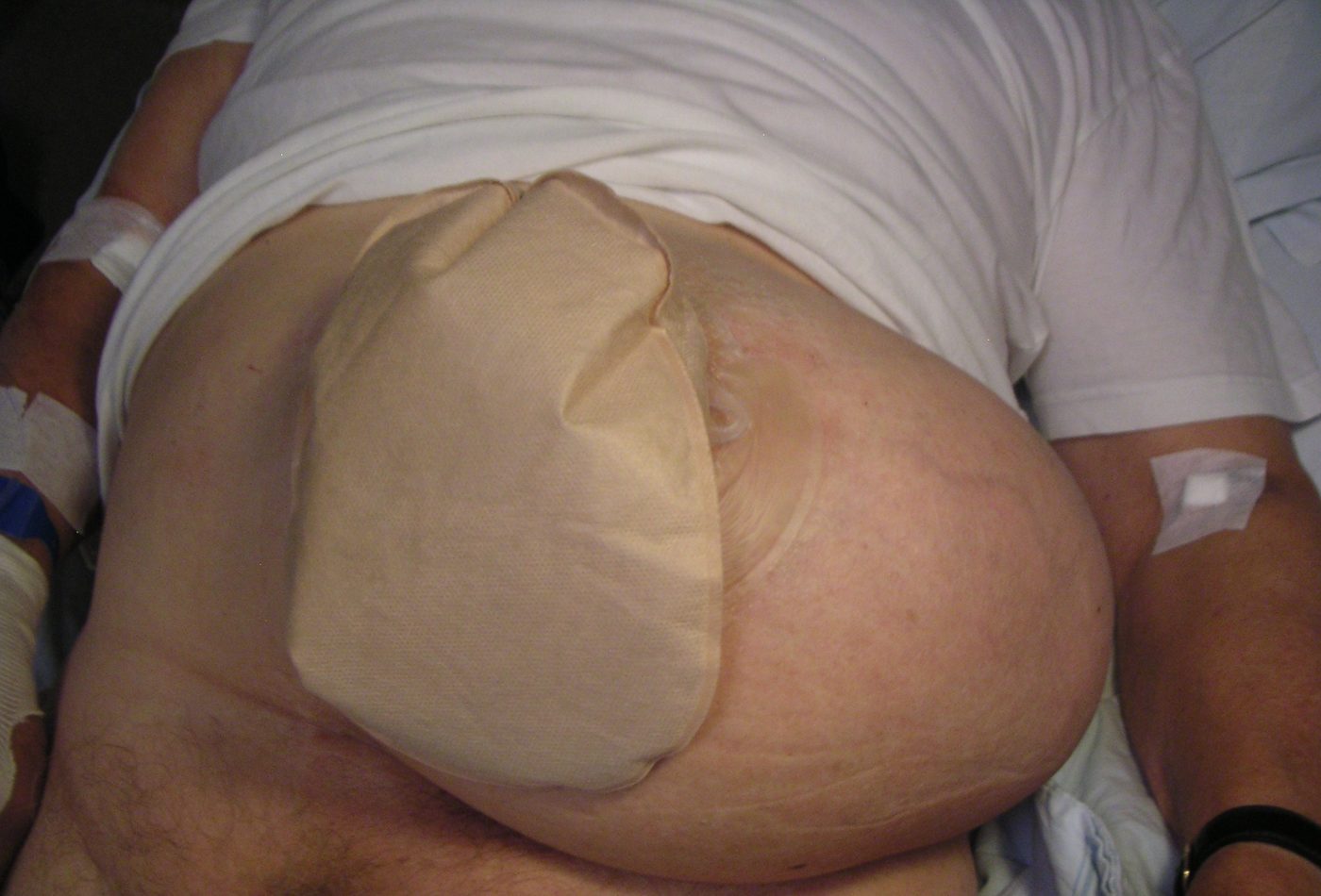
Image - A colostomy with a large parastomal hernia. The bulge alongside the stoma is caused by abdominal contents protruding through the defect in the abdominal wall
Creative commons source by Mikael Häggström [CC0 1.0 (https://creativecommons.org/publicdomain/zero/1.0)]
Stoma prolapse is the telescoping of an excessive length of bowel through the stoma, so that the stoma appears abnormally long. It tends to worsen when the patient stands, coughs or strains and to reduce on lying down. A chronically prolapsed stoma can become oedematous and, if venous drainage is impaired, may develop venous congestion and secondary ischaemia.
Stoma retraction is the opposite problem – the stoma sinks below the level of the skin, giving it a concave appearance. This usually results from tension on the bowel or weight gain, and it makes achieving a good seal with the appliance difficult, leading to leakage and peristomal skin damage.
Mucocutaneous separation is a breakdown of the join between the stoma and the surrounding skin, leaving a visible gap or wound at the junction. It is an early complication, usually arising from poor healing, tension or local infection, and it allows output to track under the appliance, which both delays healing and damages the skin.
Stomal bleeding should also be noted. A little bleeding from the surface when the stoma is cleaned or rubbed is normal, reflecting its rich superficial blood supply. Persistent or significant bleeding is abnormal and may arise from peristomal varices (caput medusae at the mucocutaneous junction in portal hypertension), trauma from the appliance, or, rarely, a tumour at the stoma.
Finally, look again at the colour of the mucosa for ischaemia and inspect for stenosis of the opening, both described above.
Completing the Examination
Once finished, help the patient to re-cover and reposition themselves comfortably, ensuring the appliance is secure and their dignity is maintained.
Thank the patient and wash your hands.
Summarise your findings, stating clearly the type of stoma you believe is present and the reasoning behind it – for example, “a spouted, single-lumen stoma in the right iliac fossa with liquid output, consistent with an end ileostomy, with no evidence of a parastomal hernia or skin complications”.
To complete the examination, suggest performing a full abdominal examination, a digital rectal examination if appropriate, an assessment of the patient’s fluid (hydration) status, and a review of the stoma chart and fluid balance to quantify output volumes. You could also suggest a review by the stoma care nurse specialist, relevant blood tests (including urea and electrolytes to assess for dehydration and electrolyte loss in a high-output stoma) and imaging such as CT if a complication such as a parastomal hernia or obstruction is suspected.
- 5