
In any OSCE examination, it is important to understand the pathology and reasoning behind each sign and symptom you elicit, even if the patient is ‘normal’. This article explains how to perform a spine examination and the key findings you should look for, showing you what each sign means and what conditions it may indicate.
Like most musculoskeletal examinations, the spine examination is built around the look, feel, move framework, finished with a set of special tests and a focussed neurovascular assessment of the lower limbs (checking their nerves and blood supply). Throughout, you are trying to localise pathology to a particular region (cervical, thoracic or lumbar). You are also deciding whether the problem is mechanical, inflammatory, degenerative (caused by wear and tear) or due to compression of a nerve root or of the spinal cord itself. A nerve root is one of the bundles of nerve fibres that leave the spinal cord and join to form a spinal nerve.
Inspection (Look)
With the patient standing, inspect the spine systematically from behind, from the side, and from the front, asking them to turn in stages.
From behind, look for evidence of scoliosis: an abnormal lateral curvature (sideways curve) of the spine. Check whether the shoulders and iliac crests (the upper edges of the pelvic bones) are level, as asymmetry may indicate scoliosis or a leg-length discrepancy. Look for any scars from previous spinal surgery and any abnormal hair tufts or skin lesions over the lower spine. These can occasionally indicate an underlying congenital abnormality such as spina bifida occulta (a small gap in the bony arch at the back of one or more vertebrae, covered by skin and usually causing no symptoms). Note any muscle wasting of the paraspinal muscles (the muscles running alongside the spine) and any bruising that might point to recent trauma.
If you suspect scoliosis, ask the patient to bend forwards as if to touch their toes (Adam’s forward bend test) and look along the back. A structural scoliosis is fixed and produces a rib hump on one side as the curve becomes more obvious on flexion. A postural (functional) scoliosis, by contrast, tends to disappear on forward bending. This is because it is caused not by a fixed bony deformity but by a correctable problem such as a leg-length discrepancy or muscle spasm.
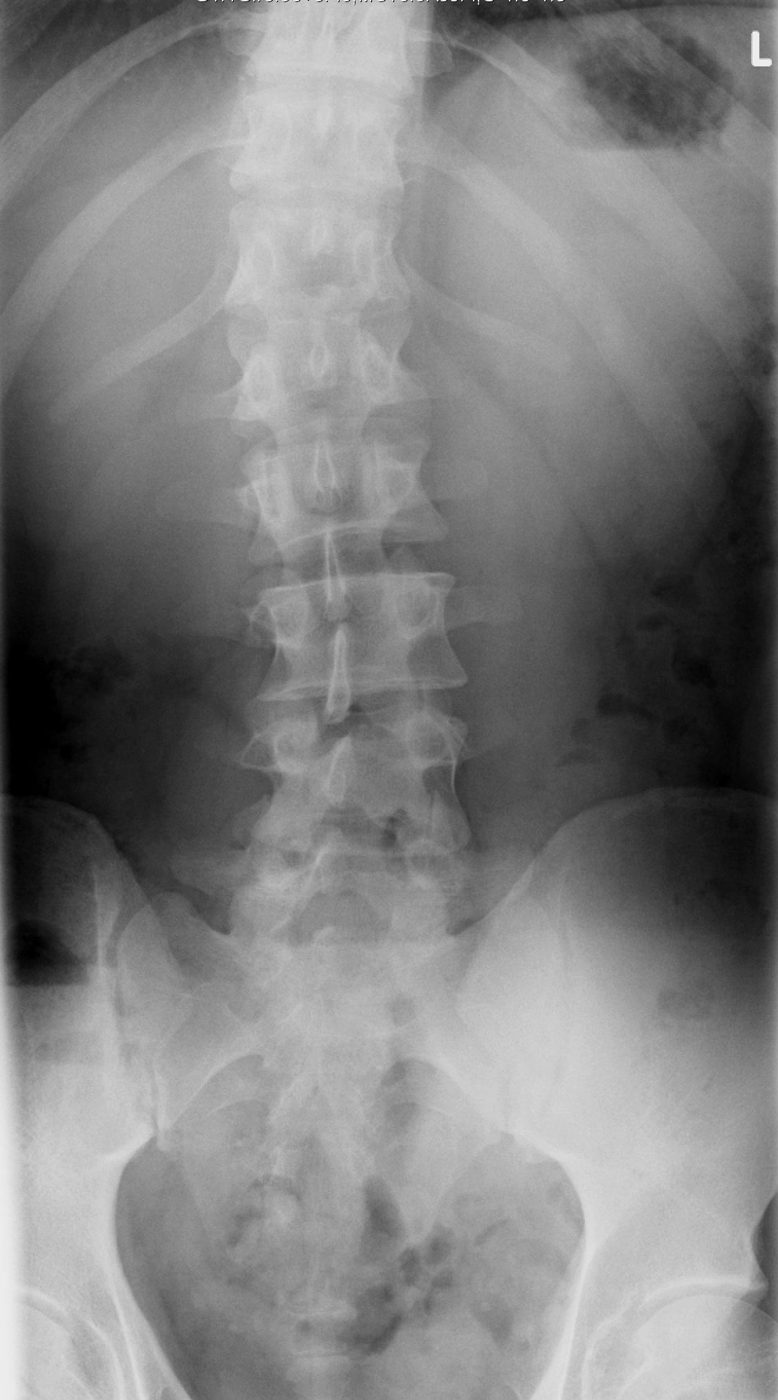
Image - Scoliosis, a lateral curvature of the spine. On forward flexion a structural scoliosis produces a characteristic rib hump, whereas a postural scoliosis corrects
SimpleMed original image, credit ‘SimpleMed original’
From the side, assess the normal sagittal curves. The spine normally has a gentle cervical lordosis, a thoracic kyphosis and a lumbar lordosis. A lordosis curves inwards (like the hollow of the lower back) and a kyphosis curves outwards (like the rounded upper back). Look for:
- Exaggerated thoracic kyphosis (hyperkyphosis), seen with osteoporotic wedge fractures in older people and with Scheuermann’s disease in adolescents. Scheuermann’s disease (also called Scheuermann’s kyphosis) is a developmental deformity of the spine.
- Exaggerated lumbar lordosis (hyperlordosis).
- Loss of the normal lumbar lordosis (a flattened lower back), which is characteristically seen in ankylosing spondylitis (a long-term inflammatory arthritis that mainly affects the spine and the joints between the spine and the pelvis) and in acute muscle spasm.
A fixed, stooped, ‘question-mark’ posture with loss of lumbar lordosis and an exaggerated thoracic kyphosis is the classic appearance of advanced ankylosing spondylitis.
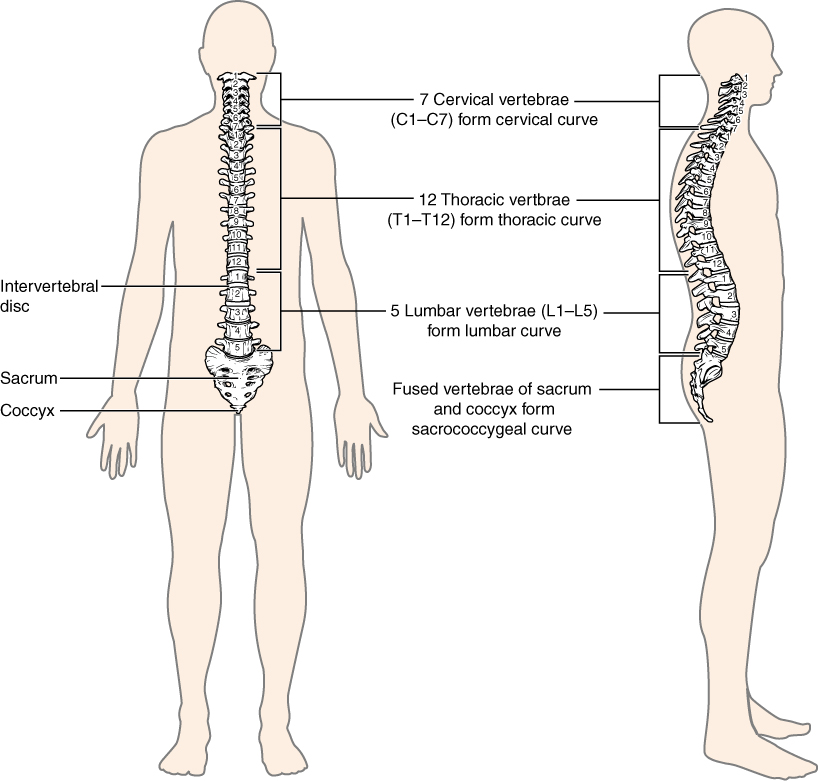
Image - The normal curvatures of the vertebral column: a cervical lordosis, a thoracic kyphosis and a lumbar lordosis. Recognising the normal sagittal profile makes abnormal curvatures easier to spot on inspection
Creative commons source by OpenStax College [CC BY 3.0 (https://creativecommons.org/licenses/by/3.0)]

Image - Hyperkyphosis, an exaggerated outward curvature of the thoracic spine. In older patients this is commonly due to osteoporotic vertebral wedge fractures
Creative commons source by Laboratoires Servier [CC BY-SA 3.0 (https://creativecommons.org/licenses/by-sa/3.0)]
Schober’s Test
Schober’s test is a more objective way of quantifying lumbar flexion, and is particularly useful when ankylosing spondylitis is suspected.
With the patient standing upright, identify the dimples of Venus (which overlie the posterior superior iliac spines), and mark the midline at this level. Make a second mark 10 cm above and a third mark 5 cm below this point, giving a starting distance of 15 cm between the upper and lower marks. Strictly, this three-mark version is the modified Schober’s test: the original test used only two marks, at the lumbosacral junction (where the lumbar spine meets the sacrum) and 10 cm above it.
Ask the patient to bend forwards as far as they comfortably can and measure the new distance between the upper and lower marks. In a normal spine, the distance should increase by more than 5 cm (i.e. to greater than 20 cm), reflecting normal segmental movement of the lumbar vertebrae as the spine flexes.
An increase of less than 5 cm indicates restricted lumbar flexion. This is a classic finding in ankylosing spondylitis, in which inflammation and progressive fusion of the spine reduce the ability of the vertebrae to move relative to one another.
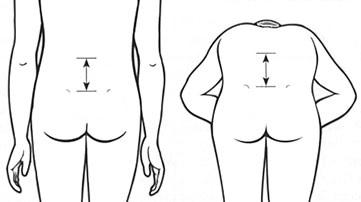
Image - Schober’s test. Marks are made above and below the lumbosacral junction and the increase in their separation on forward flexion is measured to quantify lumbar movement
Creative commons source by Nasch92 [CC BY-SA 4.0 (https://creativecommons.org/licenses/by-sa/4.0)]
Straight Leg Raise (Sciatic Nerve Stretch Test)
The straight leg raise, also known as the sciatic nerve stretch test or Lasègue’s test, is used to detect irritation of the lower lumbar and sacral nerve roots (typically L4, L5 and S1). The most common cause is a prolapsed intervertebral disc, in which the soft centre of a disc bulges out through its tougher outer ring and presses on a nerve root.
With the patient lying supine and the leg straight, slowly raise the leg by flexing at the hip while keeping the knee fully extended. This progressively stretches the sciatic nerve and its nerve roots. The test is positive if it reproduces the patient’s characteristic shooting pain radiating down the back of the leg (sciatica), usually between about 30° and 70° of hip flexion. Pain felt only in the back, or only at the very end of range, is less specific.
The finding can be confirmed with the sciatic stretch (Bragard’s) manoeuvre: at the angle that reproduces the pain, lower the leg slightly until the pain eases, then dorsiflex the foot. Because dorsiflexion further tensions the sciatic nerve, this reproduces the pain again if the nerve roots are genuinely irritated, helping to distinguish true nerve root pain from hamstring tightness.
A crossed straight leg raise, where raising the unaffected leg reproduces pain in the affected leg, is less sensitive but highly specific for a prolapsed disc. This means it misses about 7 in 10 people who do have a prolapsed disc, but it is positive in only about 1 in 10 people who do not have one.
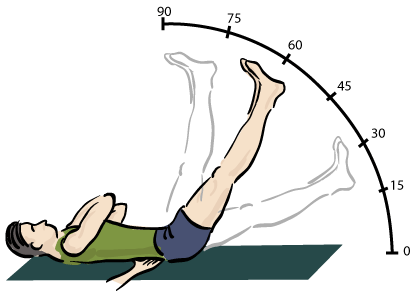
Image - The straight leg raise. The leg is raised with the knee extended, stretching the sciatic nerve roots; reproduction of radiating leg pain is a positive result
Creative commons source by Davidjr74 [CC0 1.0 (https://creativecommons.org/publicdomain/zero/1.0)]
Lower Limb Neurovascular Assessment
Because spinal pathology frequently affects the nerve roots or spinal cord, a focussed neurological assessment of the lower limbs is an essential part of the spine examination. You should assess:
- Tone: reduced tone suggests a lower motor neurone (nerve root) lesion, whereas increased tone (spasticity) suggests an upper motor neurone lesion such as cord compression.
- Power: tested in each myotome (the group of muscles supplied by one nerve root) and graded on the Medical Research Council (MRC) scale (0–5). Focal weakness helps localise the affected nerve root.
- Reflexes: the knee jerk (L3/L4) and ankle jerk (S1). Reflexes are typically reduced or absent in nerve root lesions, but brisk with an upgoing plantar response (the big toe moves upwards when the sole of the foot is stroked) in cord compression (myelopathy).
- Sensation: tested in each dermatome (the area of skin supplied by one nerve root) to map any sensory loss to a particular nerve root level.
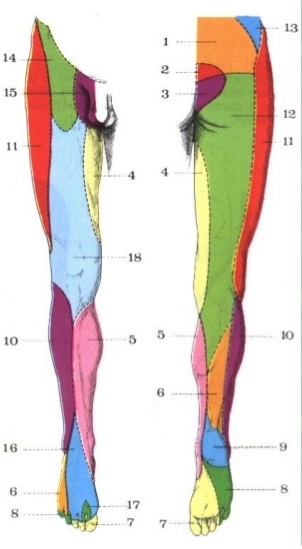
Image - The dermatomes of the lower limb. Mapping the distribution of any sensory loss to these dermatomes helps localise the affected nerve root, for example L4 over the medial shin, L5 over the dorsum (upper surface) of the foot and S1 over the lateral foot and sole
SimpleMed original image, credit ‘SimpleMed original’
Always check the peripheral pulses and capillary refill of the lower limbs as well. This is important because peripheral vascular disease can cause leg pain on walking that eases with rest (vascular claudication). This can mimic the neurogenic claudication of spinal stenosis (narrowing of the space around the spinal cord and nerve roots, which squeezes the nerves), so you need to tell the two apart.
In a patient with back or leg pain, be alert to cauda equina syndrome. This is compression of the cauda equina, the bundle of nerve roots that continues down inside the lower spine below the end of the spinal cord. Be concerned if any of the following is new (within the last 14 days) or getting worse:
- difficulty starting to pass urine, or reduced sensation of urine flowing
- altered sensation around the anus, the perineum (the skin between the genitals and the anus) or the genitals; the affected area may be small or as large as a ‘saddle’
- loss of the sensation that the rectum is full
- sexual dysfunction, such as being unable to achieve an erection or ejaculate, or loss of genital sensation (back pain with sexual dysfunction as the only other feature is unlikely to be cauda equina syndrome)
- severe or progressive neurological deficit of both legs, such as major weakness.
Arrange emergency assessment at a hospital with emergency MRI provision. Record the onset and progression of symptoms, the patient’s own report of sensation around the anus (perianal sensation), and the power and sensation in both legs, without delaying referral. Normal physical tests do not exclude cauda equina syndrome when concerning symptoms are present. Under the national suspected cauda equina syndrome pathway from GIRFT (Getting It Right First Time, an NHS England improvement programme), a digital rectal examination is not necessary; do not wait for one before referral or imaging. MRI and specialist assessment guide whether emergency decompression is required.
- 219