
During any examination in an OSCE it is important to understand the pathology and reasoning behind each of the signs and symptoms elicited, even if the patient being examined is ‘normal’. This article explains how to perform a respiratory examination and the key findings you should look for, showing you what each sign means and what conditions it may indicate.
Hand Examination
Pick up the patient’s hands and inspect them carefully, as they carry a surprising number of respiratory signs.
Look for tar staining of the fingers, a yellow-brown discolouration caused by the tar in cigarette smoke. It is a marker of smoking, which is the single biggest risk factor for COPD and lung cancer. (Note that nicotine itself is colourless – the staining is from tar.)
Inspect the nails for finger clubbing, in which there is soft-tissue swelling of the terminal phalanx and loss of the normal angle between the nail and nail fold. It can be confirmed with Schamroth’s window test: when the dorsal surfaces of two opposing fingers are placed together, a normal person has a small diamond-shaped window, which is obliterated in clubbing. The exact mechanism is not fully understood but is thought to involve megakaryocytes and platelet clumps bypassing the lungs and releasing growth factors in the fingertips. Respiratory causes include lung cancer, bronchiectasis, cystic fibrosis, interstitial lung disease and chronic suppurative conditions such as lung abscess and empyema.
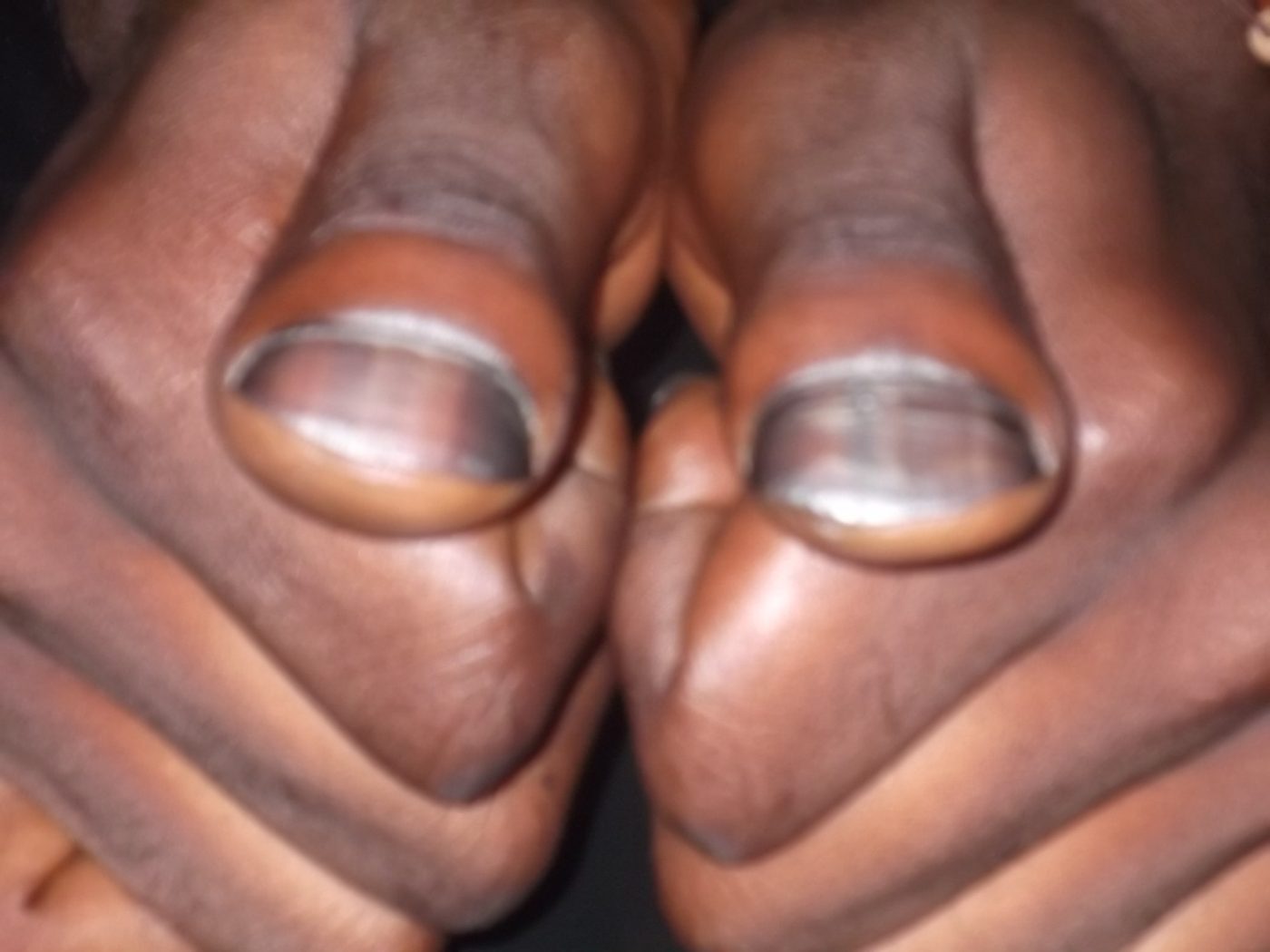
Image - Finger clubbing showing loss of the normal nail-bed angle. In a respiratory context this raises suspicion of lung cancer, bronchiectasis or interstitial lung disease
Creative commons source by Russellpa [CC BY-SA 3.0 (https://creativecommons.org/licenses/by-sa/3.0)]
Look at the skin of the hands and forearms. Thin, bruised skin may reflect long-term corticosteroid use in asthma, COPD or interstitial lung disease. Peripheral cyanosis – a bluish tinge confined to the fingertips – reflects sluggish peripheral perfusion rather than central hypoxaemia, although in respiratory failure the two often coexist.
Feel the temperature of the hands. Warm, well-perfused peripheries with a bounding pulse can be a sign of carbon dioxide retention, which causes peripheral vasodilatation.
With the arms outstretched, look first for a fine tremor. This is a rapid, low-amplitude shake most often caused by beta-2 agonist inhalers such as salbutamol, and its presence is a useful clue that the patient is being treated for asthma or COPD.
Then assess for asterixis (a ‘CO2 retention flap’) by asking the patient to hold their arms out straight with the wrists cocked back for around 30 seconds. A coarse, irregular flapping tremor is caused by the effect of hypercapnia (high blood CO2) on the brainstem, seen in type 2 respiratory failure. The same sign can occur in hepatic encephalopathy and uraemia, so it must be interpreted in context.
Face, Eyes and Mouth
Inspect the face generally. A plethoric appearance again suggests polycythaemia or CO2 retention. Look for the features of Cushing’s syndrome (a rounded ‘moon’ face), which may result from long-term oral steroids.
Look at the eyes for the triad of Horner’s syndrome – ptosis (drooping eyelid), miosis (constricted pupil) and anhidrosis (loss of sweating on that side of the face). Horner’s syndrome arises when the sympathetic chain is interrupted, and in a respiratory examination the classic cause is a Pancoast tumour at the lung apex compressing the sympathetic nerves. Pull down the lower eyelids to look for conjunctival pallor, a sign of anaemia, which may contribute to breathlessness.
Inspect the mouth and under the tongue for central cyanosis, seen as a bluish discolouration of the lips, tongue and oral mucosa. Because it affects the well-perfused central mucous membranes, it specifically indicates a low arterial oxygen saturation and is a more reliable marker of hypoxaemia than peripheral cyanosis. Also look for oral candidiasis (white plaques), which is common in patients using inhaled corticosteroids who do not rinse their mouth afterwards.
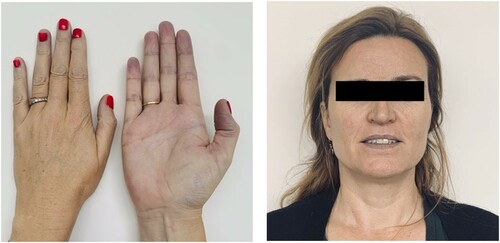
Image - Bluish discolouration of the lips (central cyanosis) and fingertips. Central cyanosis indicates hypoxaemia (a low arterial oxygen saturation)
Creative commons source by Göttgens et al. [CC BY-SA 4.0 (https://creativecommons.org/licenses/by-sa/4.0)]
Neck Examination
Assess the jugular venous pressure (JVP) with the patient at 45o and their head turned slightly to the left. The internal jugular vein lies between the two heads of the sternocleidomastoid, and the vertical height of its pulsation above the sternal angle estimates right atrial pressure. A raised JVP in a respiratory patient suggests cor pulmonale – right heart failure caused by chronic lung disease. Chronic hypoxia causes pulmonary vasoconstriction and a rise in pulmonary arterial pressure, which the right ventricle must work against; over time it fails, and the back-pressure raises the JVP. A fixed, non-pulsatile, raised JVP that does not change with respiration suggests superior vena cava obstruction, classically caused by a mediastinal tumour.
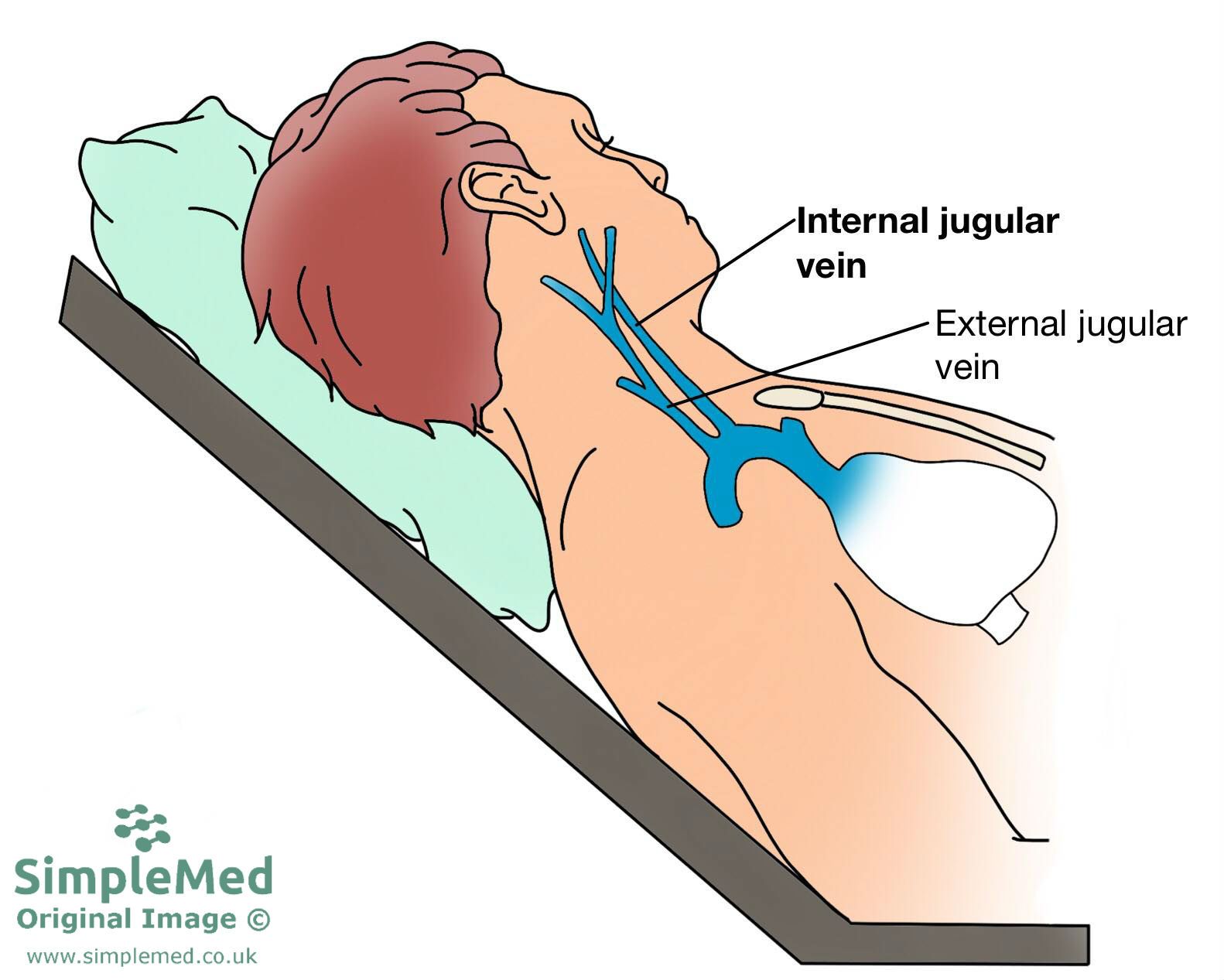
Image - The jugular venous pulse is measured vertically above the sternal angle with the patient reclined at 45 degrees. A raised JVP in a respiratory patient points towards cor pulmonale
SimpleMed original
Palpate the position of the trachea by gently placing a finger either side of it in the suprasternal notch (warn the patient that this is briefly uncomfortable). The trachea should sit centrally. Deviation away from a lesion occurs when something pushes the mediastinum across, such as a large pleural effusion or a tension pneumothorax. Deviation towards a lesion occurs when volume is lost on that side, such as in lobar collapse or a pneumonectomy. Also assess the cricosternal distance (normally three to four finger-breadths); a reduced distance reflects lung hyperinflation in COPD.
Palpate the lymph nodes of the neck from behind, including the submental, submandibular, pre- and post-auricular, occipital, cervical chains and supraclavicular nodes. Lymphadenopathy may indicate infection or malignancy; the supraclavicular nodes are of particular concern, with the left one (Virchow’s node) classically reflecting intrathoracic or abdominal malignancy.
Chest Auscultation
Auscultate with the diaphragm of the stethoscope, comparing both sides at each level and asking the patient to take steady breaths in and out through an open mouth. First characterise the breath sounds:
- Vesicular breath sounds are the normal soft, rustling sounds of air moving through healthy lung, louder on inspiration with no gap before expiration.
- Bronchial breathing is harsh and blowing, with inspiration and expiration of equal length and an audible gap between them, similar to listening over the trachea. It indicates consolidation, where solid lung transmits the central airway sounds directly to the chest wall.
- Reduced or absent breath sounds occur when air, fluid or collapsed lung prevents sound reaching the stethoscope, as in a pleural effusion or pneumothorax.
Then listen for added sounds:
- Wheeze – a continuous, musical, whistling sound, usually loudest on expiration, produced by air passing through narrowed airways. It is typical of asthma and COPD. A widespread polyphonic wheeze suggests diffuse airway narrowing, whereas a fixed monophonic wheeze may indicate localised obstruction by a tumour or foreign body.
- Crackles – discontinuous popping sounds caused by the sudden reopening of small airways. Fine, late-inspiratory crackles suggest pulmonary oedema or interstitial lung disease, while coarse crackles suggest pneumonia or bronchiectasis. Crackles that clear on coughing are usually not significant.
- Pleural rub – a creaking, ‘leather-on-leather’ sound caused by inflamed pleural surfaces rubbing together, heard in pleurisy or pulmonary embolism.
Finally, assess vocal resonance by listening over the chest while the patient repeats ‘ninety-nine’. The findings mirror tactile vocal fremitus: increased resonance over consolidation and reduced resonance over an effusion or pneumothorax. Over consolidation, whispered words can become abnormally clear (whispering pectoriloquy).
It is worth memorising how the palpation, percussion and auscultation findings cluster together, as recognising the pattern lets you reach a diagnosis quickly in an OSCE. Consolidation gives reduced expansion, dull percussion, increased fremitus and resonance, bronchial breathing and crackles. A pleural effusion gives reduced expansion, stony dull percussion, reduced fremitus and resonance and reduced breath sounds. A pneumothorax gives reduced expansion, hyper-resonant percussion, reduced fremitus and reduced breath sounds. Lobar collapse gives reduced expansion, dull percussion and reduced breath sounds, often with the trachea pulled towards the affected side.
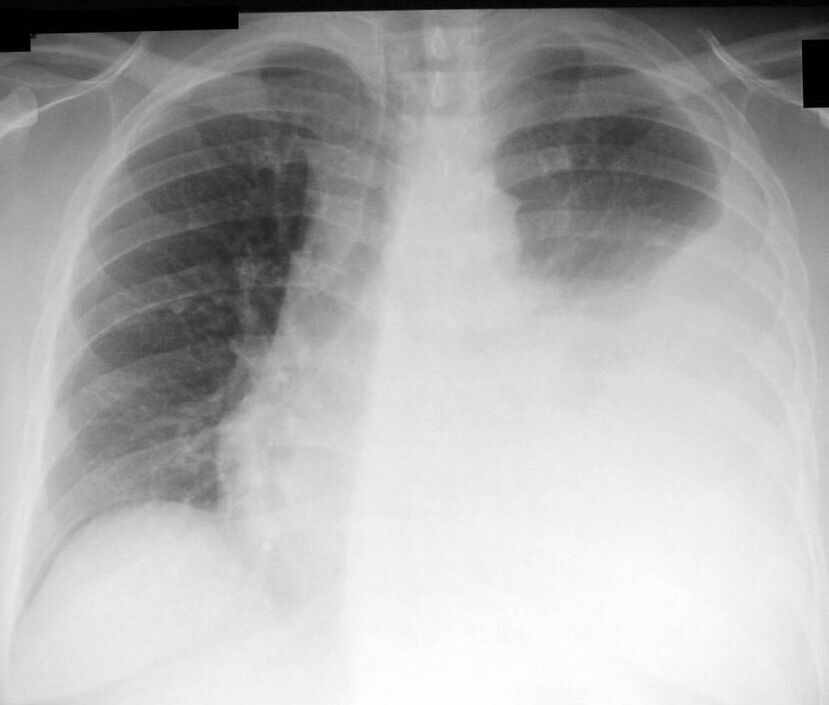
Image - Chest X-ray of a large left-sided pleural effusion. On examination this would produce a stony dull percussion note, reduced breath sounds and reduced vocal resonance over the effusion
Creative commons source by Clinical Cases [CC BY-SA 2.5 (https://creativecommons.org/licenses/by-sa/2.5)]
Posterior Chest Examination
Ask the patient to sit forward and fold their arms across the chest, which rotates the scapulae out of the way and gives better access to the lung fields. The back of the chest is where most clinically significant findings are detected, because the lung bases lie posteriorly.
Repeat the full sequence on the back: inspect for scars and deformity, assess chest expansion, percuss all zones comparing side to side, assess tactile vocal fremitus or vocal resonance, and auscultate the breath sounds and any added sounds. Take care to reach the lung bases and the axillae, as basal crackles of pulmonary oedema, fibrosis or infection are easily missed if examination stops too high.
While the patient is sitting forward, press on the sacrum and palpate the ankles for peripheral oedema. Pitting oedema in a respiratory patient is an important sign of cor pulmonale, where right heart failure secondary to chronic lung disease causes fluid to accumulate in the dependent tissues.
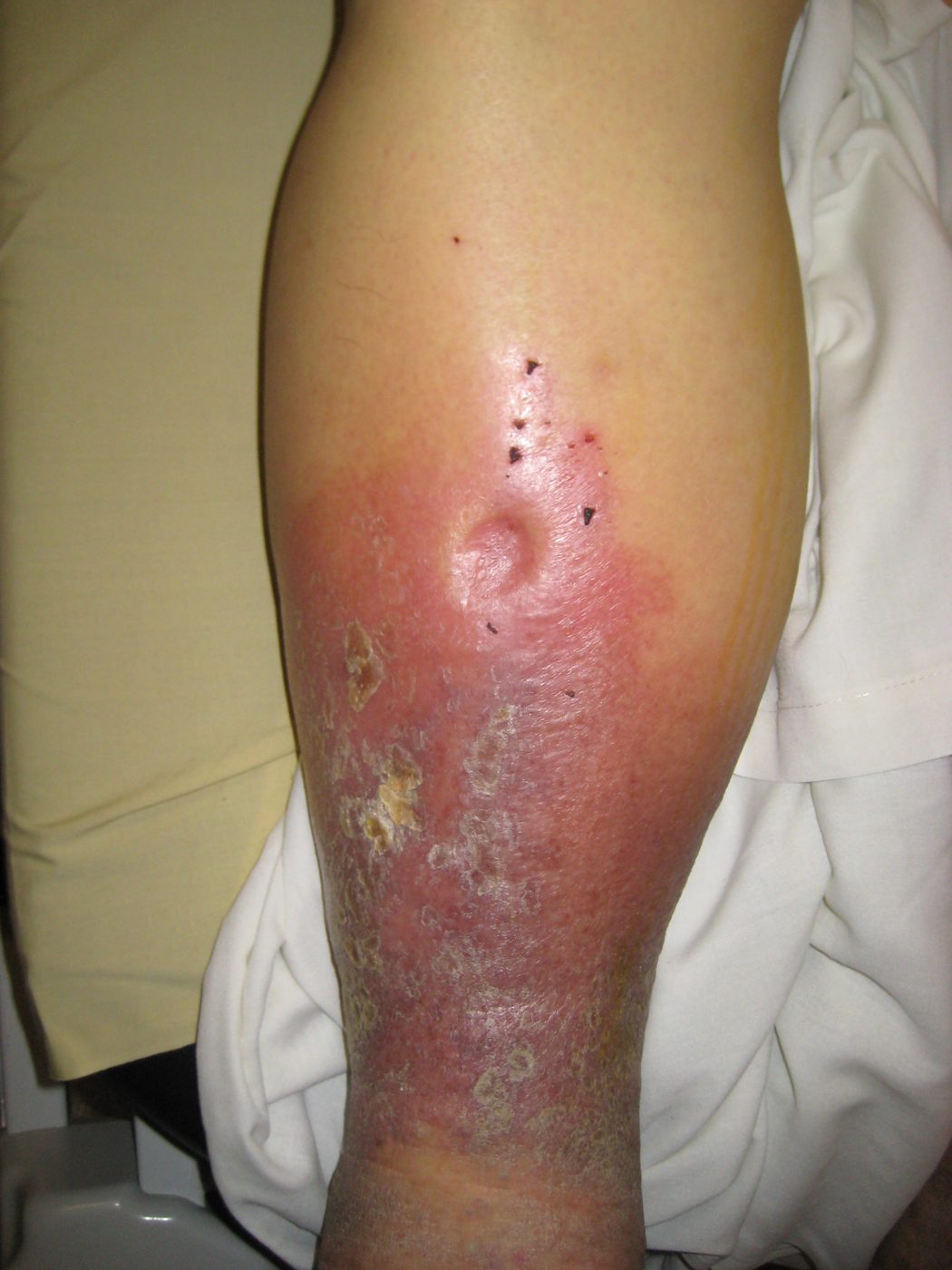
Image - Pitting oedema, where firm pressure leaves a lasting indentation. In a breathless patient this suggests fluid overload from cor pulmonale
SimpleMed original
- 311