
Rectal (PR) OSCE Examination
During any examination in an OSCE it is important to understand the pathology and reasoning behind each of the signs and symptoms elicited, even if the patient being examined is ‘normal’. This article explains how to perform a rectal (PR) examination and the key findings you should look for, showing you what each sign means and what conditions it may indicate.
The rectal examination – written as ‘PR’ for per rectum, and often called a digital rectal examination (DRE) – allows you to assess the perianal skin, anal canal, rectum and, in men, the prostate gland. It is an intimate examination, so a sensitive, professional approach and a chaperone are essential throughout.
Introduction
Wash your hands and don a pair of non-sterile gloves and an apron. Good hand hygiene reduces the risk of transmitting infection during this intimate examination.
Introduce yourself to the patient, giving your name and grade e.g. 3rd year medical student/junior doctor/registrar.
Confirm the patient’s details taking 3 points of identification; usually full name, date of birth and NHS/hospital number.
Briefly explain the examination in clear, jargon-free language – that you need to examine the back passage by gently inserting a gloved, lubricated finger into the anus to feel for any abnormalities. Reassure the patient that it may feel uncomfortable but should not be painful, and that they can ask you to stop at any time. Obtain verbal consent.
Offer and clearly document a chaperone. A chaperone is considered essential for an intimate examination – it protects both patient and examiner, provides reassurance, and is a key marking point in any OSCE.
Ask the patient to remove their lower clothing and underwear in privacy, and to lie on the couch in the left lateral position with their knees drawn up towards their chest. This position relaxes the gluteal muscles and brings the rectum and prostate within easy reach of the examining finger. Cover the patient with a sheet until you are ready to begin to preserve their dignity.
Before starting, ask whether the patient has any pain, particularly around the back passage, as severe perianal pain may make the examination intolerable (for example with an anal fissure).
General Inspection
Begin with a brief general inspection of the patient and their surroundings. Note whether the patient appears comfortable or is in obvious pain or distress, which may suggest an acutely painful condition such as an anal fissure, perianal abscess or thrombosed haemorrhoid.
Look for signs that hint at the underlying reason for the examination. Pallor may suggest anaemia – relevant if the patient is being investigated for gastrointestinal blood loss. A cachectic appearance (significant weight loss and muscle wasting) raises concern about an underlying malignancy, such as colorectal or prostate cancer.
Scan the bedside for relevant objects such as stoma bags, incontinence pads, catheters or a commode, which can give clues about bowel or urinary symptoms. Ensure the equipment you need is to hand: gloves, water-based lubricating jelly, gauze or tissue, and a clinical waste bin.
Inspection of the Perianal Region
With the patient in the left lateral position, gently lift the upper buttock to expose the anus and perianal skin. Inspect carefully in good light before touching the patient. Many important diagnoses are made on inspection alone.
Look for the following:
- Skin tags – small flaps of skin around the anus. They are often harmless but may be associated with previous haemorrhoids or, when multiple and florid, with Crohn’s disease.
- External haemorrhoids – swollen vascular cushions arising below the dentate line, where the lining carries somatic nerves, so they tend to be felt and seen as a lump at the anal margin. A thrombosed haemorrhoid appears as a tense, dark, exquisitely tender lump, caused by clot within the haemorrhoidal vessel.
- Anal fissure – a tear in the lining of the anal canal, most often in the posterior midline. Fissures usually arise from the passage of hard stool and are intensely painful due to spasm of the internal anal sphincter; this pain may make digital examination impossible, in which case it should not be forced.
- Fistula or abscess – an external fistula opening discharging pus, or a hot, red, fluctuant swelling indicating a perianal abscess. Anal fistulae are abnormal tracts between the anal canal and the skin and are again strongly associated with Crohn’s disease.
- Rectal prolapse – a protruding mass of rectal mucosa, classically with concentric rings, that may appear or worsen when the patient bears down.
- Anal warts (condylomata acuminata) – fleshy, often clustered lesions around the anal margin, caused by human papillomavirus and indicating a sexually transmitted infection.
- Excoriation, rashes or discharge – suggesting pruritus ani, dermatological conditions or infection.
- Blood, mucus or faecal soiling – soiling may indicate poor sphincter control or overflow incontinence secondary to constipation.
Now ask the patient to bear down or cough and watch the anus, as some abnormalities only declare themselves under raised intra-abdominal pressure:
- Rectal prolapse may protrude or become more obvious on straining, confirming the diagnosis if it was not already apparent at rest.
- Internal haemorrhoids – these originate above the dentate line and are covered by insensate rectal mucosa, so they are usually painless and are not seen at rest. On straining they may bulge into view as soft, bluish, mucosa-covered swellings, and they are a common cause of painless, bright-red bleeding on defecation.
If inflammatory bowel disease is the reason for examination, the perianal findings can help distinguish the subtypes. Crohn’s disease can affect anywhere from mouth to anus and characteristically produces perianal disease – multiple skin tags, fistulae and abscesses – whereas ulcerative colitis is confined to the colon and rectum and more typically presents with bloody, mucoid stool rather than perianal complications.
It can be helpful to describe the position of any abnormality using a clock face, with 12 o’clock anterior (towards the genitals) and 6 o’clock posterior (towards the coccyx), so that findings are documented unambiguously.
Digital Examination: Insertion and Anal Tone
Once external inspection is complete, warn the patient that you are about to begin the internal examination and that they will feel some pressure. Apply a generous amount of water-based lubricant to your gloved index finger.
Place the pulp of your index finger flat against the anal margin and apply gentle, steady pressure, allowing the sphincter to relax before slowly advancing the finger into the rectum. Pushing directly inwards against a closed sphincter is uncomfortable and counterproductive. Encouraging the patient to breathe steadily and relax can ease passage of the finger.
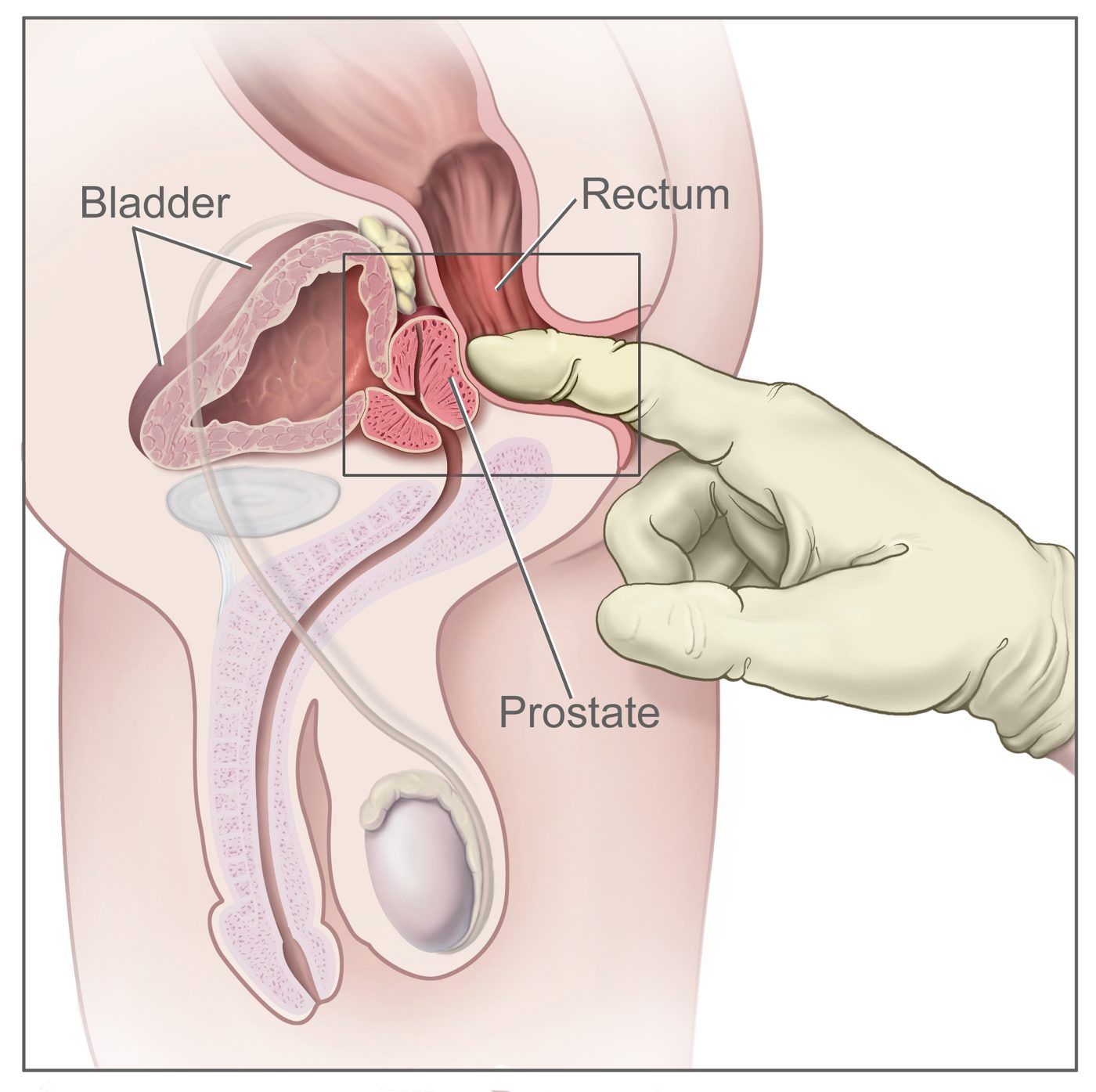
Image - A digital rectal (PR) examination. The gloved, lubricated finger is inserted into the rectum to palpate the rectal walls and, in men, the prostate gland on the anterior wall
Creative commons source by National Cancer Institute [Public domain]
As you insert your finger, assess the resting anal tone – the baseline squeeze of the internal anal sphincter around your finger.
- Reduced tone may indicate neurological pathology. In the context of back pain, leg weakness or urinary symptoms, a lax anus is a red-flag sign of cauda equina syndrome, which requires urgent imaging and surgical referral. Reduced tone may also follow obstetric injury, previous anorectal surgery or chronic neurological disease.
- Increased tone or spasm may accompany a painful anal fissure or anxiety.
Next, ask the patient to squeeze down on your finger as if holding in wind, to assess the voluntary contraction of the external anal sphincter. A weak voluntary squeeze adds further evidence of neurological or sphincter dysfunction.
If cauda equina syndrome is suspected, also test perianal (saddle) sensation by lightly touching the skin around the anus on both sides. Reduced perianal sensation, together with reduced anal tone, is a key red flag pointing to compression of the sacral nerve roots and mandates urgent MRI and surgical referral.
Palpation of the Rectal Walls
With your finger fully inserted, systematically rotate it through a full 360° to palpate the entire circumference of the rectal wall. Move slowly and methodically so that no area is missed.
Feel for:
- Masses – a hard, irregular, or ulcerated mass may represent a rectal carcinoma. Note its position (using the clock face), size, and whether it is fixed or mobile, as fixed masses suggest more advanced local invasion.
- Polyps – smooth, often pedunculated lesions that may be benign but can harbour malignancy.
- Tenderness – localised tenderness may indicate inflammation, an abscess or, anteriorly in women, gynaecological pathology.
- Faecal loading – a rectum full of hard stool supports a diagnosis of constipation and faecal impaction, an important and easily missed cause of overflow diarrhoea and confusion in elderly patients.
An empty, ballooned rectum in a patient who feels they need to defecate but cannot is a recognised sign of bowel obstruction.
Palpation of the Prostate (in Males)
In male patients, rotate your finger to face anteriorly (towards the front of the body, at the 12 o’clock position) to palpate the prostate gland, which lies just beyond the anterior rectal wall. Assess its size, shape, consistency, symmetry, the presence of the central groove, and any tenderness or nodules.
A normal prostate is approximately the size of a walnut, smooth, symmetrical, with a firm consistency similar to the tip of the nose, and a palpable central (median) sulcus dividing the two lateral lobes.
Abnormal findings and what they suggest:
- Benign prostatic hyperplasia (BPH) – a smoothly enlarged, symmetrical, rubbery and non-tender prostate. As the gland enlarges, the central sulcus may become less palpable. BPH commonly causes lower urinary tract symptoms such as hesitancy and poor stream.
- Prostate cancer – a hard, irregular or nodular prostate, often asymmetrical with loss of the central sulcus. The malignant gland may feel craggy and, in advanced disease, fixed to surrounding tissues. Any such finding warrants urgent referral and further investigation, including PSA and prostate MRI.
- Prostatitis – an acutely tender, boggy, warm and swollen prostate. In suspected acute bacterial prostatitis, vigorous prostatic massage should be avoided as it may precipitate bacteraemia.
It is important to remember that the DRE is not a sensitive test for early prostate cancer – a normal-feeling prostate does not exclude malignancy – but it remains valuable for assessing gland size, consistency and obvious abnormality, and for guiding further investigation.
Withdrawal and Inspection of the Glove
Slowly withdraw your finger and, before removing your glove, inspect the gloved fingertip carefully. The appearance of any material on the glove provides valuable diagnostic information:
- Fresh red blood – suggests a lower gastrointestinal source such as haemorrhoids, an anal fissure, or a rectal or colorectal tumour.
- Melaena – black, tarry, offensive-smelling stool indicating digested blood from an upper gastrointestinal bleed (for example a peptic ulcer), as the blood has been altered by passage through the gut.
- Mucus – may be seen in inflammatory bowel disease, infection, or with certain colorectal tumours.
- Pale, bulky, greasy stool (steatorrhoea) – suggests fat malabsorption, for example in pancreatic insufficiency or coeliac disease.
- Hard stool – supports a diagnosis of constipation.
Wipe away any residual lubricant from the perianal skin with the gauze or tissue to leave the patient clean and comfortable.
Completing the Examination
Help the patient to clean themselves if needed, restore their dignity, and offer them privacy to get dressed.
Dispose of your gloves, apron and used equipment into the clinical waste bin, and wash your hands.
Thank the patient.
Document the examination clearly in the notes, including the indication, the findings, and the name of the chaperone present.
Summarise your findings.
To complete the examination, suggest performing a full abdominal examination, taking a focused history, and, where appropriate, arranging further investigations such as blood tests (including full blood count and haematinics for anaemia, renal function, and, in men, a PSA), stool tests (including faecal immunochemical testing), and endoscopic or radiological assessment such as flexible sigmoidoscopy, colonoscopy or CT of the abdomen and pelvis. In men with an abnormal prostate, a prostate MRI and urology referral would be indicated.
- 3