
During any examination in an OSCE it is important to understand the pathology and reasoning behind each of the signs and symptoms elicited, even if the patient being examined is ‘normal’. This article explains how to perform a peripheral vascular (arterial) examination and the key findings you should look for, showing you what each sign means and what conditions it may indicate.
The peripheral vascular examination is principally an assessment of the arterial supply to the limbs. The overwhelming majority of findings relate to peripheral arterial disease (PAD), which is caused by atherosclerosis narrowing the arteries and reducing perfusion to the tissues. Many of the risk factors for PAD – smoking, diabetes, hypertension and hyperlipidaemia – are shared with coronary and cerebrovascular disease, so a patient with PAD should always prompt you to think about their wider cardiovascular risk.
Lower Limb Inspection
The lower limbs are the focus of the examination. Inspect both legs together so that you can directly compare one side with the other, looking at the whole limb from the groin down to the toes, and remembering to inspect between the toes and the soles of the feet, where ulcers are easily missed.
Look at the colour of the limbs. Pallor (pale skin) suggests poor arterial perfusion. Ischaemic rubor is a dusky, red-purple discolouration that develops when the leg is hanging down (dependent); it occurs because chronic ischaemia causes loss of capillary tone, so the dilated capillaries fill with stagnant, deoxygenated blood.
Look for trophic skin changes caused by chronically reduced perfusion. These include hair loss over the legs and feet, shiny, thin skin, and brittle, slow-growing nails. The tissues are simply not receiving enough blood to maintain their normal structures.
Inspect carefully for arterial ulcers. These are typically found at the most peripheral and pressure-prone sites – the tips of the toes, the heels and over bony prominences such as the lateral malleolus. They are classically small, sharply defined with a ‘punched-out’ appearance, deep, and painful. This contrasts with venous ulcers, which are usually larger, shallow and found around the medial malleolus (the ‘gaiter’ area).
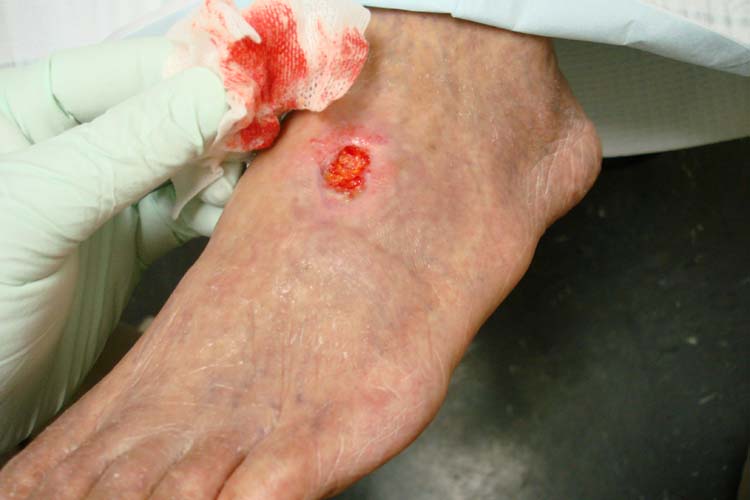
Image - An arterial ulcer in a patient with peripheral vascular disease. Arterial ulcers are typically deep, ‘punched-out’ and painful, and occur at the most peripheral, pressure-bearing sites
Creative commons source by Jonathan Moore [CC BY 3.0 (https://creativecommons.org/licenses/by/3.0)]
Look for gangrene, which is tissue necrosis (death) due to a critical lack of perfusion. Dry gangrene appears as black, mummified, dry tissue, most often at the toes, and represents end-stage critical limb ischaemia. Note any missing toes or limbs, which indicate previous amputation for critical ischaemia or diabetic foot disease. Finally, look for any surgical scars – for example a long scar down the inner thigh and leg may indicate a previous bypass graft, and a scar in the groin or abdomen may suggest previous vascular surgery.
Lower Limb Pulses
Palpate the lower limb pulses systematically, always working from proximal to distal. This allows you to assess and compare the arterial inflow into each leg and to localise the level of any disease – pulses will be diminished or absent below the level of an obstruction.
- Femoral pulse – palpated at the mid-inguinal point, halfway between the anterior superior iliac spine and the pubic symphysis. This assesses inflow from the aorto-iliac segment.
- Popliteal pulse – felt deep in the popliteal fossa behind the knee, with the knee slightly flexed and relaxed, using the fingertips of both hands to press the artery against the back of the tibia. It is normally difficult to feel even in healthy people, so a prominent or easily palpable popliteal pulse should raise suspicion of a popliteal aneurysm (a pulsatile mass behind the knee). Both popliteal fossae should be examined, as popliteal aneurysms are frequently bilateral and may co-exist with an abdominal aortic aneurysm.
- Posterior tibial pulse – felt just behind and below the medial malleolus.
- Dorsalis pedis pulse – felt on the dorsum of the foot, lateral to the extensor hallucis longus tendon.

Image - The posterior tibial pulse is palpated just behind and below the medial malleolus (the bony prominence on the inner ankle)
SimpleMed original

Image - The dorsalis pedis pulse is felt on the dorsum of the foot, lateral to the tendon of extensor hallucis longus
SimpleMed original
Always compare each pulse with the same pulse on the opposite leg. The absence of one or more of these pulses is a key sign of peripheral arterial disease, and the level at which pulses disappear helps localise the disease – for example an absent femoral pulse points to aorto-iliac disease, whereas present femoral but absent foot pulses suggest more distal (femoro-popliteal) disease. If a foot pulse cannot be felt, state that you would confirm whether flow is present using a hand-held Doppler. Note also that the dorsalis pedis pulse is congenitally absent in a small proportion of healthy individuals, so it should always be interpreted alongside the other findings.
Palpate the femoral and radial pulses simultaneously to assess for radio-femoral delay. In a healthy person these pulses are felt at the same time. A delay between them suggests coarctation of the aorta, where narrowing of the aorta delays blood flow to the lower body.
- 237