
Rash and Non-Pigmented Skin Lesion OSCE Examination
During any examination in an OSCE it is important to understand the pathology and reasoning behind each of the signs and symptoms elicited, even if the patient being examined is ‘normal’. This article explains how to perform a rash and non-pigmented skin lesion examination and the key findings you should look for, showing you what each sign means and what conditions it may indicate.
Unlike the examination of a pigmented lesion (where the priority is to exclude melanoma), this examination is about describing an inflammatory rash or a non-pigmented lesion accurately and methodically. A clear, systematic description of site, distribution, morphology and palpation findings is often enough to reach a working diagnosis, so the discipline of describing what you see is just as important as the diagnosis itself.
Introduction
Wash your hands using alcohol gel or soap and water before approaching the patient.
Introduce yourself to the patient and ensure to mention your grade e.g. 3rd year medical student/junior doctor/consultant.
Confirm the patient’s details taking 3 points of identification usually; full name, date of birth and NHS/hospital number.
Obtain consent for the examination, ensuring to explain what the examination will entail. Explain that you would like to look at and gently feel the affected skin, and that you may need to examine other areas such as the nails, scalp and other skin folds. Offer a chaperone, particularly if examination of intimate or sensitive areas may be required.
Ask the patient if the area is painful or itchy before you begin, so that you can be gentle and avoid causing discomfort.
Expose the affected area adequately while maintaining the patient’s dignity. Remember that a localised rash may be part of a more widespread condition, so be prepared to inspect the whole skin surface in a private, well-lit environment. Good natural lighting is essential, as artificial light can alter the apparent colour of a lesion.
General Inspection
Begin by standing back and observing the patient as a whole. A skin condition is frequently the visible part of a systemic disease, so a general inspection can provide valuable diagnostic clues before you focus on a single lesion.
Assess whether the patient appears comfortable or whether they are visibly scratching or distressed, which suggests an intensely itchy (pruritic) condition such as eczema, scabies or urticaria. Look for signs of being systemically unwell – a patient who is febrile and unwell with a widespread rash may have a serious condition such as a drug reaction, erythroderma or a skin infection.
Look around the bedside for clues, such as emollients, topical steroid tubes or bandages/dressings, which indicate an ongoing skin condition and its current treatment.
Note the patient’s overall skin type and any obvious widespread changes such as generalised redness (erythroderma, defined as erythema affecting more than 90% of the body surface), which is a dermatological emergency due to the risks of fluid loss, hypothermia and infection.
Close Inspection – Site, Number and Distribution
Move in to inspect the affected skin closely. Begin by describing the site and the number of lesions – whether there is a solitary lesion, a few discrete lesions, or a widespread rash made up of many lesions – and note any surrounding skin changes such as scratch marks, scaling or normal skin in between (the latter described as ‘discrete’).
The distribution of a rash is one of the most useful diagnostic clues, as many conditions have characteristic patterns:
- Extensor surfaces (elbows, knees, scalp, lower back) – classically affected in psoriasis.
- Flexural surfaces (antecubital and popliteal fossae, neck, wrists) – the typical distribution of atopic eczema in older children and adults.
- Acral (the hands and feet, and sometimes the mouth) – a distal pattern seen in hand, foot and mouth disease and in some forms of eczema and palmoplantar pustulosis.
- Follicular – lesions centred on hair follicles in sebaceous-gland-rich areas (face, chest, upper back), as seen in acne and folliculitis.
- Photosensitive (sun-exposed) areas (face, neck, dorsum of hands) – suggests a photosensitive eruption, a drug reaction, or systemic/cutaneous lupus erythematosus.
- Dermatomal – lesions confined to a single dermatome that do not cross the midline are characteristic of shingles (herpes zoster), reflecting reactivation of varicella zoster virus within a single sensory ganglion.
- Symmetrical vs asymmetrical – a symmetrical, bilateral rash points towards an endogenous or systemic cause, whereas an asymmetrical or unilateral eruption suggests an exogenous cause such as contact dermatitis or infection.
Note whether the lesions follow lines of trauma or scratching. The development of new lesions along a scratch or scar is called the Koebner phenomenon and is seen in psoriasis, lichen planus and vitiligo.
Close Inspection – Size, Shape, Colour and Margin
For an individual lesion, describe its size (measured in millimetres or centimetres rather than compared to fruit), its shape, its colour and the nature of its margin (border). A useful mnemonic for structuring your description of any lesion in the exam is SCAM – Size, Colour, Associated secondary change (such as scale, crust or excoriation) and Morphology – which ensures you cover the core descriptive features before moving on to configuration and palpation.
The colour of non-pigmented lesions carries useful information. Erythema (redness) reflects increased blood flow due to inflammation or vasodilation. A silvery-white scale overlying erythematous plaques is characteristic of psoriasis, caused by hyperproliferation of keratinocytes and retention of nuclei within the stratum corneum (parakeratosis). A violaceous (purple) colour is suggestive of lichen planus.
The margin helps distinguish between conditions. A well-demarcated border with a clear edge between affected and normal skin is typical of psoriasis, whereas the ill-defined border of eczema blends gradually into surrounding skin, reflecting the diffuse nature of the inflammation.
It is important to assess whether erythema blanches on pressure. Press gently on the redness (a glass slide can be used) and observe whether it fades. Blanching erythema indicates that blood is contained within intact, dilated vessels (as in most inflammatory rashes), whereas a non-blanching rash indicates that blood has leaked out of the vessels into the skin – purpura. A non-blanching purpuric rash in an unwell, febrile patient is a red-flag sign that must prompt urgent consideration of meningococcal sepsis.
Morphology of the Lesion
Describing the morphology – the form and structure of the lesion – using the correct terminology is a key skill in this examination. Primary lesions arise directly from the disease process, while secondary lesions result from the evolution of primary lesions or from external factors such as scratching.
Common primary lesions include:
- Macule – a flat area of altered colour less than 1cm in diameter (a larger flat lesion is a patch).
- Papule – a raised lesion less than 1cm in diameter (a larger raised lesion is a nodule).
- Plaque – a raised, flat-topped lesion greater than 1cm, as seen in psoriasis.
- Vesicle – a small fluid-filled blister less than 1cm (a larger blister is a bulla), seen in conditions such as eczema, herpes infections and bullous disorders.
- Pustule – a pus-filled lesion, which may be infective or sterile (as in pustular psoriasis).
- Wheal – a transient, raised, itchy area of dermal oedema seen in urticaria, caused by histamine release leading to vascular leakage into the dermis. Wheals classically come and go within 24 hours.
Common secondary lesions include scale (accumulated keratin), crust (dried exudate), excoriation (scratch marks), lichenification (thickened skin with exaggerated markings from chronic rubbing) and fissures (linear cracks). Their presence helps gauge the chronicity of a condition – lichenification, for example, indicates long-standing scratching as in chronic eczema.
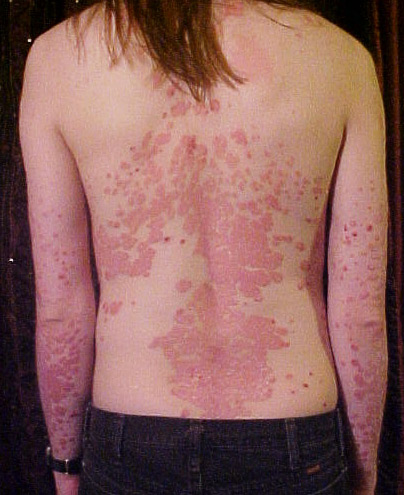
Image - Well-demarcated, erythematous plaques with silvery scale on the back, typical of chronic plaque psoriasis
Creative commons source by Marnanel [CC BY-SA 3.0 (https://creativecommons.org/licenses/by-sa/3.0)]
Configuration and Arrangement
When multiple lesions are present, describe how they are arranged in relation to one another, as the pattern often points to a specific diagnosis:
- Discoid (nummular) – coin-shaped, round lesions, as seen in discoid eczema.
- Annular – ring-shaped, with an active edge and central clearing. This is classically seen in fungal infections such as tinea (ringworm), where the fungus spreads outwards leaving healing skin behind.
- Linear – arranged in a line, which may reflect the Koebner phenomenon or external contact (e.g. a plant brushing the skin in contact dermatitis).
- Target (targetoid) – concentric rings of colour, characteristic of erythema multiforme.
- Grouped (herpetiform) – clustered vesicles or papules on an erythematous base, as seen in herpes simplex and dermatitis herpetiformis.
- Serpiginous – a wavy, snake-like track, classically left by the larva of cutaneous larva migrans.
- Reticulate – a net-like or lacy pattern.
- Confluent – individual lesions merging together into larger areas.
Noting the configuration alongside the distribution and morphology allows you to build a precise verbal description, which is the cornerstone of dermatological diagnosis and communication.

Image - Urticaria, showing raised wheals of dermal oedema caused by histamine release; these lesions are transient and intensely itchy
Public Domain Source George Henry Fox [Public domain]
Palpation
Before touching the skin, ask again about pain and don gloves if there is any risk that the lesion is infective or likely to expose you to bodily fluids such as blood or pus. Palpation provides information that cannot be obtained by inspection alone.
Assess the following:
- Surface texture – note whether the lesion feels smooth or rough. A rough, scaly surface (e.g. a psoriatic plaque) reflects an abnormal, thickened stratum corneum.
- Elevation – confirm by touch whether the lesion is flat, raised above the skin, or depressed below it, which can be difficult to judge by sight alone.
- Consistency – note whether the lesion feels soft, firm or hard. A firm or indurated lesion suggests dermal involvement.
- Fluctuance – a fluctuant (boggy, fluid-filled) swelling that transmits a wave between two fingers suggests a collection of fluid or pus, as in an abscess.
- Temperature – use the back of your hand to compare the lesion with surrounding skin. Warmth indicates increased blood flow due to active inflammation or infection (e.g. cellulitis or an abscess).
- Tenderness – gentle pressure helps identify a painful, inflamed or infected lesion.
- Mobility – assess whether a lesion is freely mobile over deeper structures or tethered/fixed, which has implications when considering deeper or malignant pathology.
If a fluid-filled lesion is present, you may comment on whether it is tense or flaccid, which helps differentiate between types of blistering disorder.
Examination of Associated Areas
Many skin conditions affect more than just the skin, so a thorough examination includes inspecting the nails, scalp and hair, and mucous membranes. These sites can confirm a diagnosis suspected from the rash.
Inspect the nails for changes that accompany skin disease:
- Pitting – small depressions in the nail plate, seen in psoriasis and reflecting abnormal keratinisation of the proximal nail matrix.
- Onycholysis – separation of the nail plate from the nail bed, again associated with psoriasis.
- Subungual hyperkeratosis and a yellow-brown ‘oil drop’ discolouration, also features of nail psoriasis.
Look at the elbows and other extensor sites, which can show diagnostic clues away from the main rash. Well-demarcated scaly plaques here support a diagnosis of psoriasis, firm yellowish deposits over the tendons point to xanthomas (and underlying hyperlipidaemia), and firm subcutaneous lumps over the olecranon suggest rheumatoid nodules in a patient with rheumatoid arthritis.
Examine the scalp and hair, as psoriasis and seborrhoeic dermatitis commonly affect the scalp, and some conditions (such as discoid lupus and lichen planus) can cause scarring hair loss (alopecia).
Inspect the mucous membranes of the mouth (and, where relevant and with appropriate chaperoning, the genital mucosa). Oral involvement is seen in lichen planus (a lacy white network known as Wickham’s striae) and in conditions such as erythema multiforme and pemphigus.
Regional Lymph Nodes
Palpate the regional lymph nodes that drain the affected area of skin. Skin infections, inflammatory conditions and malignancies can all cause the draining nodes to become enlarged.
Lymphadenopathy (enlarged lymph nodes) accompanying a skin lesion may indicate a local infective process (such as cellulitis or an infected lesion), an inflammatory skin disease, or, importantly, spread from a skin malignancy. Note the size, consistency, tenderness and mobility of any palpable nodes – tender, mobile nodes suggest a reactive (infective/inflammatory) cause, whereas hard, fixed, non-tender nodes are more concerning for malignancy.
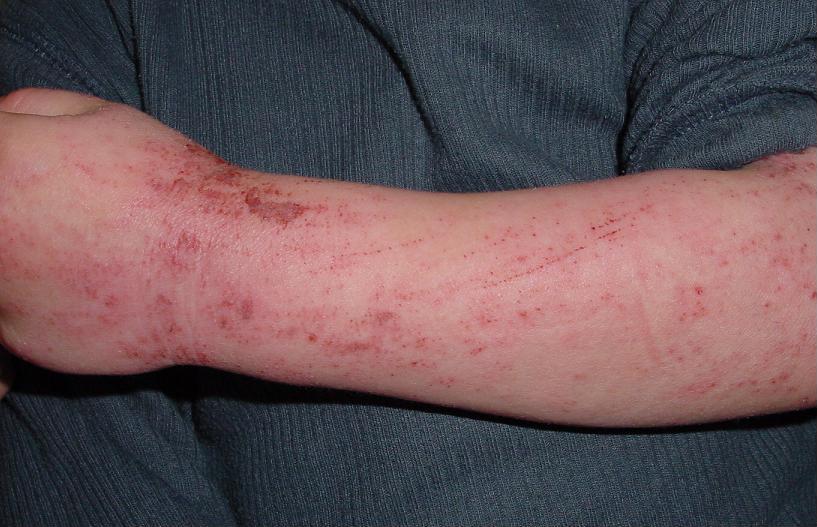
Image - Atopic eczema affecting the flexor surface of the arm, showing erythema with an ill-defined border – contrast this with the sharply demarcated plaques of psoriasis
Creative commons source by Eisfelder [CC BY-SA 3.0 (https://creativecommons.org/licenses/by-sa/3.0)]
Completing the Examination
Thank the patient, ensure they are covered and comfortable, and wash your hands.
Summarise your findings, ideally describing the lesion or rash in a structured way: its site and distribution, the morphology and configuration of the lesions, their size, colour and margin, and the relevant palpation findings, followed by any associated nail, scalp, mucosal or lymph node changes.
To complete the examination, state that you would like to:
- Take a full dermatological history, including the onset and evolution of the rash, associated symptoms (itch, pain), triggers, personal and family history of atopy or skin disease, drug history (for possible drug reactions) and the impact on the patient’s quality of life.
- Perform a full skin examination of the entire skin surface if not already done.
- Consider bedside tests such as dermoscopy, skin swabs for microscopy and culture if infection is suspected, and skin scrapings for fungal microscopy in suspected tinea.
- Arrange relevant investigations where appropriate, such as a skin biopsy for histological diagnosis, patch testing for suspected allergic contact dermatitis, and blood tests if a systemic or autoimmune cause is suspected.
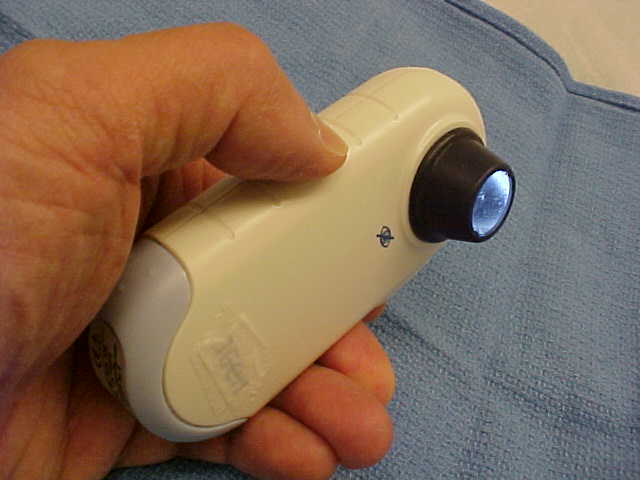
Image - A dermatoscope (dermoscopy) gives a magnified, illuminated view of a lesion's surface, supporting diagnosis at the bedside
SimpleMed original
- 4