
Neck Lump OSCE Examination
During any examination in an OSCE it is important to understand the pathology and reasoning behind each of the signs and symptoms elicited, even if the patient being examined is 'normal'. This article explains how to perform a neck lump examination and the key findings you should look for, showing you what each sign means and what conditions it may indicate.
The neck contains a large number of structures packed into a small space, so a lump can arise from the lymph nodes, the thyroid gland, the salivary glands, the skin, blood vessels or congenital remnants. A systematic approach – inspecting, characterising the lump, palpating the lymph node chains, examining the thyroid and then performing the special manoeuvres – allows you to build a differential diagnosis and decide which structure the lump is arising from.
Introduction
Wash your hands and don personal protective equipment if appropriate.
Introduce yourself to the patient and ensure to mention your grade e.g. 3rd year medical student/junior doctor/consultant.
Confirm the patient's details taking 3 points of identification usually; full name, date of birth and NHS/hospital number.
Obtain consent for the examination ensuring to explain what the examination will entail. Explain that you will need to look at and feel the neck, and that the best position is to stand behind them for part of the examination.
Position the patient sitting upright on a chair with the neck and upper chest adequately exposed, ideally with access all the way around the head so you can stand behind them.
Ask the patient if they have any pain anywhere before you begin, particularly in the neck, as you will be palpating the area.
General Inspection
Begin by stepping back and observing the patient from a distance. Assess whether the patient looks comfortable and well, or whether they appear unwell, in pain, or systemically distressed. A patient who looks cachectic (very thin with muscle wasting) may have an underlying malignancy, while a patient who is sweaty, anxious and fidgety with a fine tremor may be thyrotoxic.
Look for clues that may relate to a thyroid cause. Hyperthyroidism can cause weight loss despite a good appetite, restlessness and heat intolerance, whereas hypothyroidism can cause weight gain, lethargy, dry skin and a hoarse voice. Listen to the patient's voice as they speak – a hoarse voice may indicate involvement of the recurrent laryngeal nerve, which can occur in an invasive thyroid malignancy. At the same time, listen to the patient's breathing and watch their effort, as a large neck mass can compress the upper airway; dyspnoea (breathlessness) or stridor (a harsh, high-pitched noise on inspiration) is an important warning sign of airway narrowing and should prompt urgent assessment.
Scan the bedside and surroundings for clues such as a fan (heat intolerance in hyperthyroidism), tissues, mobility aids, or any medications and monitoring. Look at the front of the neck for an obvious swelling, asymmetry, scars from previous surgery, sinuses or any overlying skin changes such as redness suggesting infection.
Glance at the eyes, as thyroid eye disease (seen in Graves' disease) can cause exophthalmos (bulging eyes) and lid retraction, pointing you towards a thyroid cause for a neck lump even before you palpate.
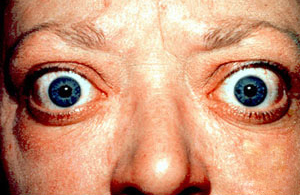
Image - Exophthalmos and lid retraction in Graves' disease. Thyroid eye signs noticed on general inspection suggest a thyroid cause for a midline neck swelling
SimpleMed original
Close Inspection of the Lump
Move in for a closer look at the lump itself, inspecting from the front and from the side. Note the location of the lump – this is one of the most useful pieces of information in the whole examination. A midline lump is more likely to arise from the thyroid, a thyroglossal cyst or a dermoid cyst, whereas a lump in the anterior or posterior triangle is more likely to be a lymph node, a salivary gland or a branchial cyst.
Comment on the approximate size, shape and whether there is more than one lump. Inspect the overlying skin for erythema (suggesting an inflammatory or infective cause such as an abscess), a punctum (suggesting a sebaceous cyst), tethering or ulceration (which raises concern for an underlying malignancy infiltrating the skin), and any scars from previous biopsy or surgery.
Ask the patient to open their mouth and inspect the oral cavity and floor of the mouth, as a submandibular gland swelling may have an obvious cause (such as a stone or pus at the duct opening) visible inside the mouth, and a primary mucosal tumour of the tongue, tonsil or pharynx can be the source of an enlarged cervical node. At the same time, look at the face for asymmetry, as a parotid lump can cause a facial nerve palsy if it is malignant and invading the nerve.
Swallow and Tongue Protrusion Tests
These two dynamic tests localise a midline lump and are a favourite of OSCE examiners, because they distinguish the common midline diagnoses on examination alone.
Offer the patient a glass of water and ask them to take a sip and swallow while you watch the lump. The thyroid gland is enclosed within the pretracheal fascia and is therefore attached to the larynx and trachea. When the patient swallows, the larynx rises, and so any swelling arising from the thyroid – such as a goitre or thyroid nodule – will move upwards with swallowing. A thyroglossal cyst also moves up on swallowing. Most other lumps, such as lymph nodes, lipomas and skin lesions, do not move with swallowing.
Next, ask the patient to protrude their tongue and again watch the lump. A thyroglossal cyst is connected to the base of the tongue via the remnant of the thyroglossal duct, the embryological tract along which the thyroid descended from the foramen caecum of the tongue. Because of this attachment, a thyroglossal cyst will move upwards on tongue protrusion – a finding that is essentially diagnostic. A thyroid goitre and lymph nodes will not move on tongue protrusion, which is how you distinguish a thyroglossal cyst from other midline thyroid swellings.
Palpating and Characterising the Lump
Before palpating, confirm again that the patient has no pain, then work through the standard lump characteristics. A useful structure is site, size, shape, surface, consistency, mobility, fluctuance, tenderness, temperature and pulsatility.
- Site – confirm the exact location (midline vs anterior/posterior triangle) as discussed above.
- Size and shape – measure roughly in your mind and describe whether it is round, oval or irregular.
- Surface and edge – a smooth, well-defined lump is more likely benign, whereas an irregular, poorly defined edge raises concern for malignancy.
- Consistency – a soft lump suggests a lipoma or cyst, a rubbery consistency is classically associated with lymphoma, and a hard, craggy lump suggests a carcinoma or metastatic lymph node.
- Tenderness and temperature – a tender, warm lump suggests an inflammatory or infective cause, such as reactive lymphadenopathy or an abscess, whereas a painless lump is more concerning for malignancy.
- Mobility and tethering – gently try to move the lump in two perpendicular planes and assess whether it moves freely or is tethered to the overlying skin or to deeper structures. A lump that moves with the skin lies superficially (for example a sebaceous cyst), whereas one fixed to deeper tissue sits within or beneath the muscle. Asking the patient to tense the sternocleidomastoid (by turning the head against your hand) and reassessing helps localise the lump: a swelling that becomes less mobile or disappears under the contracted muscle lies deep to it, while a superficial node remains palpable. Tethering and fixation to skin or deep structures suggest an infiltrating malignant process.
Assess for fluctuance by pressing on two opposite edges of the lump with the fingers of one hand while feeling whether the centre bulges out; a fluctuant lump contains fluid and suggests a cyst or abscess.
Finally, place a finger either side of the lump and assess for pulsatility. A lump that lifts your fingers apart is expansile and pulsatile, suggesting a vascular cause such as a carotid aneurysm, whereas one that simply moves your fingers in the same direction is merely transmitting a pulse from an adjacent vessel.
Lymph Node Examination
If the lump may be a lymph node, or simply as part of a thorough examination, palpate all of the cervical lymph node chains systematically. It is best to examine from behind the patient using the pads of the fingers of both hands, palpating each side at the same time so you can compare for symmetry. Ask the patient to tilt their chin slightly downwards to relax the neck muscles and make the nodes easier to feel.
Palpate the chains in a logical order so that none are missed:
- Submental – under the point of the chin.
- Submandibular – along the underside of the jaw.
- Tonsillar (jugulodigastric) – at the angle of the mandible; this node enlarges with tonsillitis and pharyngeal infection.
- Pre-auricular – in front of the ear.
- Post-auricular – behind the ear over the mastoid.
- Occipital – at the back of the skull, over the occiput.
- Anterior cervical chain – along the front border of the sternocleidomastoid muscle.
- Posterior cervical chain – along the back border of the sternocleidomastoid.
- Supraclavicular – in the hollow above the clavicle, feeling deep behind the clavicle on each side. Asking the patient to bring their ear towards their shoulder relaxes the overlying muscle and makes these nodes easier to reach.
- Infraclavicular – just below the clavicle, completing the assessment of the lower neck.
For each enlarged node, characterise it as you would any lump (size, consistency, tenderness, mobility). Tender, mobile, soft nodes suggest reactive lymphadenopathy from a local infection such as tonsillitis or a dental abscess. Rubbery, non-tender nodes are associated with lymphoma. Hard, fixed, non-tender nodes suggest metastatic carcinoma.
Pay particular attention to the left supraclavicular node, known as Virchow's node; enlargement here (Troisier's sign) is classically associated with gastric and other intra-abdominal or thoracic malignancies, because the thoracic duct drains into the venous system at this point. Widespread lymphadenopathy with palpable nodes elsewhere may point towards a systemic cause such as lymphoma, leukaemia or infections such as glandular fever or HIV.
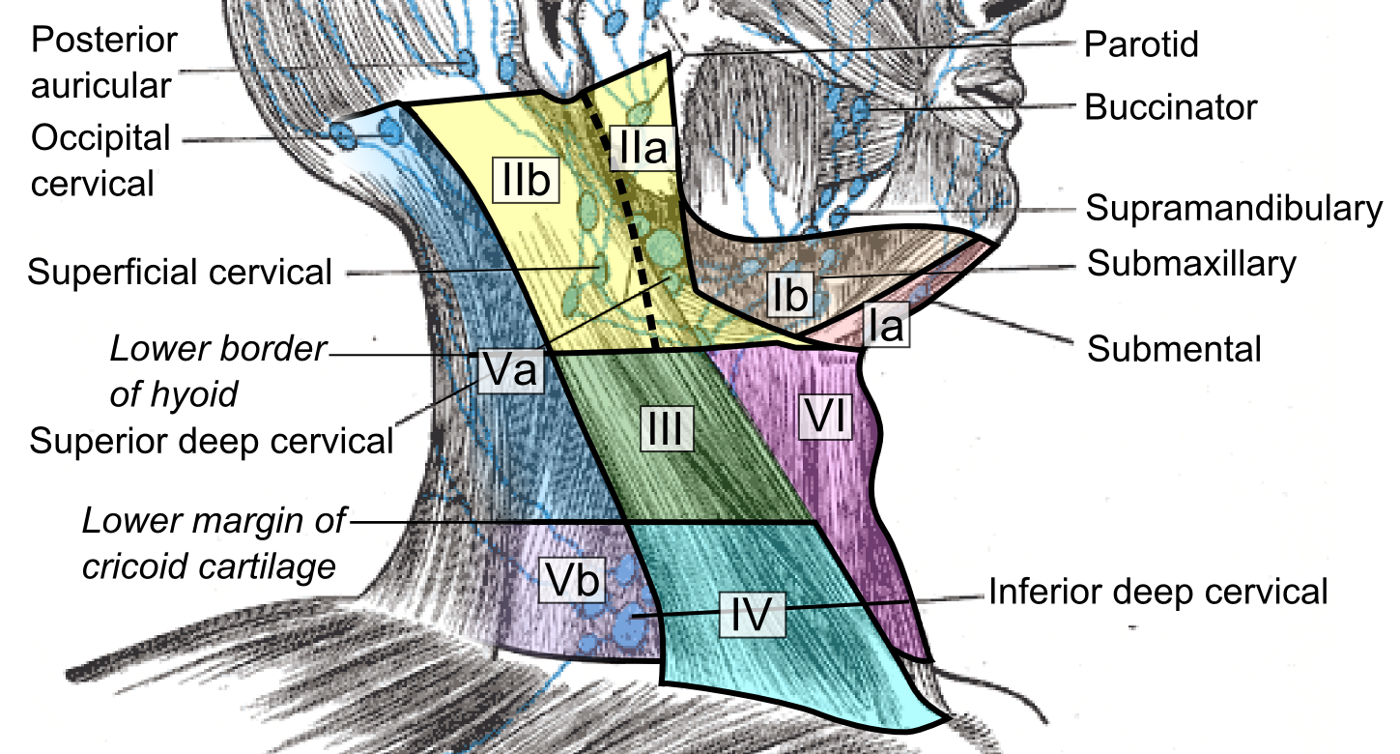
Image - The cervical lymph node chains and surgical levels of the neck. Palpating each chain systematically ensures no group of nodes is missed
Creative commons source by Mikael Häggström, M.D. [CC0 1.0 / Public Domain (https://creativecommons.org/publicdomain/zero/1.0)]
Salivary Gland Examination
If the lump lies over a salivary gland, examine the glands directly, as they are a common source of neck and facial swellings. The parotid gland sits in front of and below the ear, overlying the angle of the jaw; a parotid swelling characteristically lifts the ear lobe. The submandibular gland sits beneath the body of the mandible.
Palpate the submandibular gland bimanually, with one gloved finger inside the floor of the mouth and the fingers of the other hand pressing up under the jaw, so you can feel the gland between them. This is the best way to detect a stone in the duct, which causes painful swelling that is worse at mealtimes (sialolithiasis).
A diffusely enlarged, tender gland suggests infection or duct obstruction, whereas a discrete, firm or fixed mass within the gland raises concern for a salivary gland tumour. As noted, a parotid mass causing a facial nerve palsy is highly suspicious of malignancy, because the facial nerve passes through the gland.
Thyroid Examination
If the lump is in the midline, or if you suspect a thyroid cause, examine the thyroid gland in more detail. Stand behind the patient and place the three middle fingers of each hand over the front of the neck, with your fingertips meeting in the midline just below the thyroid cartilage. The thyroid isthmus lies over the trachea, with the two lobes on either side.
Gently palpate the gland, assessing its size, symmetry and consistency, and whether you can feel a single nodule or a diffusely enlarged gland. A diffuse, smooth enlargement (goitre) is seen in conditions such as Graves' disease, Hashimoto's thyroiditis and iodine deficiency, while a solitary nodule raises the possibility of a thyroid adenoma, cyst or carcinoma, and a multinodular gland suggests a multinodular goitre.
Ask the patient to swallow again while you palpate, confirming that the gland rises as expected. Assess whether the lower border can be felt; if you cannot feel the lower border, the goitre may have a retrosternal extension into the chest, which is important because it can compress the trachea and great vessels.
Feel the position of the trachea to assess for any deviation, which can be caused by a large goitre or a retrosternal mass pushing the trachea to one side.
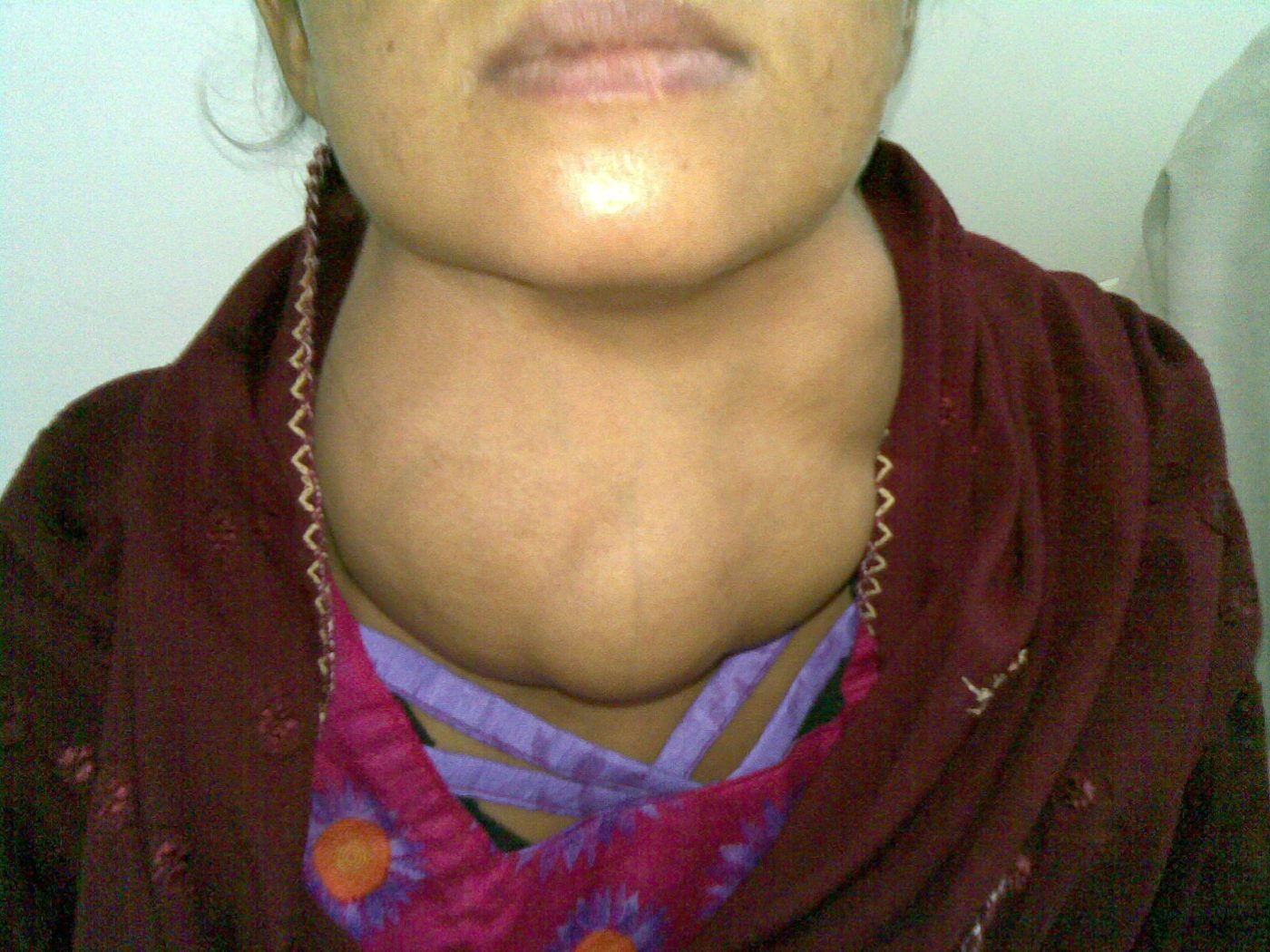
Image - A goitre seen as a midline neck swelling. A diffuse thyroid enlargement like this moves upwards on swallowing but not on tongue protrusion
Public Domain source by Almazi [Public domain]
Percussion and Auscultation
Percuss over the sternum, working downwards from the manubrium. A change from a resonant to a dull note suggests a retrosternal extension of a goitre into the superior mediastinum, which would not be felt on palpation alone.
Auscultate over the lump using the diaphragm of the stethoscope. Over a thyroid goitre, listen for a bruit – a whooshing sound caused by increased and turbulent blood flow through a hypervascular gland. A thyroid bruit is most commonly heard in Graves' disease, where the gland is overactive and very vascular.
If the lump is in the line of the carotid artery, auscultating may reveal a bruit from a vascular cause; a pulsatile, expansile lump with a bruit raises the possibility of a carotid body tumour or an aneurysm, and such lumps should be handled with caution.
Transillumination
If the lump feels fluctuant and may contain fluid, darken the room if possible and place a pen torch against the lump. A lump filled with clear fluid will transilluminate – it will glow as the light passes through it. This is a useful sign for a cystic lesion such as a cystic hygroma (lymphangioma), which classically transilluminates brilliantly, or a simple thyroglossal or branchial cyst.
A solid lump, such as a lymph node, a solid thyroid nodule or a tumour, will not transilluminate, as the light cannot pass through solid tissue. This simple bedside test therefore helps to separate fluid-filled lesions from solid ones.
Completing the Examination
Thank the patient and wash your hands.
Summarise your findings, describing the lump using the characteristics above and stating your leading differential diagnosis.
To complete the examination, suggest the following further assessments and investigations:
- Perform a full thyroid status examination if a thyroid cause is suspected, looking for the peripheral signs of hyper- or hypothyroidism.
- Perform a full lymphoreticular examination, including assessing for hepatosplenomegaly and other lymph node groups, if lymphoma or leukaemia is suspected.
- Examine the oral cavity, oropharynx and scalp to look for a primary mucosal or skin lesion that could be draining to an enlarged node.
- Request relevant bedside and blood tests, including thyroid function tests (TSH, free T4), a full blood count, inflammatory markers and a blood film where appropriate.
- Arrange an ultrasound scan of the neck as the first-line imaging investigation, often combined with an ultrasound-guided fine needle aspiration (FNA) for cytology to obtain a tissue diagnosis.
- Consider cross-sectional imaging (CT or MRI) for staging if a malignancy is identified.
- 4