
Nasal OSCE Examination
During any examination in an OSCE it is important to understand the pathology and reasoning behind each of the signs and symptoms elicited, even if the patient being examined is ‘normal’. This article explains how to perform a nasal examination and the key findings you should look for, showing you what each sign means and what conditions it may indicate.
Introduction
Wash your hands and don personal protective equipment if appropriate.
Introduce yourself to the patient and ensure to mention your grade e.g. 3rd year medical student/junior doctor/consultant.
Confirm the patient’s details taking 3 points of identification; usually full name, date of birth and NHS/hospital number.
Briefly explain the examination in patient-friendly language and obtain consent, making clear that you will be looking inside the nose using a light and that this should not be painful.
Position the patient sitting upright on a chair, at roughly the same height as you so that you can comfortably look into both nostrils.
Ask the patient whether they have any pain, particularly around the nose or face, before you begin, as this examination involves palpation.
Gather your equipment: a good light source (pen torch, head torch or otoscope), a nasal speculum (Thudichum’s speculum) where available, and tissues. An otoscope fitted with a large speculum is a perfectly acceptable alternative for illuminating and magnifying the nasal cavity in most OSCEs.
General Inspection
Begin by standing back and observing the patient and their immediate surroundings, as the general appearance often gives clues before you touch the nose.
Look at the patient’s breathing and listen for mouth breathing or audible nasal obstruction, which may suggest significant blockage of the nasal airway from a deviated septum, polyps or chronic rhinosinusitis.
Note any nasal voice (rhinolalia), where speech sounds ‘blocked’, again pointing towards obstruction or nasal congestion.
Observe for an audible sniff, frequent use of tissues, or a visible nasal discharge, which may indicate rhinitis or infection.
Look around the bedside for relevant objects such as nasal sprays (steroid or decongestant), tissues, or a nasal splint/dressing following recent trauma or surgery.
Note any obvious facial swelling, skin changes or signs that the patient is systemically unwell, as facial pain with fever may suggest acute sinusitis.
Finally, glance at the eyes and periorbital region. Periorbital swelling, redness or restricted eye movements in a patient with sinus symptoms is a red flag for orbital cellulitis, a serious complication of ethmoid sinusitis that requires urgent treatment.
Inspection of the External Nose
Inspect the external nose systematically from the front, from the side, and from above and behind the patient, as deformities are often only obvious from a particular angle. Viewing from behind with the patient’s head tilted slightly back, so that you look down the line of the nose, is the most reliable way to detect a subtle lateral deviation of the bony or cartilaginous framework.
Assess the overall shape and symmetry of the nose. A deviation of the bony or cartilaginous framework may follow previous trauma or fracture and can be associated with a deviated septum and nasal obstruction.
Look specifically for a saddle-nose deformity, in which the bridge of the nose is collapsed and depressed. This results from loss of support from the nasal septum and can be caused by a septal haematoma or abscess (which destroys the underlying cartilage), previous trauma or surgery, cocaine use, or systemic disease such as granulomatosis with polyangiitis (GPA) or, historically, syphilis.
Inspect the skin of the nose for lesions such as basal cell carcinoma (a common site for skin cancer due to sun exposure), and for rhinophyma — a bulbous, thickened nasal tip seen in advanced rosacea due to sebaceous gland hypertrophy.
Look for signs of recent trauma such as bruising, swelling or laceration, and for the ‘nasal crease’ (a transverse line across the lower nose), which suggests habitual rubbing from allergic rhinitis (the ‘allergic salute’).
Inspect the columella (the strip of tissue between the nostrils) and the nostrils themselves for symmetry. A widened, flattened bridge with broadening of the nose can be a further sign of underlying septal or cartilage loss, while excoriation of the nasal openings supports chronic discharge or recurrent epistaxis.
Watch the nasal alae (the soft outer walls of the nostrils) as the patient breathes in. If the alae are drawn inwards on inspiration, this indicates alar (nasal valve) collapse, a cause of obstruction that worsens with deeper breathing and is confirmed by Cottle’s test.
Palpation of the External Nose
Before palpating, check again that the patient is not in pain, as a recently injured nose can be very tender.
Using your fingers, gently palpate the nasal bones and cartilages, starting at the bony bridge and working down to the tip.
Assess for tenderness, steps or depressions in the contour, abnormal mobility, and crepitus (a crackling sensation). These findings suggest a nasal bone fracture, which is the most commonly fractured bone in the face.
Gently press over the frontal sinuses (just above the medial eyebrows) and the maxillary sinuses (over the cheeks, below the orbits) to check for tenderness. The paranasal sinuses are air-filled spaces that drain into the nasal cavity; when their drainage is obstructed by mucosal swelling, secretions accumulate and become infected. Sinus tenderness, particularly in the context of facial pain that is worse on leaning forward, purulent discharge and fever, therefore supports a diagnosis of acute sinusitis.
Inspection of the Nasal Cavity (Anterior Rhinoscopy)
The internal examination is performed by anterior rhinoscopy, which allows direct inspection of the front of the nasal cavity. Sit facing the patient with your knees together and positioned to one side of the patient’s knees. Ask the patient to keep their head in a neutral position and look straight ahead; tilting the head back slightly can improve the view of the upper cavity but is not essential.
Gently elevate the tip of the nose with your thumb to open the nostrils, and direct your light source into the nasal cavity. Where a Thudichum’s speculum or an otoscope is used, this gently widens the nostril and improves the view, but take care never to touch the highly sensitive nasal septum.
Examine the nasal vestibule (the entrance, lined by skin) for inflammation, crusting, ulceration or signs of folliculitis. Also look for any foreign body lodged in the cavity, which is a frequent cause of unilateral obstruction and offensive, often blood-stained, discharge in young children and should always be considered in that setting.
Inspect the nasal septum and note its position. A deviated septum narrows one side of the nasal cavity and is a common cause of unilateral nasal obstruction. Look also for:
- Septal perforation — a hole through the septum, which may be caused by previous surgery, nose-picking, cocaine use, or vasculitis such as GPA. It can produce crusting and whistling during breathing.
- Septal haematoma — a boggy, bilateral swelling of the septum after trauma. This is a surgical emergency, as the collection of blood strips the cartilage of its blood supply and can lead to cartilage necrosis and a saddle-nose deformity or abscess if not drained.
- Dilated superficial vessels or evidence of previous cautery over Little’s area on the anterior septum. This region contains Kiesselbach’s plexus, an anastomosis of several arteries, and is the most common source of anterior epistaxis (nosebleeds) because the mucosa here is thin and exposed to drying and trauma.
Inspect the turbinates on the lateral wall of each cavity. These are bony projections covered in vascular mucosa that warm, humidify and filter inspired air. The inferior turbinate is the most readily seen on anterior rhinoscopy; the middle turbinate sits above it, and the middle meatus beneath it is important because the frontal, maxillary and anterior ethmoid sinuses drain here, so pus tracking from the middle meatus points to sinus infection. Note any asymmetry, swelling or colour change: boggy, pale or bluish swollen turbinates suggest allergic rhinitis, whereas red, swollen turbinates with discharge suggest infective rhinitis. The inferior turbinate can be mistaken by the inexperienced for a polyp, so it is important to distinguish the two.
Look for nasal polyps, which appear as pale, grey, glistening, mobile swellings. Unlike turbinates, they are typically insensitive to gentle touch and do not shrink with decongestion. Polyps arise from chronically inflamed mucosa and are associated with chronic rhinosinusitis, asthma, aspirin sensitivity and cystic fibrosis. Unilateral polyps in an adult always warrant specialist referral to exclude a tumour.
Finally, note the character of any discharge or secretions: clear and watery in allergic rhinitis, mucopurulent in infection, and unilateral clear watery rhinorrhoea following head trauma should raise suspicion of a cerebrospinal fluid (CSF) leak.
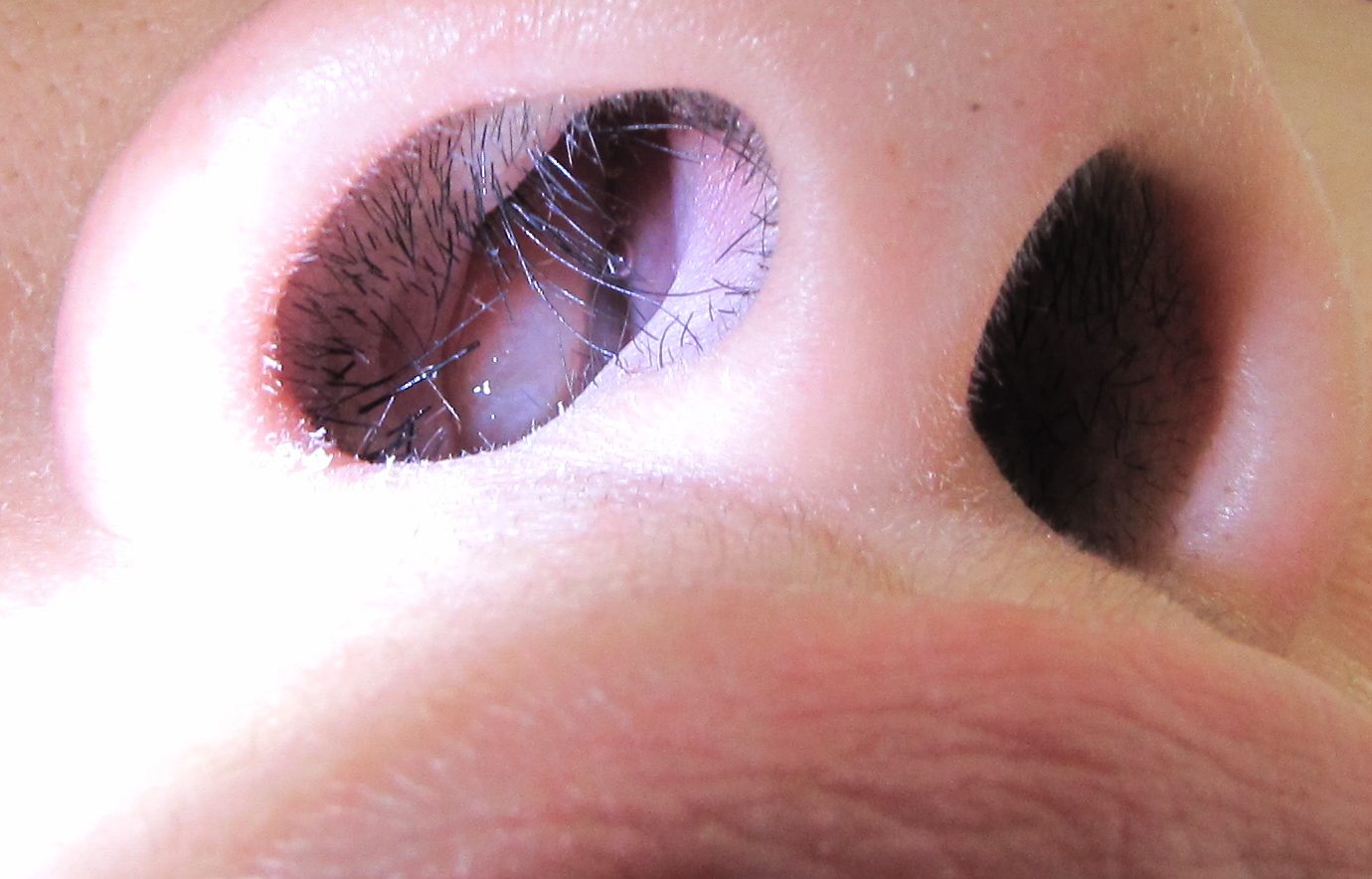
Image - A nasal polyp visible within the nasal cavity. Polyps are pale, glistening and insensitive swellings associated with chronic rhinosinusitis and asthma
Creative commons source by MathieuMD [CC BY-SA 3.0 (https://creativecommons.org/licenses/by-sa/3.0)]
Assessment of Nasal Airflow (Patency)
Assessing nasal airflow tests whether each side of the nose is patent and helps localise the side and degree of any obstruction.
One simple method is to occlude one nostril at a time with your thumb, ask the patient to breathe in through the open nostril, and compare the airflow on each side. Press on the side of the nostril rather than squeezing the nasal valve, as too much pressure creates a false impression of obstruction.
Alternatively, hold a cold, shiny metal surface (such as the back of a Lack’s tongue depressor or a metal spatula) beneath the nostrils and ask the patient to breathe out through the nose. The misting patterns from each nostril are compared — reduced misting on one side indicates reduced airflow on that side.
Reduced unilateral airflow most commonly reflects a deviated septum, turbinate hypertrophy, a polyp or, particularly in a child, an inhaled foreign body, whereas bilateral reduction suggests rhinitis or bilateral polyps.
Special Tests
Several additional tests can be incorporated where the history points towards a particular problem:
- Cottle’s test — gently draw the cheek laterally on one side to pull the nasal valve open. If the patient’s breathing improves noticeably, this suggests nasal valve collapse as a cause of obstruction. The modified Cottle test uses an instrument to support the lateral wall directly.
- Assessment of smell (olfaction) — the sense of smell can be screened using readily identifiable odours (for example coffee or vanilla) presented to each nostril in turn. Anosmia (loss of smell) or hyposmia may be caused by nasal obstruction (polyps, severe rhinitis), by damage to the olfactory nerve (cranial nerve I), or by viral infection. Formal testing uses standardised kits such as the University of Pennsylvania Smell Identification Test (UPSIT).
- Assessment for facial trauma — if there is a history of injury, palpate the infraorbital margins and assess eye movements and sensation over the cheek to screen for an orbital blowout fracture, and re-examine the septum for a haematoma.
Completing the Examination
Thank the patient and wash your hands.
Summarise your findings to the examiner.
To complete the examination, state that you would perform a full ear and throat examination (the nose should not be assessed in isolation), examine the oral cavity and postnasal space, and assess the cervical lymph nodes of the head and neck, as nasal and sinonasal malignancy can spread to the neck.
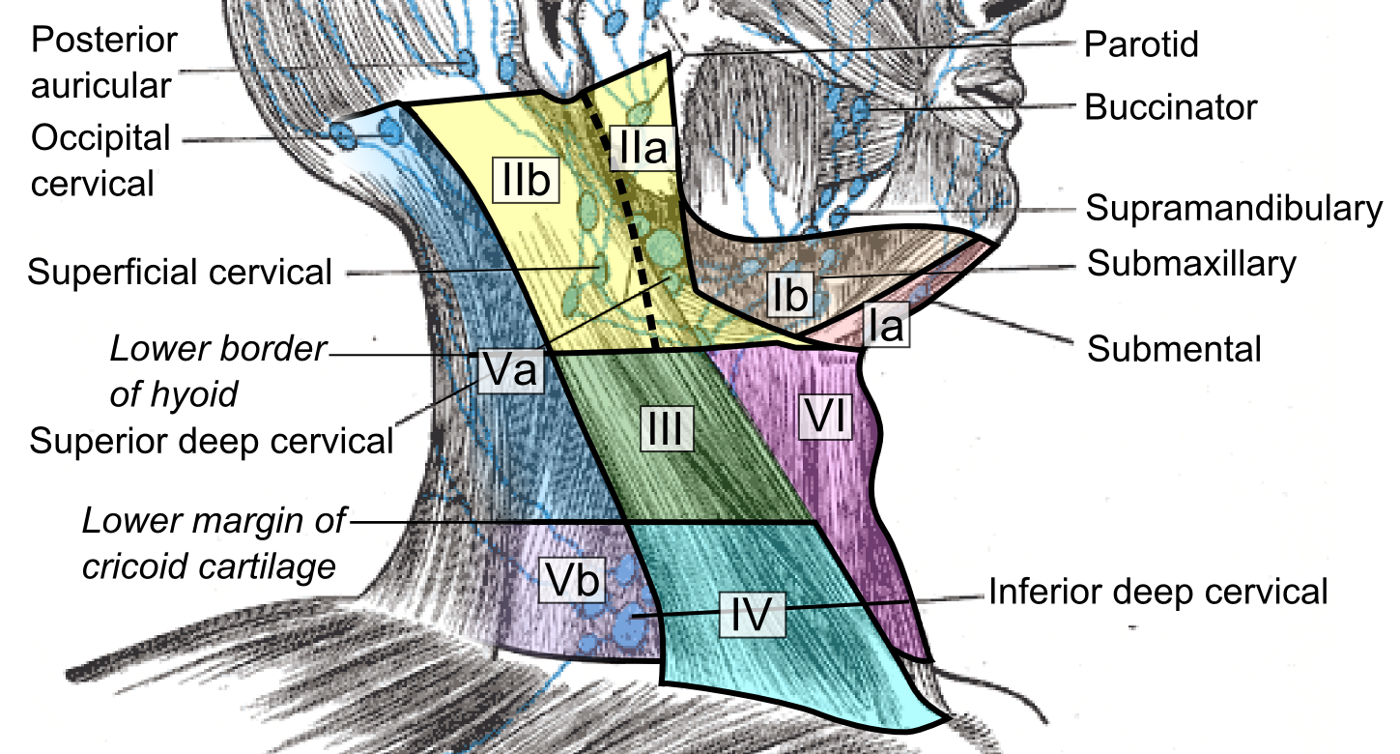
Image - The levels of the cervical lymph nodes. A full nasal assessment is completed by palpating these node groups, as sinonasal disease can drain to the neck
SimpleMed original image: credit ‘SimpleMed original’
You would also consider further assessment and investigations as guided by the history, including nasal endoscopy (rigid or flexible) for a more complete view of the nasal cavity, postnasal space and nasopharynx, formal olfactory testing, peak nasal inspiratory flow measurement, allergy testing where allergic rhinitis is suspected, and cross-sectional imaging (CT) of the sinuses for chronic rhinosinusitis, suspected tumour or complex trauma.
Remember that anterior rhinoscopy only shows the front of the nose; lesions further back in the cavity, in the nasopharynx or around the sinus drainage pathways can be missed and need endoscopic assessment by an ENT specialist. Red flag features such as unilateral symptoms, blood-stained discharge, a unilateral mass or cranial nerve involvement warrant urgent referral to exclude malignancy.
- 4