
Lower Limb Neurological OSCE Examination
During any examination in an OSCE it is important to understand the pathology and reasoning behind each of the signs and symptoms elicited, even if the patient being examined is ‘normal’. This article explains how to perform a lower limb neurological examination and the key findings you should look for, showing you what each sign means and what conditions it may indicate.
The central aim of this examination is to work out where a problem lies within the nervous system. The most useful distinction to keep in mind throughout is between an upper motor neurone (UMN) lesion (in the brain or spinal cord) and a lower motor neurone (LMN) lesion (in the anterior horn cell, nerve root, plexus or peripheral nerve). Almost every sign you elicit helps to place the lesion into one of these patterns.
Introduction
Wash your hands and don personal protective equipment if appropriate.
Introduce yourself to the patient and ensure to mention your grade e.g. 3rd year medical student/junior doctor/consultant.
Confirm the patient’s details taking 3 points of identification usually; full name, date of birth and NHS/hospital number.
Obtain consent for the examination, ensuring to explain what the examination will entail. A useful explanation is that you would like to look at how the nerves and muscles of the legs are working, which will involve watching them walk, moving their legs, tapping their knees and ankles, and testing sensation.
Ask the patient about any pain, particularly in the back, hips or legs, before you begin moving the limbs.
Expose the patient’s lower limbs fully (ideally down to underwear) so that muscle bulk and any abnormal movements can be seen, and position them lying on the bed with the head supported and the legs flat.
Before you start, gather your equipment: a tendon hammer, a 128 Hz tuning fork (for vibration sense), a neuro-pin (for pin-prick) and cotton wool (for light touch). Having everything to hand keeps the examination slick and shows the examiner you know what each modality requires.
General Inspection
Begin by standing back and observing the patient and the area around the bed. Look at the patient’s general comfort and posture, and note any mobility aids such as walking sticks, a frame, a wheelchair or ankle-foot orthoses, which give immediate clues about the degree of disability and its cause.
Look around the bedside for objects of relevance, such as catheters (which may accompany a spinal cord lesion), prescriptions, or adaptations suggesting a chronic neurological condition.
Inspect the legs themselves for muscle wasting, fasciculations, tremor, abnormal posturing and scars.
- Muscle wasting suggests a lower motor neurone lesion or simple disuse atrophy. Asymmetry between the two legs is particularly informative.
- Fasciculations are fine, flickering, involuntary twitches of muscle fibres seen under the skin. They reflect lower motor neurone pathology and, when widespread, raise the possibility of motor neurone disease.
- Scars over the spine or limbs may indicate previous spinal surgery, joint replacement or nerve repair, all of which can explain neurological signs.
- Abnormal posturing of a limb, such as a leg held extended and internally rotated, can point to a long-standing UMN lesion such as a previous stroke.
- Tremor or other involuntary movements at rest may suggest a Parkinsonian or other movement disorder.
- Pseudoathetosis describes slow, writhing movements of the toes when the patient cannot see the limb, caused by loss of proprioception rather than a primary movement disorder; it points back to the dorsal columns.
It is also worth glancing at the patient’s footwear if it is to hand: uneven wear at the toe can betray a chronic foot drop from scuffing the ground.
Gait
Assessing gait is one of the most valuable parts of the examination because it integrates motor power, coordination, proprioception and balance all at once. If it is safe to do so, ask the patient to walk a few metres, turn, and walk back, staying close in case they are unsteady.
Observe the symmetry, stride length, arm swing, the turn, and whether the patient is steady. Several characteristic patterns may emerge:
- Hemiplegic gait – one leg is held stiff and extended and is swung outwards in an arc (circumduction) with each step. This reflects a UMN lesion on one side and is classically seen after a stroke.
- High-stepping gait – the patient lifts the foot high to avoid catching the toes on the ground because of foot drop (weak ankle dorsiflexion). This indicates a problem with the common peroneal nerve, the L5 root, or a peripheral neuropathy.
- Ataxic gait – a broad-based, unsteady, lurching walk. A cerebellar cause produces a wide stance that does not improve with vision, whereas a sensory (proprioceptive) ataxia worsens markedly when the eyes are closed.
- Parkinsonian gait – small shuffling steps, reduced arm swing, a stooped posture and difficulty initiating and turning, seen in Parkinson’s disease.
- Waddling gait – the pelvis drops on alternate sides, seen with proximal myopathy.
Where appropriate you may also ask the patient to walk heel-to-toe (tandem gait), which exaggerates a cerebellar ataxia, and to walk on their toes and heels to screen plantarflexion (S1) and dorsiflexion (L4/L5) respectively.
Romberg’s Test
Romberg’s test screens for sensory ataxia – unsteadiness caused by loss of proprioception rather than a cerebellar problem. Ask the patient to stand with their feet together and arms by their sides, and stand close by ready to catch them. Once they are stable with their eyes open, ask them to close their eyes.
Maintaining balance relies on three inputs: vision, proprioception and the vestibular system. With the eyes open, the patient can compensate for poor proprioception using vision. When the eyes close, that compensation is removed, so a patient with impaired proprioception (for example from dorsal column disease, peripheral neuropathy or B12 deficiency) becomes markedly more unsteady or falls – a positive test.
Romberg’s test is often wrongly thought to assess the cerebellum. A patient with a cerebellar lesion is unsteady even with the eyes open, so closing the eyes adds little – this is not a true positive. A genuinely positive Romberg’s test therefore points to a sensory (proprioceptive) rather than cerebellar cause.
Tone
Tone is the resistance felt in a muscle when it is passively moved. Ask the patient to relax and ‘let the leg go floppy’, then assess tone by performing a leg roll (rolling the relaxed thigh from side to side and watching the foot flop) and a leg lift (briskly lifting the knee off the bed and watching whether the heel stays in contact or flies up).
- Increased tone (hypertonia) indicates a UMN lesion. Spasticity is velocity-dependent, being more pronounced with rapid movement, and is typical of UMN lesions such as stroke or spinal cord disease. Rigidity (which includes the ‘lead-pipe’ and ‘cog-wheel’ varieties) is present throughout the range of movement and is associated with Parkinson’s disease and other extrapyramidal disorders.
- Reduced tone (hypotonia) can be seen with LMN lesions and in the acute phase of a UMN lesion (‘spinal shock’), though it is a subtle sign.
Next assess for ankle clonus. With the leg relaxed and slightly externally rotated and the knee bent, briskly dorsiflex the foot and hold it in dorsiflexion. Clonus is felt as a series of involuntary, rhythmic beats of plantarflexion and dorsiflexion. A few beats can be normal, but sustained clonus (more than around five beats) is abnormal and is a sign of a UMN lesion.
Power
Power is tested by asking the patient to move against your resistance, comparing the two sides and working through the muscle groups systematically. Each movement is supplied predominantly by a particular myotome (spinal nerve root), so a pattern of weakness helps localise a lesion to a root, a peripheral nerve, or a more diffuse process.
Grade power using the MRC scale:
- 0 – no movement
- 1 – a flicker of contraction
- 2 – movement with gravity eliminated
- 3 – movement against gravity but not resistance
- 4 – movement against some resistance
- 5 – normal power
Test each of the following movements in turn:
- Hip flexion – L1/L2
- Hip extension – L5/S1/S2
- Knee extension – L3/L4
- Knee flexion – S1
- Ankle dorsiflexion – L4/L5
- Ankle plantarflexion – S1/S2
- Big toe extension – L5
The pattern of weakness is more important than its severity. A pyramidal pattern of weakness, in which the flexors are weaker than the extensors in the leg, is characteristic of a UMN lesion. Weakness confined to muscles supplied by a single nerve root (for example weak big toe and ankle dorsiflexion in an L5 radiculopathy) or a single peripheral nerve suggests an LMN lesion at that level. Symmetrical proximal weakness suggests a myopathy, whereas distal weakness is more typical of a peripheral neuropathy.
Reflexes
Deep tendon reflexes test a simple reflex arc: a tap on the tendon stretches the muscle, triggering a sensory signal to the spinal cord that produces a motor contraction. The response is normally modulated (dampened) by descending UMN pathways, which is why reflex changes are so useful for localising lesions.
- Knee-jerk reflex – L3/L4. Support the knee in slight flexion and strike the patellar tendon; the leg should extend.
- Ankle-jerk reflex – S1. With the ankle relaxed and slightly everted, strike the Achilles tendon; the foot should plantarflex.
- Plantar reflex. Run a blunt object along the lateral border of the sole and then across the ball of the foot. Unlike the knee and ankle jerks this is not a simple tendon reflex but a test of the corticospinal tract, so its interpretation differs (see below).
If a reflex appears absent, ask the patient to perform a reinforcement manoeuvre (such as clenching the teeth or interlocking and pulling the fingers apart) and test again before concluding it is truly absent.
Reflexes are conventionally graded as absent (0), present only with reinforcement (±), normal (+), brisk (++) or very brisk with clonus (+++). Always compare like with like on the two sides, since asymmetry is often more telling than the absolute briskness.
- Brisk (exaggerated) reflexes indicate a UMN lesion, because loss of the normal descending inhibition leaves the reflex arc over-active.
- Reduced or absent reflexes indicate an LMN lesion (interruption of the reflex arc itself), as seen in radiculopathy or peripheral neuropathy.
The plantar reflex deserves particular attention. The normal adult response is flexion (downward movement) of the big toe. An abnormal response – extension (upward movement) of the big toe with fanning of the other toes – is a positive Babinski sign and is a reliable indicator of a UMN lesion. (An extensor plantar is normal in infants up to around one year of age, before the corticospinal tracts are fully myelinated.)
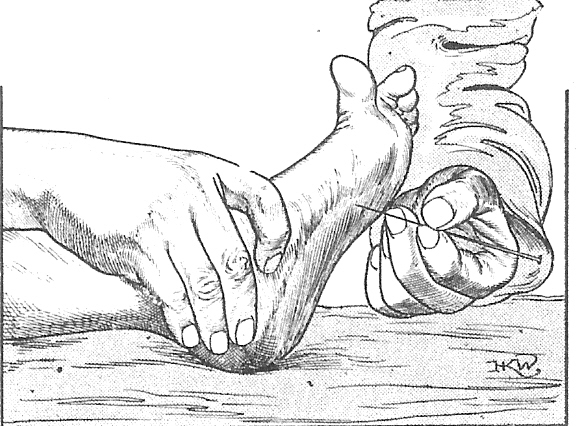
Image - The plantar reflex. Extension of the big toe with fanning of the other toes (a positive Babinski sign) indicates an upper motor neurone lesion
Creative commons source [Public domain]
Coordination
Coordination in the lower limb is assessed primarily with the heel-to-shin test. Ask the patient to place one heel on the opposite knee and then slide it smoothly down the front of the shin to the ankle, lift it off, and repeat. Demonstrate the movement first.
A smooth, accurate movement is normal. In a cerebellar lesion, the movement becomes clumsy and erratic, with the heel wobbling off the line of the shin (an intention tremor and dysmetria). This is part of the wider picture of cerebellar dysfunction, which classically also includes ataxic gait, nystagmus and slurred speech.
It is important to interpret incoordination in the context of power: a patient who is simply weak may perform the test poorly without any cerebellar problem, so always assess coordination alongside the rest of the examination.
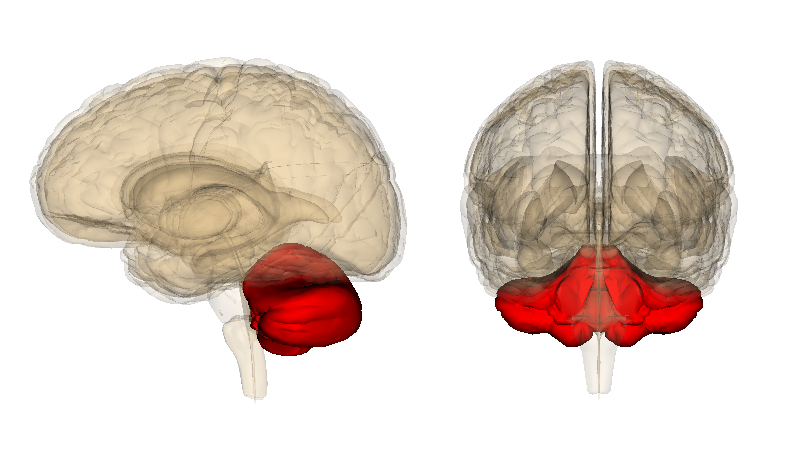
Image - The cerebellum. Damage to it produces the incoordination (dysmetria and intention tremor) seen on heel-to-shin testing, classically on the same side as the lesion
SimpleMed original
Sensation
Sensory testing maps any deficit onto either a dermatome (a strip of skin supplied by a single nerve root) or the territory of a peripheral nerve, which again helps localise the lesion. Always demonstrate each modality on the sternum or another normal area first so the patient knows what to expect, then test with their eyes closed, comparing left with right at each level.
Different modalities travel in different spinal pathways, which is why testing several is informative:
- Light touch – tested with a wisp of cotton wool. Carried by both the dorsal columns and the spinothalamic tracts.
- Pin-prick (pain) – tested with a disposable neuro-pin. Carried by the spinothalamic tract (which crosses to the opposite side within the spinal cord). If sensation is reduced distally, work proximally up the limb until normal sensation returns, which maps out a ‘stocking’ loss.
- Temperature – also carried by the spinothalamic tract and tested with a cold object (the flat of a tuning fork feels suitably cold, or a dedicated cold tube). It is often omitted in practice if pin-prick is normal, since the two share a pathway.
- Vibration – tested with a 128 Hz tuning fork placed on a bony prominence, starting at the big toe and moving proximally if reduced. Carried by the dorsal columns.
- Proprioception (joint position sense) – tested by holding the sides of the big toe and moving it up or down with the patient’s eyes closed. Also carried by the dorsal columns.
The distribution of any loss is the key to interpretation. A dermatomal pattern suggests a nerve root lesion (radiculopathy); a peripheral nerve pattern suggests mononeuropathy; a ‘stocking’ distribution (worst distally and improving proximally) suggests a peripheral polyneuropathy, classically caused by diabetes or alcohol excess; and a clear sensory level on the trunk suggests a spinal cord lesion. Loss of pain on one side with loss of proprioception and vibration on the other suggests cord hemisection (Brown-Séquard syndrome), reflecting the different routes the pathways take.

Image - The sensory territories (dermatomes) of the lower limb. Mapping a sensory deficit onto these strips helps localise the affected nerve root
Creative commons source by FerIndigo97 [CC BY-SA 4.0 (https://creativecommons.org/licenses/by-sa/4.0)]
Completing the Examination
Thank the patient, help them to re-dress, and wash your hands.
Summarise your findings, ideally framing them as a pattern, for example ‘an upper motor neurone pattern of weakness in the right leg’ or ‘a length-dependent sensory neuropathy’.
To complete the examination, suggest performing a full upper limb neurological examination and a cranial nerve examination to define the extent of any deficit, examining the patient’s gait if not already done, and assessing the back and spine. Relevant bedside tests and investigations include a blood glucose and HbA1c (for diabetic neuropathy), vitamin B12 and folate levels, and, depending on the suspected lesion, imaging of the brain or spine (MRI) and nerve conduction studies.
- 4