
Share:
During any examination in an OSCE it is important to understand the pathology and reasoning behind each of the signs and symptoms elicited, even if the patient being examined is ‘normal’. This article explains how to perform a knee examination and the key findings you should look for, showing you what each sign means and what conditions it may indicate.
The knee examination follows the standard musculoskeletal structure of look, feel and move, finishing with a set of special tests that stress individual structures such as the cruciate and collateral ligaments and the menisci. Throughout, always compare the affected knee with the contralateral side, as asymmetry is often the most reliable abnormal finding.
Contents
- Introduction
- General Inspection
- Gait Assessment
- Look (Standing)
- Look (Lying)
- Knee Anatomy
- Feel (Temperature and Palpation)
- Feel (Effusion Tests)
- Move (Range of Movement)
- Patellofemoral Assessment
- Special Tests – Cruciate Ligaments
- Special Tests – Collateral Ligaments
- Special Tests – Menisci
- Completing the Examination
- Quiz
Introduction
Wash your hands and don personal protective equipment if appropriate.
Introduce yourself to the patient and ensure to mention your grade e.g. 3rd year medical student/junior doctor/consultant.
Confirm the patient’s details taking 3 points of identification usually; full name, date of birth and NHS/hospital number.
Briefly explain the examination and gain consent, for example: “I’d like to examine your knees today. This will involve looking at and feeling both knees, moving them, and doing some specific tests. Is that alright?”
Ask the patient if they have any pain anywhere before you begin, and reassure them you will stop if they become uncomfortable. This is both courteous and clinically important, as pain often localises the underlying pathology.
Adequately expose both lower limbs from the groin down so that the knees, thighs and lower legs can be compared directly. The patient should ideally be in shorts. Begin with the patient standing so you can assess alignment and gait.
General Inspection
Take a moment to look at the patient as a whole and at the area around the bed. Look for mobility aids such as walking sticks, crutches, a frame or a wheelchair, which suggest reduced weight-bearing ability or instability. Note any knee braces, splints or supports, and look for prescriptions or analgesia that hint at chronic pain.
Assess whether the patient appears comfortable or in distress, and whether they look systemically well. Note the patient’s body habitus: a raised body weight loads the knee heavily and is an important risk factor for both osteoarthritis and slower recovery from injury. Generalised features such as a rheumatoid hand deformity or a psoriatic rash may point towards an inflammatory arthropathy affecting the knee.
Gait Assessment
Ask the patient to walk a short distance, turn, and walk back, while you observe the whole gait cycle. The normal cycle moves through heel strike, foot flat, mid-stance, heel off and toe off; pain or weakness disrupts these phases.
An antalgic gait, where the patient spends as little time as possible bearing weight on the painful leg (a shortened stance phase), is the classic finding of a painful knee, for example in osteoarthritis or following injury. Look also for an unstable or ‘giving way’ gait, which suggests ligamentous injury or quadriceps weakness, and for a stiff knee that the patient swings out to the side (circumduction) because they cannot flex it.
Note any leg-length discrepancy, which may be either the cause or the consequence of knee pathology, and watch how confidently the patient turns, as turning slowly often reflects pain or instability.
Glance at the patient’s footwear as well: uneven sole wear can betray an abnormal gait pattern or chronic deformity, and orthotic insoles suggest an attempt to correct alignment or offload a painful compartment.
Look (Standing)
With the patient still standing, inspect both knees from the front, the side and behind, always comparing one side with the other.
From the front, assess the coronal alignment of the legs. Genu varum (‘bow legs’) describes knees that bow outwards and is commonly seen in medial compartment osteoarthritis, where loss of medial cartilage collapses the joint into varus. Genu valgum (‘knock knees’) describes knees that angle inwards and is more typical of lateral compartment disease or rheumatoid arthritis.
From the side, look for genu recurvatum (hyperextension of the knee), which may reflect ligamentous laxity. From behind, inspect the popliteal fossa for any swelling, in particular a Baker’s cyst – a fluid-filled distension of the bursa behind the knee that communicates with the joint and is associated with effusions and osteoarthritis.
Throughout, look for scars (suggesting previous surgery such as arthroscopy or joint replacement), swelling, muscle wasting and redness.
Look (Lying)
Ask the patient to lie on the couch with their legs straight and re-inspect the knees up close.
Look for an effusion, seen as a loss of the normal dimples either side of the patella and a generally ‘full’ appearance to the joint. An effusion represents extra fluid within the joint – this may be synovial fluid (osteoarthritis, inflammatory arthritis), blood (a haemarthrosis following an acute ACL rupture or intra-articular fracture) or pus (septic arthritis).
Assess the quadriceps, particularly the vastus medialis, for wasting. Because the quadriceps rapidly atrophies with disuse, wasting is a useful sign of chronic knee pathology or pain that has limited activity.
Look again for scars, erythema (which may indicate infection or active inflammation) and any obvious deformity.
Knee Anatomy
A quick recap of the relevant anatomy makes the special tests much easier to understand. The knee is stabilised by four key ligaments. The anterior cruciate ligament (ACL) prevents anterior translation of the tibia on the femur. The posterior cruciate ligament (PCL) prevents posterior translation. The medial collateral ligament (MCL) resists valgus (inward-angulating) force, and the lateral (fibular) collateral ligament (LCL) resists varus (outward-angulating) force. The two menisci are C-shaped fibrocartilage discs that cushion and distribute load across the joint.
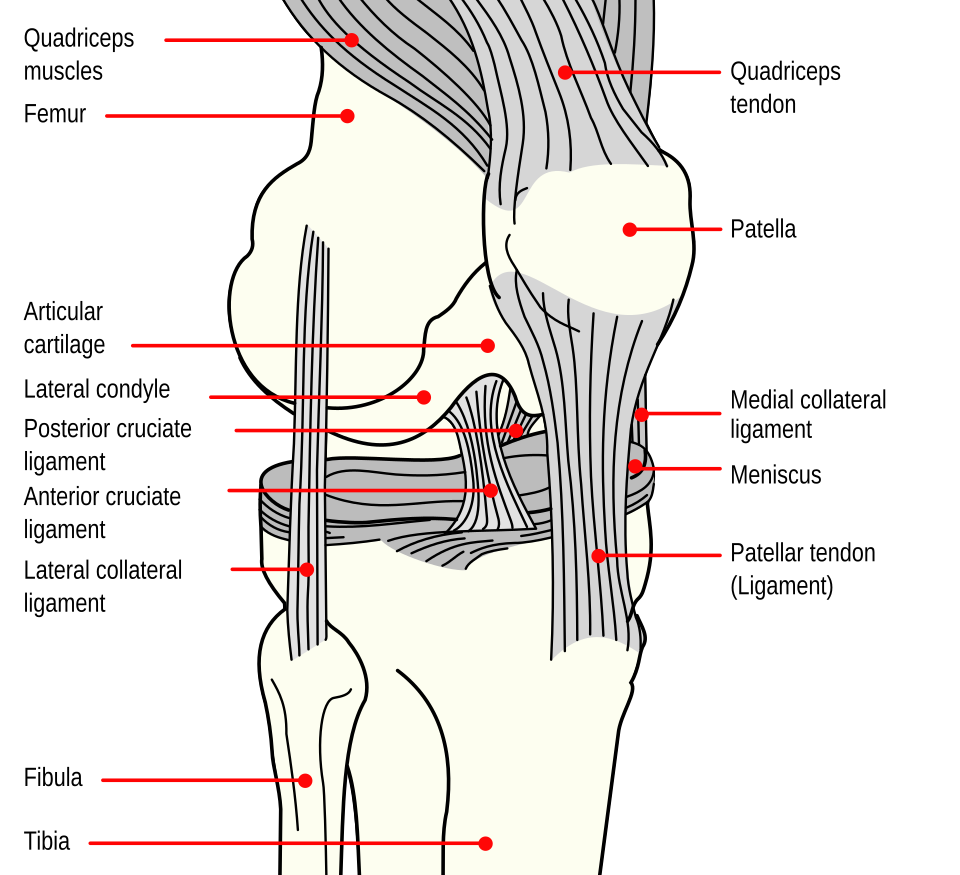
Image - Anatomy of the right knee showing the cruciate ligaments, collateral ligaments and menisci. Understanding these structures explains the logic behind each special test
Creative commons source by Mysid [Public domain]
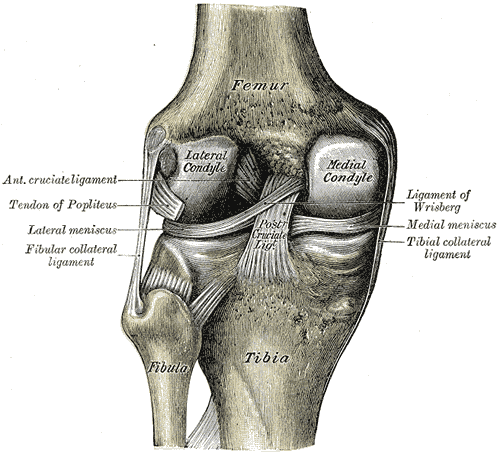
Image - The knee joint viewed from behind, demonstrating the cruciate and collateral ligaments that the special tests are designed to isolate
Creative commons source by Henry Vandyke Carter [Public domain]
Feel (Temperature and Palpation)
Before palpating, ask again about pain and watch the patient’s face throughout.
Using the back of your hand, assess and compare the temperature over both knees and the thigh above. An increased temperature over the joint suggests an active inflammatory or infective process such as septic arthritis, gout or a flare of inflammatory arthritis. The back of the hand is used because it is more temperature-sensitive than the palm.
Measure and compare quadriceps bulk by measuring the thigh circumference a fixed distance (e.g. 15 cm) above the tibial tuberosity on each side; a measurable difference confirms quadriceps wasting.
With the knee extended, palpate systematically for tenderness over the borders of the patella, the quadriceps and patellar tendons, the tibial tuberosity and the joint lines. Joint-line tenderness is an important sign of meniscal injury or osteoarthritis. Tenderness at the tibial tuberosity in an adolescent suggests Osgood–Schlatter disease.
Then flex the knee to 90° and palpate the joint lines again, along with the collateral ligaments, the head of the fibula and the popliteal fossa. A soft swelling in the popliteal fossa supports a Baker’s cyst.
Feel (Effusion Tests)
Two bedside manoeuvres help confirm and grade a knee effusion:
- The patellar tap (ballottement) test is used for a large effusion. Empty the suprapatellar pouch by sliding one hand down the thigh, then push the patella sharply backwards with a finger of the other hand. If fluid is present, the patella sinks, strikes the femur and bounces back with a palpable ‘tap’.
- The sweep (bulge) test is more sensitive for a small effusion. Empty the medial side of the joint by stroking upwards, then stroke down the lateral side; a positive test produces a visible bulge of fluid reappearing on the emptied medial side.
A confirmed effusion narrows the differential to the causes of joint fluid – degenerative, inflammatory, infective or traumatic – and should prompt consideration of joint aspiration if infection is possible.
Move (Range of Movement)
Assess active movement first by asking the patient to move the knee themselves, then passive movement by moving it for them while feeling for crepitus with a hand over the joint.
Normal flexion is approximately 0–135° (some quote up to 140°) and the knee should fully extend to 0°. Reduced range, especially a fixed flexion deformity where the knee cannot fully straighten, is common in osteoarthritis. A difference between active and passive range suggests a muscular or tendon problem (e.g. an extensor mechanism rupture) rather than a true joint restriction.
Crepitus – a grinding sensation through movement – reflects roughened, worn articular surfaces and is typical of osteoarthritis. Always note whether movement reproduces the patient’s pain.
Patellofemoral Assessment
The patella deserves attention in its own right, as anterior knee pain and instability often arise from the patellofemoral joint rather than the tibiofemoral compartments.
Assess patellar tracking by watching the patella as the patient slowly straightens and bends the knee through a small range. The patella should glide smoothly in the trochlear groove; a sudden lateral deviation near full extension (a positive ‘J-sign’) suggests maltracking and a tendency to subluxation.
Check patellar mobility by gently pushing the patella medially and laterally with the knee relaxed in slight flexion. Reduced glide implies a tight or arthritic joint, whereas excessive lateral glide points to laxity and risk of dislocation.
The patellar apprehension test screens for a history of recurrent lateral dislocation. With the knee almost straight, slowly push the patella laterally. If the patient becomes visibly anxious, tenses the quadriceps or tries to stop you, the test is positive, because they are anticipating the patella slipping out of joint as it has done before.
If anterior knee pain is the main complaint, you may also perform Clarke’s test (the patellar grind test): press the patella distally into the trochlea and ask the patient to tense the quadriceps. Pain or grinding as the patella is pulled across the femur suggests patellofemoral pain or chondromalacia patellae, though the test is uncomfortable even in normal knees and should be interpreted cautiously.
Special Tests – Cruciate Ligaments
The cruciate ligament tests detect abnormal front-to-back movement of the tibia on the femur. Always compare with the other knee, as some baseline laxity is normal.
Begin by inspecting for a posterior sag sign. With both knees flexed to 90° and feet flat, look from the side; if the PCL is torn, the tibia sags backwards under gravity, producing a step-off below the patella. Identifying a sag first is important because it can give a false-positive anterior drawer (you are simply pulling a sagged tibia back to neutral).
The anterior drawer test assesses the ACL. Flex the knee to 90°, sit gently on the foot to fix it, and pull the tibia forwards. Excessive anterior translation indicates an ACL tear, which classically occurs with a sudden twisting or pivoting injury and a haemarthrosis.
The posterior drawer test uses the same position but the tibia is pushed backwards; excessive posterior movement indicates a PCL injury, often caused by a ‘dashboard’ force driving the tibia backwards.
The Lachman test is the most sensitive test for the ACL. With the knee flexed to about 20–30°, stabilise the femur with one hand and pull the tibia forwards with the other. Increased anterior glide with a soft or absent end-point indicates an ACL rupture; the smaller flexion angle removes the protective splinting of the hamstrings, making this test more reliable than the anterior drawer.
Special Tests – Collateral Ligaments
The collateral ligament tests detect abnormal side-to-side opening of the joint.
For the valgus stress test, hold the ankle, place your other hand on the lateral side of the knee, and push the knee inwards (applying a valgus force) while the leg is held in slight flexion. Excessive opening of the medial joint line, or pain there, indicates a medial collateral ligament (MCL) injury, as the MCL is the structure that normally resists this force.
For the varus stress test, reverse the hands: place one hand on the medial side and push the knee outwards (a varus force). Excessive opening of the lateral joint line indicates a lateral (fibular) collateral ligament (LCL) injury.
Testing in slight flexion (around 30°) isolates the collateral ligaments; testing in full extension recruits the cruciates and joint capsule, so marked laxity in extension implies a more severe, multi-ligament injury.
Special Tests – Menisci
The menisci can tear with a twisting injury on a loaded, flexed knee, typically producing joint-line tenderness, locking or a sensation of the knee giving way.
McMurray’s test is used to assess for a meniscal tear. With the patient supine, fully flex the knee, then rotate the tibia and slowly extend the knee while feeling along the joint line. External rotation with extension stresses the medial meniscus, and internal rotation stresses the lateral meniscus. A palpable click or reproduction of the patient’s pain suggests a tear, as the displaced meniscal fragment is being trapped and released between the joint surfaces.
Two alternatives may also be mentioned. Apley’s grind test is done with the patient prone and the knee flexed to 90°: pressing the tibia downwards while rotating it loads and grinds the menisci, so reproduced pain points to a meniscal tear, whereas pain on distraction (pulling the tibia up while rotating) points instead to a ligamentous problem. The Thessaly test asks the standing patient to rotate the body over a knee flexed to 20° while you support their hands; joint-line pain or locking is a positive result and this weight-bearing test is considered one of the more reliable.
Because these tests are uncomfortable and none is highly specific, findings should always be interpreted alongside the history and joint-line tenderness, and confirmed where necessary on MRI.
Completing the Examination
Thank the patient and allow them to redress, then wash your hands.
Summarise your findings and offer a sensible differential diagnosis.
To complete the examination, state that you would assess the joints above and below – namely the hip and the ankle and foot – as pathology in these joints can refer pain to the knee. You would also perform a neurovascular examination of both lower limbs, checking pulses, sensation and power.
Finally, suggest relevant investigations guided by your findings, such as plain radiographs of the knee (for osteoarthritis or fracture), an MRI scan (for suspected ligament or meniscal injury), and joint aspiration with fluid microscopy and culture if septic arthritis or crystal arthropathy is suspected.
Quiz
- 245