
Hip OSCE Examination
During any examination in an OSCE it is important to understand the pathology and reasoning behind each of the signs and symptoms elicited, even if the patient being examined is ‘normal’. This article explains how to perform a hip examination and the key findings you should look for, showing you what each sign means and what conditions it may indicate.
The hip examination follows the standard musculoskeletal framework of look, feel and move, finishing with a set of special tests. Throughout, you are comparing one side against the other, so always examine both hips even when the patient only complains of symptoms on one side.
Introduction
Wash your hands and don personal protective equipment if appropriate.
Introduce yourself to the patient and ensure to mention your grade e.g. 3rd year medical student/junior doctor/consultant.
Confirm the patient’s details taking 3 points of identification usually; full name, date of birth and NHS/hospital number.
Obtain consent for the examination ensuring to explain what the examination will entail. The hip examination involves watching the patient walk and moving the joint, so explain this clearly.
Ask the patient if they have any pain anywhere, particularly in the hip, groin, buttock or knee, before you begin. Hip pathology classically refers pain to the groin, and may also present as referred knee pain, so do not be caught out by a patient who points to their knee.
Expose the patient appropriately. The patient should ideally be in shorts or underwear so that both legs, the pelvis and the lower back can be seen. Maintain the patient’s dignity throughout.
Position the patient standing initially, as the examination begins with gait and standing inspection before moving on to assessment on the couch.
General Inspection
Begin by standing back and observing the patient and the area around them. Look for clues about the severity and chronicity of their condition.
From the end of the bed, assess whether the patient appears comfortable or is in obvious distress, and note their general build.
Look around the bedside for mobility aids such as walking sticks, crutches or a frame, which suggest reduced mobility and weight-bearing difficulty. A walking stick is conventionally held in the hand opposite the affected hip, as this reduces the load and the force the abductors must generate on the painful side.
Note any wheelchairs, orthotic footwear or shoe raises (which may compensate for a leg length discrepancy), and any analgesia visible on the bedside table, hinting at the level of pain the patient experiences.
Gait
Ask the patient to walk a short distance away from you, turn, and walk back, while you watch from both behind and the side. Gait abnormalities can localise the underlying problem before you have even touched the patient.
Assess the gait for its smoothness, symmetry, stride length and the time spent in the stance and swing phases on each side.
An antalgic gait is a painful, limping gait in which the patient spends as little time as possible bearing weight on the affected side. The stance phase is shortened on the painful leg. This indicates a painful pathology such as osteoarthritis, fracture or septic arthritis.
A Trendelenburg gait (sometimes called a ‘waddling’ gait if bilateral) is caused by weakness of the hip abductors (gluteus medius and minimus). During the stance phase on the affected side, the abductors cannot stabilise the pelvis, so the pelvis drops towards the contralateral (swinging) side. The patient often leans their trunk over the affected hip to compensate and keep their centre of gravity over the foot. This points to abductor weakness, which may stem from a superior gluteal nerve lesion, an L5 radiculopathy, or chronic hip pathology.
A short-leg gait produces a consistent dip of the pelvis on the shorter side with every step and is caused by a true leg length discrepancy.
Also watch the patient turn, as a slow, guarded turn is a sensitive sign of hip and balance problems.
Look (Standing and Lying Inspection)
With the patient still standing, inspect from the front, side and back. Look for scars (a lateral or posterior scar may indicate a previous total hip replacement), asymmetry and obvious deformity. Note any asymmetric swelling, which around the hip is hard to see but may reflect a joint effusion, inflammatory arthropathy or septic arthritis.
Inspect the muscle bulk of the gluteal region and the quadriceps. Wasting suggests disuse atrophy secondary to chronic joint pathology, or a lower motor neurone lesion.
From the side, observe the lumbar lordosis and pelvic tilt. An exaggerated lordosis can be a sign that the patient is compensating for a fixed flexion deformity of the hip by tilting the pelvis.
Now ask the patient to lie supine on the couch with their legs straight and the pelvis square (both anterior superior iliac spines level). Re-inspect for scars, swelling and the resting position of the limbs. A leg that lies shortened and externally rotated is the classic appearance of a fractured neck of femur, while a fixed flexed, adducted, internally rotated position may be seen with established hip pathology.
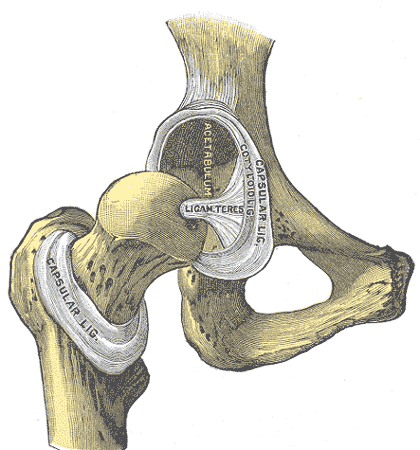
Image - The hip joint viewed from the front, a ball-and-socket joint between the femoral head and the acetabulum. Understanding the underlying anatomy helps interpret the deformities and movement restrictions found on examination
Public domain source by Henry Vandyke Carter (Gray’s Anatomy, 1918) [Public domain]
Feel (Palpation)
Before palpating, ask again whether the patient has any pain and watch their face for discomfort.
Assess the temperature over each hip using the back of your hand, comparing both sides. Increased warmth suggests an inflammatory or septic process within or around the joint.
Palpate the greater trochanter on the lateral aspect of the hip. Tenderness here is the hallmark of greater trochanteric pain syndrome (trochanteric bursitis or gluteal tendinopathy), a very common cause of lateral hip pain that is often mistaken for true hip joint disease.
Palpate the inguinal region over the joint line for tenderness, which may reflect genuine intra-articular pathology, and feel for any masses such as a femoral hernia or enlarged lymph nodes.
Systematically palpate the surrounding bony landmarks – the anterior superior iliac spine, the iliac crest, the pubic symphysis and the ischial tuberosity – for tenderness, as localised pain over these points can indicate an avulsion injury, enthesopathy or pain referred from the sacroiliac joint rather than the hip joint itself.
Leg length should now be assessed, as a discrepancy is an important sign and changes how the rest of the examination is interpreted. With the patient supine, the pelvis squared and the legs in a comparable position, measure both legs with a tape measure:
- True (real) leg length is measured from the anterior superior iliac spine (ASIS) to the medial malleolus on each side. A difference indicates a genuine structural shortening of the bone or loss of length at the hip joint itself, for example from a fracture, arthritis with joint space loss, or previous surgery.
- Apparent leg length is measured from a fixed midline point, the umbilicus (or xiphisternum), to the medial malleolus. A difference here with equal true lengths reflects a pelvic tilt caused by a fixed adduction or abduction deformity, rather than true bony shortening.
Distinguishing the two tells you whether a short leg is a problem of the bone and joint (true) or of pelvic positioning (apparent).
Move (Range of Movement)
Assess active movement first (the patient moves themselves), then passive movement (you move the joint), comparing both sides. A quick active screen, asking the patient to bring each knee up towards the chest, shows how much movement they can manage comfortably before you take over. Passive assessment then lets you feel for crepitus and detect the true limit of movement, while watching the patient’s face for pain. Reduced and painful movement, particularly loss of internal rotation, is one of the earliest signs of hip osteoarthritis.
With the patient supine, assess:
- Flexion – bring the knee up towards the chest. Normal range is approximately 120°.
- Internal and external rotation – with the hip and knee both flexed to 90°, move the foot outwards to test internal rotation (normal around 40°) and inwards to test external rotation (normal around 45°). Loss of internal rotation is an early and sensitive sign of osteoarthritis.
- Abduction – stabilise the contralateral ASIS with one hand and move the leg outwards, away from the midline (normal around 45°). Stabilising the pelvis ensures you are measuring hip movement and not pelvic rotation.
- Adduction – again stabilising the pelvis, move the leg across the midline over the opposite limb (normal around 30°).
Then ask the patient to lie prone to assess:
- Extension – lift the straightened leg backwards off the couch (normal around 15–20°). Loss of extension may indicate a fixed flexion deformity.
A restricted, painful range in multiple planes suggests osteoarthritis or inflammatory arthritis, whereas a globally rigid, exquisitely painful joint in an unwell patient should raise concern for septic arthritis.
Note: in a patient with a hip replacement, avoid forcing internal rotation, adduction and flexion beyond 90°, as these positions place the prosthesis at risk of dislocation.
Special Test – Thomas’s Test
Thomas’s test is used to unmask a fixed flexion deformity of the hip, which patients commonly hide by tilting the pelvis and increasing their lumbar lordosis (arching the lower back).
With the patient lying supine, place one hand flat under the lumbar spine, palm upwards. This lets you detect and prevent the patient from flattening the curve of their back to mask the deformity. Fully flex the unaffected hip by bringing the knee towards the chest until the lumbar lordosis flattens onto your hand.
Observe the opposite (affected) leg. Normally it should remain flat on the couch. The test is positive if the affected thigh lifts off the couch into flexion, demonstrating that the hip cannot fully extend, i.e. a fixed flexion deformity. Repeat on the other side.
A fixed flexion deformity suggests contracture of the hip secondary to osteoarthritis, previous inflammatory arthritis, or neurological disease.
Note: Thomas’s test should not be performed in a patient with a hip prosthesis or suspected fracture, as forced flexion risks dislocation or harm.
Special Test – Trendelenburg’s Test
Trendelenburg’s test assesses the function of the hip abductors (gluteus medius and minimus), which are supplied by the superior gluteal nerve. Their job is to stabilise the pelvis when standing on one leg.
Stand facing the patient and ask them to place their hands on yours for balance. Place your hands on the patient’s iliac crests (or simply observe the pelvis) and ask them to stand on one leg, lifting the other foot off the ground. Observe what happens to the pelvis on the non-weight-bearing (raised) side. Repeat on the other side.
Normally, the abductors of the weight-bearing leg contract and hold the pelvis level or lift it slightly on the raised side. The test is positive when the pelvis drops on the side of the raised (non-weight-bearing) leg, indicating weakness of the abductors on the opposite, weight-bearing side. A simple way to remember this is that the pelvis ‘sound side sags’ – the side that drops is the healthy (sound) side, and the weakness lies on the supporting side.
A positive Trendelenburg’s sign indicates hip abductor weakness, which may be due to a superior gluteal nerve lesion (sometimes iatrogenic after hip surgery), gluteal muscle pathology, painful hip conditions such as osteoarthritis, or abnormalities of the hip joint mechanics such as developmental dysplasia or a dislocated hip.
Special Test – FABER (Patrick’s) Test
The FABER test is a pain-provocation manoeuvre whose name describes the position used: Flexion, ABduction and External Rotation of the hip. It helps separate pain arising from the hip joint itself from pain arising from the sacroiliac joint.
With the patient supine, flex the hip and knee and rest the ankle of the test leg on the opposite thigh, just above the knee, creating a ‘figure-of-four’ position. Stabilise the opposite anterior superior iliac spine with one hand to prevent pelvic movement, then gently press the flexed knee downwards towards the couch.
The test is positive if this reproduces the patient’s pain. Anterior groin pain suggests intra-articular hip pathology such as osteoarthritis or femoroacetabular impingement, whereas posterior pain over the buttock points to sacroiliac joint dysfunction. Pain felt laterally may instead reflect greater trochanteric pain syndrome. Always compare with the other side.
Completing the Examination
Thank the patient and ensure they are comfortable and able to redress. Wash your hands.
Summarise your findings and offer a differential diagnosis.
To complete the examination, state that you would:
- Perform a full examination of the joints above and below, namely the lumbar spine and the knee, as pathology in these joints can refer pain to the hip and vice versa.
- Carry out a lower limb neurovascular examination, assessing the distal pulses, sensation and power.
- Assess the patient’s function and gait aids, and consider a more detailed functional assessment.
- Request relevant imaging, typically plain radiographs of the pelvis and affected hip, with an MRI if soft tissue or labral pathology is suspected, and consider further investigations such as blood tests (including inflammatory markers if infection or inflammatory arthritis is suspected) and joint aspiration if septic arthritis is a concern.
- 4