
Hernia OSCE Examination
During any examination in an OSCE it is important to understand the pathology and reasoning behind each of the signs and symptoms elicited, even if the patient being examined is ‘normal’. This article explains how to perform a hernia (groin) examination and the key findings you should look for, showing you what each sign means and what conditions it may indicate.
A hernia is the protrusion of an organ or tissue through a weakness in the wall of the cavity that normally contains it. In the groin, this is most commonly a loop of bowel or omentum pushing through the abdominal wall. The whole point of the examination is to confirm that a groin lump is a hernia, to work out which type it is, and to decide whether it is safe (reducible) or potentially dangerous (irreducible, obstructed or strangulated).
Introduction
Wash your hands and put on personal protective equipment if appropriate.
Introduce yourself to the patient and ensure to mention your grade e.g. 3rd year medical student/junior doctor/consultant.
Confirm the patient’s details taking 3 points of identification; usually full name, date of birth and NHS/hospital number.
Obtain consent for the examination, ensuring to explain what it will entail. This is an intimate examination, so explain clearly that you will need to look and feel the groin and scrotum, that the patient will need to remove their lower clothing, and that you will ask them to cough and to stand up. Warn them it may be slightly uncomfortable but should not be painful.
Offer a chaperone – this is essential for any intimate examination and protects both patient and examiner. Document the chaperone’s name.
Ask the patient if they have any pain anywhere before you begin, as tenderness over a hernia is an important clue to complications.
Position and expose the patient appropriately. The patient should initially lie supine on the couch, exposed from the umbilicus to the knees. A key part of this examination is that hernias are often more obvious when the patient is standing, as gravity and raised intra-abdominal pressure encourage the contents to protrude, so you will examine in both positions.
General Inspection
Begin by standing back and inspecting the patient and their surroundings from the end of the couch. Look at how comfortable the patient is at rest. A patient who is in obvious distress, lying very still, sweating or looking unwell may have a complicated hernia such as an obstructed or strangulated one, which is a surgical emergency.
Look for signs of weight loss or cachexia, which may point to an underlying malignancy contributing to raised intra-abdominal pressure, and for pallor or other general signs of chronic illness.
Cast your eye over the rest of the abdomen too. Obvious scars betray previous surgery and raise the possibility of an incisional hernia, while visible abdominal distension may reflect bowel obstruction caused by an incarcerated hernia.
Scan the bedside for clues: a vomit bowl or nasogastric tube may suggest bowel obstruction from an incarcerated hernia, and walking aids or an abdominal binder may be relevant. Note any factors that chronically raise intra-abdominal pressure and predispose to hernias, such as evidence of a chronic cough (inhalers, tissues) or obesity.
Closer Inspection of the Groin
Inspect both groins and the scrotum closely, comparing the two sides – always examine the apparently normal side as well so you do not miss a second, smaller hernia. Look specifically for:
- An obvious lump or swelling – note how many lumps there are, their location, size and whether any extends down into the scrotum.
- Scars from previous hernia repair or other groin/abdominal surgery, which raise the possibility of a recurrent or incisional hernia and may make the anatomy harder to interpret.
- Overlying skin changes such as redness, which may suggest inflammation or strangulation of the underlying bowel.
Now ask the patient to cough (or to perform a Valsalva manoeuvre) and watch the groin carefully. The appearance or sudden enlargement of a lump with coughing is a visible cough impulse, and is one of the cardinal signs of a hernia. This occurs because coughing raises intra-abdominal pressure, which is transmitted to the hernial contents and forces them further out through the defect.
If no lump is visible while the patient is lying flat, ask the patient to stand and repeat the inspection and the cough. Hernias frequently only become apparent on standing.
While the patient coughs, glance at the rest of the abdominal wall too, as the same rise in pressure can unmask an umbilical or paraumbilical hernia at the navel, or an incisional hernia bulging through an old surgical scar.
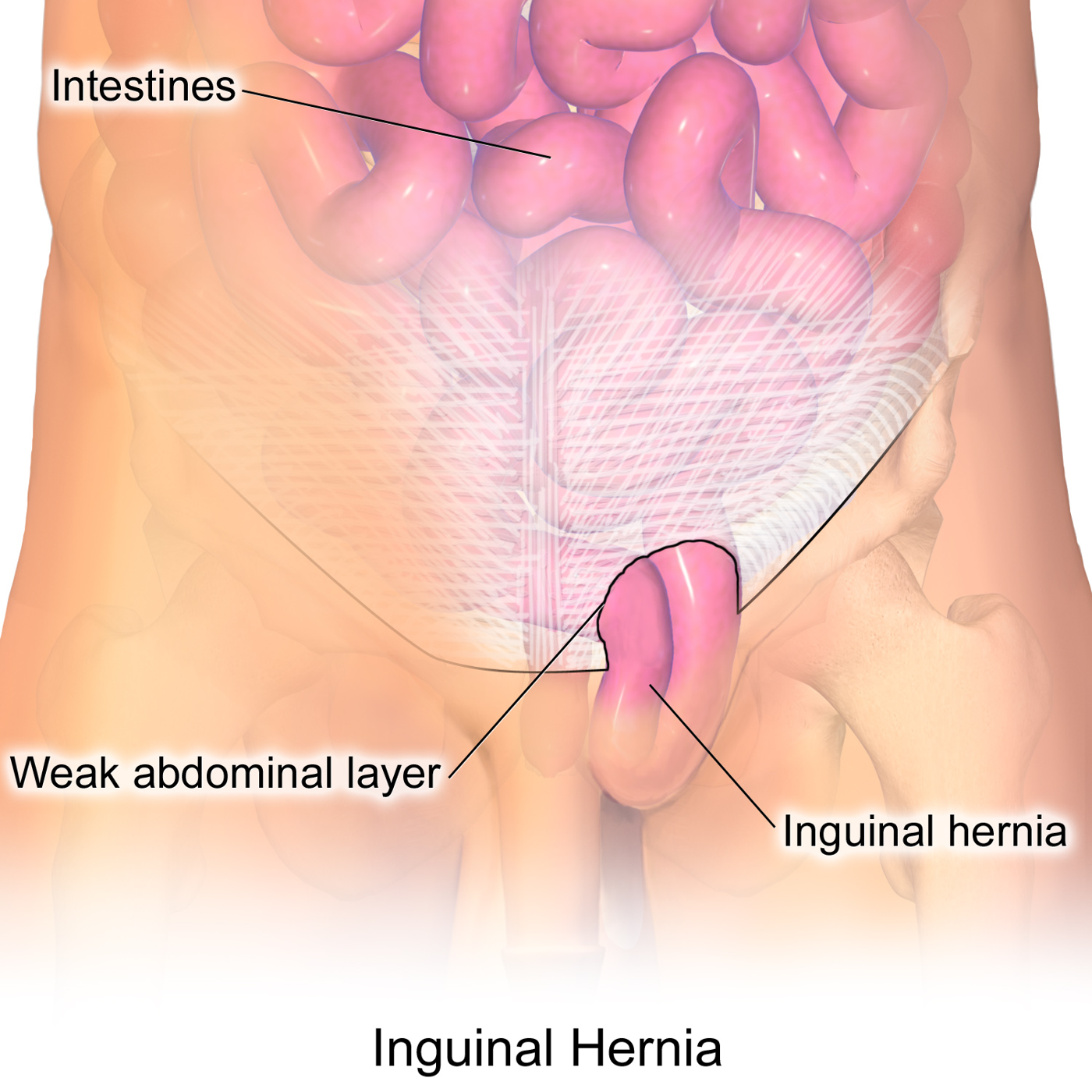
Image - An inguinal hernia. A loop of bowel has pushed through a weakness in the abdominal wall, producing a lump in the groin that extends towards the scrotum
Creative commons source by BruceBlaus [CC BY 3.0 (https://creativecommons.org/licenses/by/3.0)]
Palpation of the Lump
Before touching the patient, check once more that they are not in pain. Begin by palpating the normal side first to establish a baseline and to keep the patient at ease.
When you reach the lump, systematically assess its characteristics, as you would for any lump:
- Site, size and shape – and in particular its relationship to surrounding landmarks (covered in the next section).
- Temperature – a warm, erythematous lump is concerning for strangulation, where the blood supply to the trapped contents has been cut off.
- Tenderness – a hernia should normally be non-tender. Tenderness is a red flag that suggests incarceration, obstruction or strangulation.
- Consistency – a hernia containing bowel often feels soft and may gurgle, whereas one containing omentum feels firmer and more rubbery.
- Cough impulse – place your fingers gently over the lump and ask the patient to cough. A palpable expansile cough impulse (the lump bulges against your fingers) strongly supports a hernia. Note that the cough impulse may be absent if the hernia is incarcerated or strangulated, so its absence does not exclude a hernia.
Next, try to ‘get above’ the lump – gently feel for the upper border of the swelling between your finger and thumb. If you cannot get above the lump (i.e. it disappears up into the groin/inguinal canal), this suggests an inguinoscrotal hernia, because the lump is continuous with structures in the abdomen via the inguinal canal. If you can get above the lump, the swelling is arising from within the scrotum itself (such as a hydrocoele, epididymal cyst or testicular mass) rather than being a hernia descending from the abdomen.
Relationship to the Pubic Tubercle
Determining the position of the lump relative to the pubic tubercle is the single most useful manoeuvre for distinguishing an inguinal from a femoral hernia, and this distinction matters because femoral hernias are far more likely to strangulate and usually warrant urgent repair.
Femoral hernias are relatively more common in women and in the elderly, partly because of the wider female pelvis, so be especially alert to a groin lump in these patients. Despite this, inguinal hernias remain the commonest groin hernia overall in both sexes.
First locate the pubic tubercle – a bony prominence on the pubic bone, which is the medial attachment of the inguinal ligament. Then assess where the neck of the hernia sits in relation to it:
- Inguinal hernia – lies superior and medial to the pubic tubercle.
- Femoral hernia – lies inferior and lateral to the pubic tubercle.
This difference arises from the underlying anatomy: inguinal hernias pass through the inguinal canal, which lies above the inguinal ligament, whereas femoral hernias pass through the femoral canal, which lies below the inguinal ligament and just medial to the femoral vein.
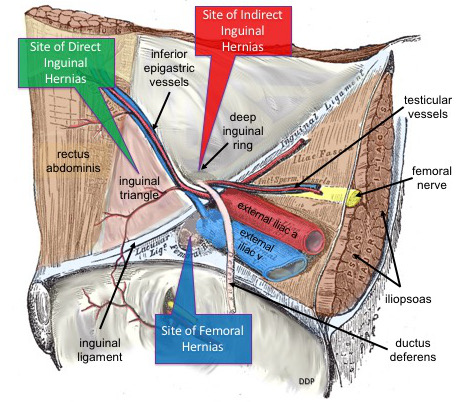
Image - The sites of lower abdominal hernias. Direct inguinal hernias arise medial to the inferior epigastric vessels, indirect inguinal hernias arise lateral to them through the deep ring, and femoral hernias pass below the inguinal ligament
Creative commons source by Dennis M. DePace, PhD [CC BY-SA 4.0 (https://creativecommons.org/licenses/by-sa/4.0)]
Reducibility and the Deep Ring Occlusion Test
Assessing reducibility tells you whether the hernia contents can be returned to the abdomen, which is reassuring, and the deep ring occlusion test then attempts to distinguish an indirect from a direct inguinal hernia.
First, attempt to reduce the hernia. With the patient lying flat (which itself often allows partial reduction), apply gentle, steady pressure starting at the most inferior part of the lump and direct the contents upwards and laterally towards the deep inguinal ring, following the line of the inguinal canal. A hernia that can be returned in this way is reducible; one that cannot is irreducible (incarcerated). An irreducible, tender hernia is a surgical emergency because of the risk of obstruction and strangulation, and you should never use force to reduce a tender hernia.
Once the hernia is reduced, locate the deep (internal) inguinal ring, which lies at the mid-point of the inguinal ligament – roughly midway between the anterior superior iliac spine and the pubic tubercle. Apply firm pressure over this point with two fingers and ask the patient to cough or stand:
- If the hernia remains controlled (does not reappear) while you occlude the deep ring, it is likely an indirect inguinal hernia. This is because an indirect hernia passes through the deep ring, so blocking the ring prevents the contents re-emerging.
- If the hernia reappears despite pressure over the deep ring, it is likely a direct inguinal hernia. A direct hernia pushes directly through a weakness in the posterior wall of the inguinal canal (Hesselbach’s triangle), medial to the deep ring, so occluding the ring does not control it.
The anatomical basis for this is the position of the inferior epigastric vessels: indirect hernias arise lateral to these vessels (entering at the deep ring), while direct hernias arise medial to them. It is worth being honest in your OSCE that the deep ring test is not fully reliable in practice, and that the type of hernia is ultimately confirmed at operation; nevertheless, demonstrating the test and explaining the reasoning shows sound understanding.
Auscultation and Transillumination
Auscultate over the lump with your stethoscope. Bowel sounds heard over the hernia indicate that it contains a loop of bowel, supporting the diagnosis of a hernia. The absence of bowel sounds does not exclude a hernia (the contents may be omentum, or the bowel may be obstructed or strangulated), but new absence of sounds in a previously gurgling hernia, combined with tenderness, is concerning for strangulation.
Listen also for a bruit. A bruit over a groin swelling should make you reconsider the diagnosis, as it suggests a vascular cause such as a femoral artery aneurysm or an arteriovenous malformation rather than a hernia.
If there is a scrotal swelling, perform transillumination by shining a pen-torch through it in a darkened area. A swelling that transilluminates (glows red) is fluid-filled and suggests a hydrocoele rather than a hernia. A hernia containing bowel and omentum is solid and will not transilluminate. This, together with being able to ‘get above’ the lump, helps separate a true hernia from other scrotal pathology.
Scrotal and Testicular Examination
If the swelling extends into the scrotum, or if there is any diagnostic uncertainty, examine the scrotum and testes (with the patient’s consent and a chaperone present). The aim is to confirm that you can identify both testes separately from the lump and to exclude a primary scrotal cause for the swelling.
Palpate each testis and epididymis in turn, assessing for tenderness, masses or irregularity. Being able to feel a normal testis distinct from the lump, and being able to get above the lump, points away from a hernia and towards a scrotal swelling such as a hydrocoele, epididymal cyst or testicular tumour. Conversely, if the lump is continuous with the inguinal canal and you cannot get above it, an inguinoscrotal hernia is likely.
Feel along the posterior aspect of the scrotum above each testis for a varicocoele, which classically feels like a soft ‘bag of worms’ and tends to be more prominent on standing. Like a hernia it may have a cough impulse, but it sits within the scrotum and the testis can usually be felt separately, helping to tell the two apart.
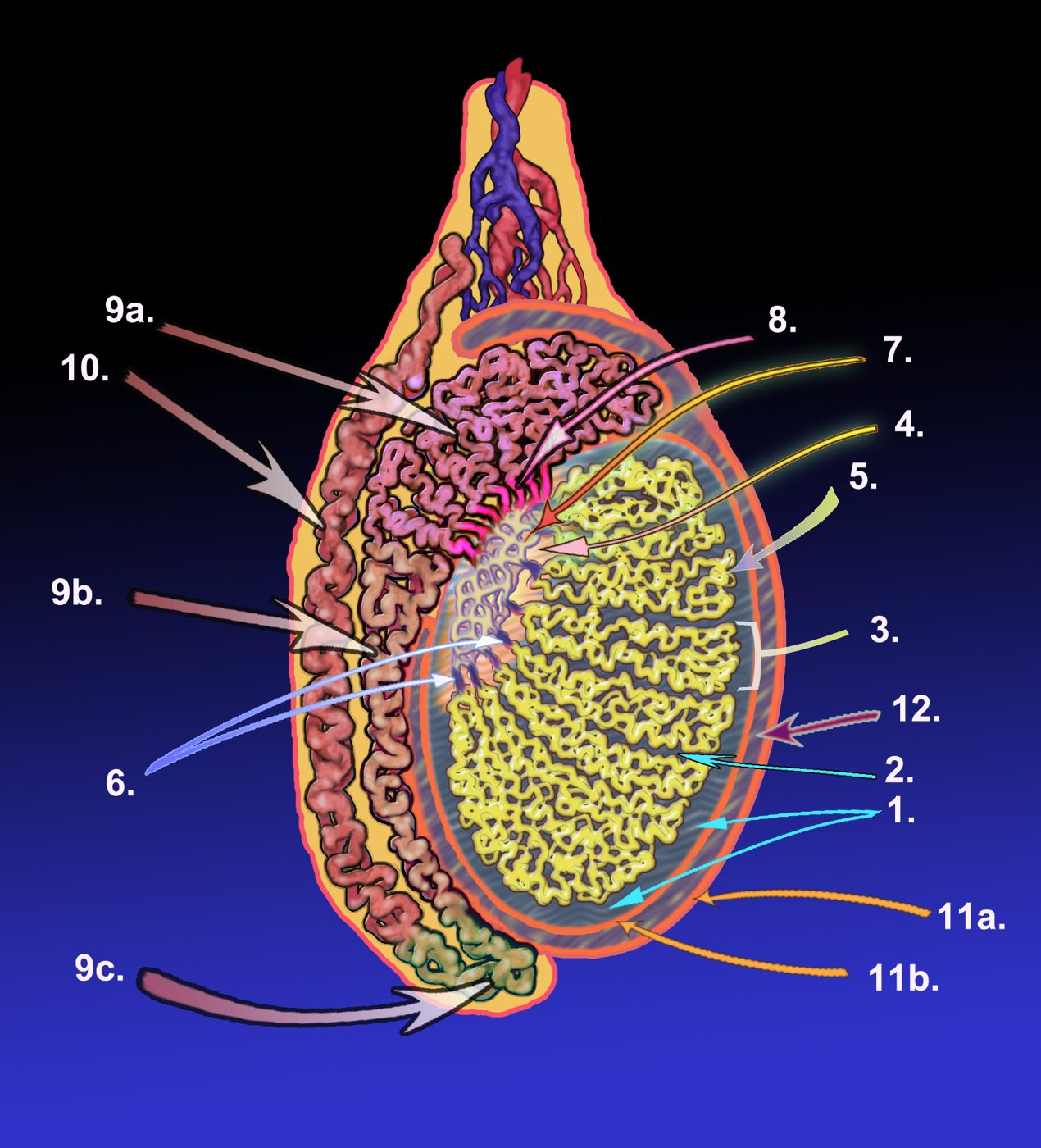
Image - The anatomy of the testis and epididymis. Identifying these structures separately from the swelling helps distinguish a scrotal lump from an inguinoscrotal hernia descending from the abdomen
SimpleMed original
Completing the Examination
Allow the patient to dress, restore their dignity, thank them and wash your hands.
Summarise your findings, stating the side, the likely type of hernia (inguinal vs femoral, and direct vs indirect where relevant), and crucially whether it is reducible and whether there are any features of complication (irreducibility, tenderness, overlying erythema or signs of bowel obstruction).
To complete the examination, state that you would:
- Examine the contralateral groin and perform a full abdominal examination, including looking for signs of bowel obstruction (distension, tinkling or absent bowel sounds).
- Examine the external genitalia fully and perform a focused examination of any associated scrotal swelling.
- Palpate the inguinal lymph nodes, as enlarged nodes can themselves present as a groin lump and may point to infection or malignancy rather than a hernia.
- Take a relevant history, including duration, reducibility, exacerbating factors and any features of obstruction such as vomiting and absolute constipation.
- Arrange relevant investigations where the diagnosis is unclear, such as an ultrasound of the groin, and order basic bloods and consider imaging for obstruction if a complicated hernia is suspected.
- Make an appropriate surgical referral, recognising that femoral hernias and any irreducible or symptomatic hernia warrant prompt review.
- 4