
Fundoscopy (Ophthalmoscopy) OSCE Examination
During any examination in an OSCE it is important to understand the pathology and reasoning behind each of the signs and symptoms elicited, even if the patient being examined is ‘normal’. This article explains how to perform a fundoscopy (ophthalmoscopy) examination and the key findings you should look for, showing you what each sign means and what conditions it may indicate.
Fundoscopy uses a focused beam of light and a series of lenses to inspect the fundus – the inner back surface of the eye. It is the only part of the body where blood vessels and a portion of the central nervous system (the optic nerve head) can be viewed directly, which makes it a uniquely valuable window onto systemic disease such as diabetes, hypertension and raised intracranial pressure.
Introduction
Gather your equipment – a direct ophthalmoscope (with charged batteries) and, where appropriate, mydriatic eye drops.
Wash your hands and don personal protective equipment if appropriate.
Introduce yourself to the patient and ensure to mention your grade e.g. 3rd year medical student/junior doctor/consultant.
Confirm the patient’s details taking 3 points of identification usually; full name, date of birth and NHS/hospital number.
Obtain consent for the examination, ensuring to explain what the examination will entail. It is worth warning the patient that you will need to dim the lights, that you will be working very close to their face, and that the light will be bright and may be uncomfortable.
Ask the patient if they have any pain in or around the eyes before you begin.
Position the patient seated in a chair at your eye level. It is important to seat the patient before dimming the lights to avoid trips and falls in the dark.
Ask the patient to remove their glasses if they wear them, as the frames get in the way; contact lenses can stay in. Any residual refractive error is corrected later using the ophthalmoscope’s lens dial.
Ask the patient to fixate on a distant target behind you (for example a spot on the wall) and to keep looking at it throughout, even when your head moves into their line of sight. Fixation on a distant point relaxes accommodation, keeps the eye still and helps bring the fundus into focus.
General Inspection
Begin with a general inspection of the patient and the bedside, as this often provides important clues before the ophthalmoscope is even picked up.
Inspect the patient for any obvious visual aids such as glasses, a white cane or a guide dog, which suggest significant visual impairment, and note any head turn or abnormal posture that a patient may adopt to compensate for a visual field defect.
Glance at the external eyes before reaching for the ophthalmoscope. Note the eyelids for ptosis (a drooping upper lid, seen in a third nerve palsy or Horner’s syndrome) and compare the pupils for size, symmetry and shape. A pupil that is fixed and dilated, or markedly unequal, is relevant both to the underlying pathology and to whether the eye has already been pharmacologically dilated.
Look around the bedside for objects relevant to the underlying diagnosis, such as capillary blood glucose monitors or insulin (suggesting diabetes), blood pressure equipment (suggesting hypertension), or eye drops. These are valuable because the most common abnormalities seen on fundoscopy – diabetic and hypertensive retinopathy – are complications of these systemic diseases.
Assess whether the patient appears comfortable or is in distress. A patient with a painful red eye, severe headache or vomiting may have an acute condition such as acute angle-closure glaucoma and should be assessed urgently.
Preparing for Fundoscopy
Good preparation is what separates a useful fundoscopy from a frustrating one, and examiners reward it.
Dilate the pupils. A small pupil is the single biggest obstacle to a good view of the fundus, as it acts like a narrow keyhole. Where appropriate, instil a short-acting mydriatic such as tropicamide 1% to widen the pupil and let in more light. The pupil typically takes around 15–20 minutes to dilate. It is essential to warn the patient that their vision will become blurred and light-sensitive for several hours and that they must not drive until it has worn off.
Before dilating, consider the risks. Mydriatics can precipitate acute angle-closure glaucoma in susceptible eyes, because widening the pupil bunches up the peripheral iris and can block drainage of aqueous humour at the iridocorneal angle, causing a sudden rise in intraocular pressure. Dilation also temporarily abolishes the pupillary response, which is unhelpful if you are monitoring a patient with a head injury or other neurological condition. In an OSCE you may simply be expected to state that you would dilate the pupil and acknowledge these considerations.
Set up the ophthalmoscope. Turn the light to its maximum brightness and select a medium, round white beam for a standard examination. Set the lens (dioptre) dial to 0 as a starting point; this dial can later be rotated to compensate for your own and the patient’s refractive error to bring the fundus into sharp focus. Most ophthalmoscopes also offer additional beam settings, including a red-free (green) filter that removes red wavelengths so that blood appears black against a green background. This sharpens the contrast of the blood vessels and small haemorrhages and is particularly useful when scrutinising the retinal vasculature and the centre of the macula in more detail.
Dim the room lights. A dark room causes the patient’s pupils to dilate naturally and greatly improves your view, complementing any pharmacological dilation.
Match eye to eye and hand to hand. Examine the patient’s right eye with your right eye, holding the ophthalmoscope in your right hand, and their left eye with your left eye and left hand. This keeps your head and the instrument out of the patient’s line of fixation and lets you get close without your noses colliding.
Assessing the Fundal (Red) Reflex
The first step of the examination proper is to assess the fundal reflex, also called the red reflex.
Hold the ophthalmoscope to your eye and, from approximately one arm’s length away and slightly to the side, shine the light onto the patient’s pupil. You should observe a reddish-orange reflection filling the pupil. This colour is produced by light reflecting back off the vascular, pigmented retina – it is the same effect that causes ‘red eye’ in flash photography.
An absent, diminished or abnormally coloured reflex indicates that something is obstructing the path of light between the cornea and the retina:
- A white reflex (leukocoria) is an important finding. In a child it must prompt urgent referral, as it can be caused by retinoblastoma (a malignant retinal tumour) or congenital cataract.
- A dark or absent reflex in an adult is most commonly due to a cataract (opacification of the lens), but can also reflect a dense vitreous haemorrhage.
Anterior Segment
As you move closer, take a moment to inspect the anterior structures of the eye through the ophthalmoscope before focusing on the retina. Increasing the positive (plus) lenses on the dioptre dial brings these more superficial structures into focus.
Look at the cornea and lens for any opacities. Lens opacities appear as dark shadows or specks silhouetted against the red reflex and represent cataract. Identifying media opacities at this stage explains why your subsequent view of the retina may be poor and prevents you from mistaking the obstruction for retinal pathology.
The Optic Disc
Keeping the red reflex in view, approach the eye from roughly 15 degrees to the temporal (outer) side rather than head-on; this lines you up with the optic disc, which sits slightly nasal to the centre of the fundus, and avoids the macula. Rest your free hand on the patient’s forehead, with your thumb above their eyebrow – this steadies you, stops you bumping noses, and lets you gently lift the upper lid if needed.
Move in to within a few centimetres of the patient’s eye, keeping the light directed onto the pupil, and adjust the dioptre dial until the retina comes into focus. The most reliable way to locate the optic disc is to find a retinal blood vessel and follow it ‘upstream’ in the direction in which the branches converge – all the vessels ultimately lead back to the disc.
The optic disc is the point at which the optic nerve and retinal vessels enter the eye. Assess it systematically using the three Cs: Colour, Contour and Cup.
- Colour: a healthy disc is orange-pink with a paler centre, often likened to a doughnut. The orange-pink rim represents healthy, well-perfused neuroretinal tissue. An abnormally pale disc indicates optic atrophy, in which nerve fibres have been lost; causes include optic neuritis (classically in multiple sclerosis), advanced glaucoma and ischaemic optic neuropathy.
- Contour: the disc margins should be sharp and well-defined. Blurring of the margins suggests swelling of the optic disc. When this is bilateral and caused by raised intracranial pressure it is termed papilloedema and is a red-flag finding that may indicate a space-occupying lesion or idiopathic intracranial hypertension.
- Cup: the cup is the pale central depression where there is no neuroretinal tissue. Its size is described as the cup-to-disc ratio; a ratio of around 0.3 (the cup occupying roughly one-third of the disc) is normal. An enlarged cup (a high cup-to-disc ratio) reflects loss of nerve fibres at the rim and is a hallmark of glaucoma.
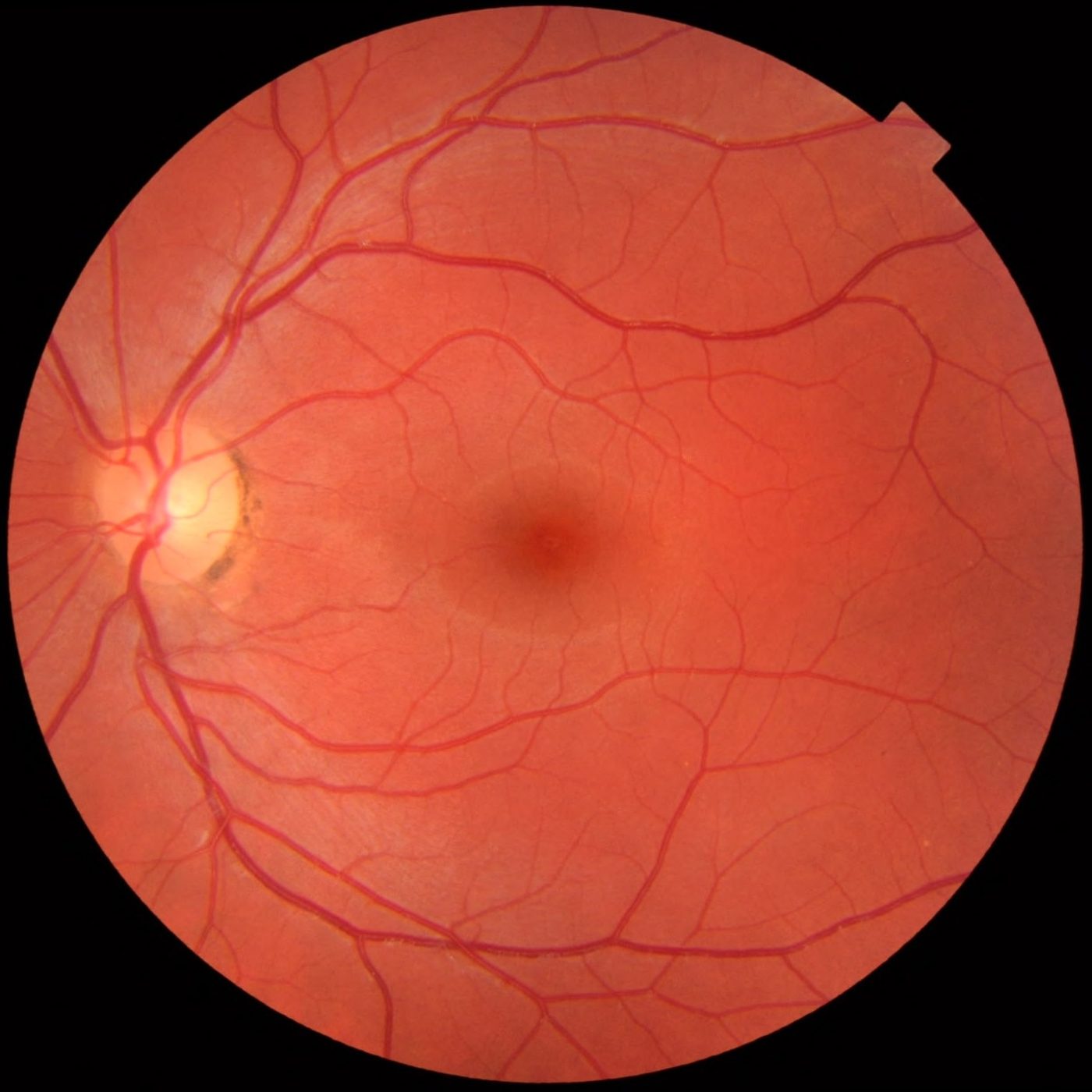
Image - A normal fundus. The orange-pink optic disc with a sharp margin and small central cup is visible, with healthy vessels radiating outwards and the darker macula to the side
Creative commons source by Mikael Häggström [CC0 (https://creativecommons.org/publicdomain/zero/1.0)]
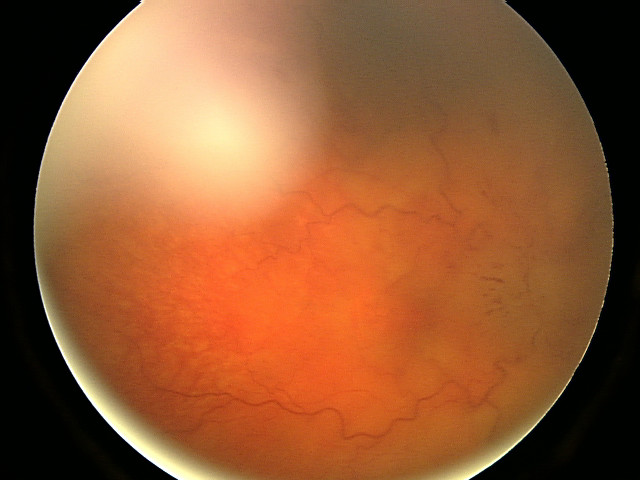
Image - Severe papilloedema. The optic disc margins are blurred and the disc is swollen and elevated, indicating raised intracranial pressure
Creative commons source by Bansal, Dabbs and Long [CC BY 2.0 (https://creativecommons.org/licenses/by/2.0)]
The Retina and Retinal Vessels
From the optic disc, follow the four main vascular arcades outwards to examine each quadrant of the retina in turn – superonasal, superotemporal, inferonasal and inferotemporal. Working systematically in a clockwise or anticlockwise fashion ensures no area is missed.
For each quadrant, trace the arteries and veins. Arteries are thinner and a brighter red, while veins are broader and a darker red. The normal ratio of arterial to venous width (the AV ratio) is approximately 2:3. Inspect the vessels and surrounding retina for the following key signs, most of which point to systemic disease:
- Arteriolar narrowing and arteriovenous (AV) nipping – where a thickened artery compresses the vein it crosses – are features of hypertensive retinopathy, reflecting long-standing high blood pressure thickening the arteriolar walls. As the walls thicken further they reflect more light, giving the artery a copper-wire and then, in advanced disease, a silver-wire appearance. These changes are graded by the Keith–Wagener–Barker classification (grades 1–4), with grade 4 defined by accompanying papilloedema.
- Microaneurysms are tiny red dots caused by outpouchings of weakened capillary walls and are typically the earliest sign of diabetic retinopathy.
- Dot-and-blot haemorrhages and flame haemorrhages represent bleeding within the retina; flame-shaped haemorrhages lie in the superficial nerve fibre layer and are common in hypertension, while deeper dot-and-blot haemorrhages are typical of diabetes.
- Hard exudates are well-defined, waxy yellow deposits of leaked lipid and protein, often arranged in rings around leaking microaneurysms, and are seen in both diabetic and hypertensive retinopathy.
- Cotton wool spots are fluffy, ill-defined white patches representing small infarcts of the retinal nerve fibre layer, indicating ischaemia in diabetes and more severe hypertension.
- Venous beading describes veins that look irregular and sausage-shaped, like a string of beads. It is a marker of significant retinal ischaemia and signals pre-proliferative (severe non-proliferative) diabetic retinopathy – a warning that new vessels are likely to follow.
- New vessels (neovascularisation) are fragile, abnormal vessels that grow in response to retinal ischaemia. They define proliferative diabetic retinopathy and are dangerous because they bleed easily, causing vitreous haemorrhage and risking sight loss.
It helps to fit these diabetic signs into the standard UK grading. Background (mild non-proliferative) retinopathy shows microaneurysms, occasional dot-and-blot haemorrhages and hard exudates. Pre-proliferative (moderate-to-severe non-proliferative) retinopathy adds markers of ischaemia – multiple haemorrhages, cotton wool spots and venous beading. Proliferative retinopathy is defined by new vessels at the disc or elsewhere. Separately, diabetic maculopathy (exudates, haemorrhage or oedema threatening the macula) can occur at any stage and is the commonest cause of visual loss in diabetes.
The pattern of vascular occlusion can also be diagnostic. A central retinal vein occlusion produces widespread haemorrhages and tortuous, engorged veins (a ‘stormy sunset’ appearance), whereas a central retinal artery occlusion causes a pale, oedematous retina with a cherry-red spot at the macula.
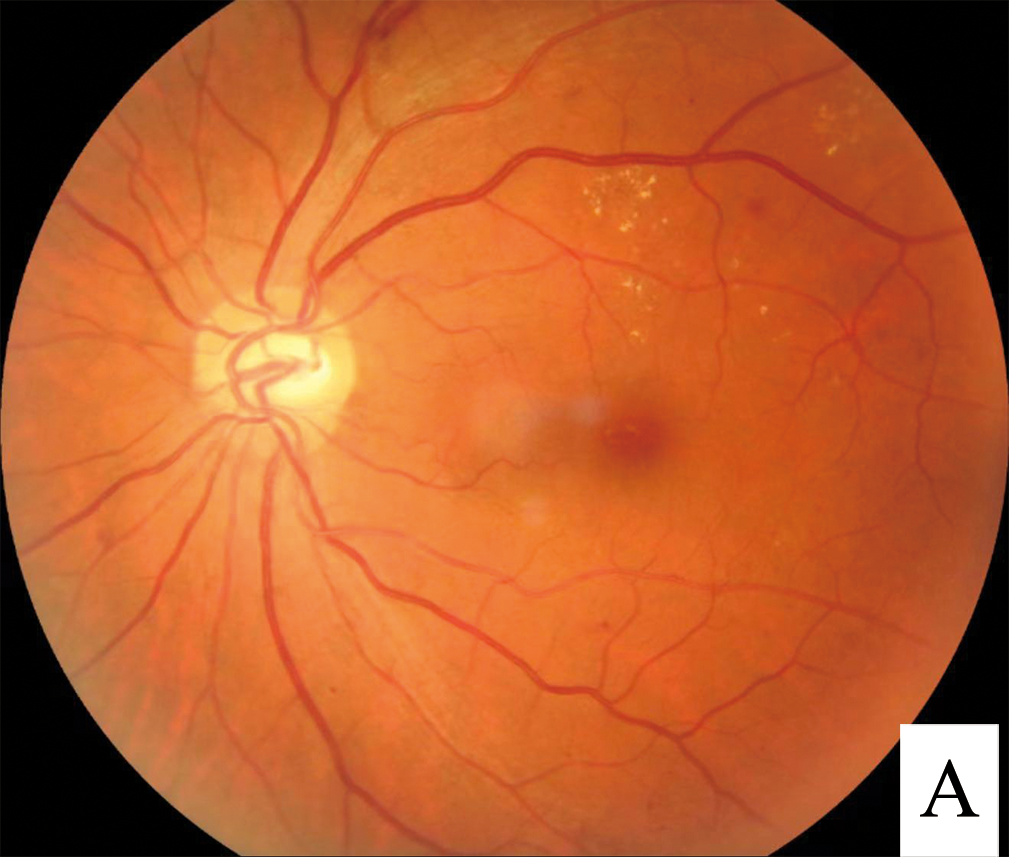
Image - Diabetic retinopathy. Scattered haemorrhages, microaneurysms and yellow hard exudates are visible across the retina
Creative commons source by Hao et al. [CC BY 4.0 (https://creativecommons.org/licenses/by/4.0)]
The Macula
Finally, examine the macula, the area responsible for central, high-acuity vision. It lies temporal (lateral) to the optic disc. The simplest way to bring it into view is to ask the patient to look directly into the light of the ophthalmoscope, which rotates the eye so that the macula faces you. It should be examined last because the bright light is uncomfortable and causes reflex pupillary constriction.
The macula appears slightly darker than the surrounding retina because it is rich in yellow xanthophyll pigment (giving it the name macula lutea, or ‘yellow spot’) and lacks large blood vessels. At its centre is the fovea, roughly one disc diameter across and the point of sharpest vision. Switching to the red-free (green) filter at this point can help define the foveal region and reveal subtle vascular or haemorrhagic changes that are easily missed under white light.
Look for drusen – small yellow deposits beneath the retina – and pigmentary change, which are features of age-related macular degeneration (AMD), the leading cause of irreversible central vision loss in older adults. Hard exudates encroaching on the macula in a diabetic patient indicate diabetic maculopathy, a sight-threatening complication, and a cherry-red spot here points to central retinal artery occlusion.
Examining the Other Eye
Once you have completed your systematic assessment of the fundal reflex, optic disc, retinal quadrants and macula in one eye, repeat the entire process in the other eye, remembering to switch to your other eye and hand.
Comparing the two sides is clinically important, as it distinguishes bilateral disease (such as the papilloedema of raised intracranial pressure or the changes of diabetic and hypertensive retinopathy) from unilateral pathology (such as a vein or artery occlusion, or unilateral optic disc swelling), which carries a different list of causes.
Completing the Examination
Restore the room lighting and thank the patient. Explain that the effects of any dilating drops will take a few hours to wear off and reiterate that they should not drive in the meantime.
Wash your hands.
Summarise your findings.
To complete the examination, state that you would perform a full eye examination, including assessment of visual acuity (using a Snellen chart), visual fields, pupillary reflexes, colour vision and eye movements, along with examination of the anterior segment using a slit lamp. Where macular disease is suspected, an Amsler grid can be used to detect the distortion (metamorphopsia) of early macular degeneration, and a cranial nerve examination is appropriate if the optic disc or pupillary findings suggest a neurological cause. Depending on the suspected diagnosis you would also measure intraocular pressure, check a capillary blood glucose and HbA1c, measure the blood pressure, and refer to ophthalmology where appropriate.
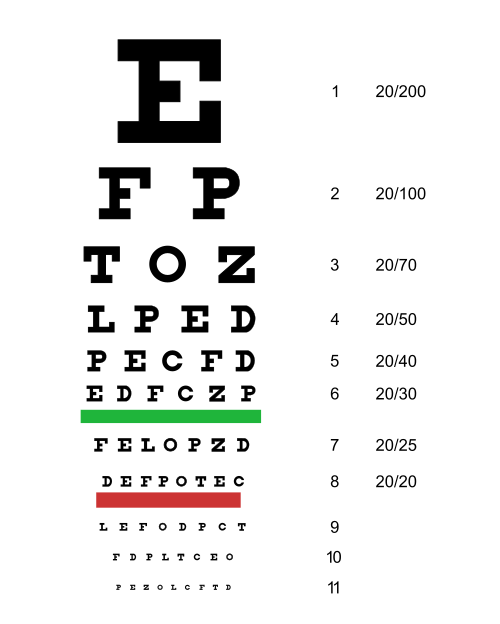
Image - A Snellen chart, used to measure visual acuity as part of the wider eye assessment that complements fundoscopy
SimpleMed original
- 4