
During any examination in an OSCE it is important to understand the pathology and reasoning behind each of the signs and symptoms elicited, even if the patient being examined is ‘normal’. This article explains how to perform an eye and vision examination and the key findings you should look for, showing you what each sign means and what conditions it may indicate.
Visual Acuity
Visual acuity is the sharpness of central vision and is the single most important measurement in an eye examination. It is assessed using a Snellen chart positioned at 6 metres from the patient (or at 3 metres using a mirror). If the patient normally wears distance glasses, these should be worn, as you are testing their best corrected vision.
Test each eye separately, asking the patient to cover the other eye and read down the chart until the letters can no longer be made out. Record each eye individually, noting whether glasses were worn.
Visual acuity is recorded as a fraction, for example 6/6. The top number is the distance the patient was from the chart (6 metres), and the bottom number is the distance at which a person with normal vision could read that same line. So 6/6 is normal vision, while 6/60 means the patient can only read at 6 metres what a normal-sighted person could read at 60 metres – markedly reduced acuity.
If the patient cannot read the top letter of the chart even at 6 metres, the assessment is stepped down: move the patient to 3 metres, then 1 metre, then test counting fingers, hand movements, and finally perception of light. This grading describes exactly how poor the vision is and is important for documentation and for assessing severe disease.
If acuity is reduced, repeat the test with the patient looking through a pinhole. A pinhole allows only the central, most focused rays of light to reach the retina. If vision improves with a pinhole, the cause is most likely a refractive error (the eye is simply out of focus, correctable with glasses). If it does not improve, this points towards a pathological cause such as cataract, macular disease or optic nerve pathology.
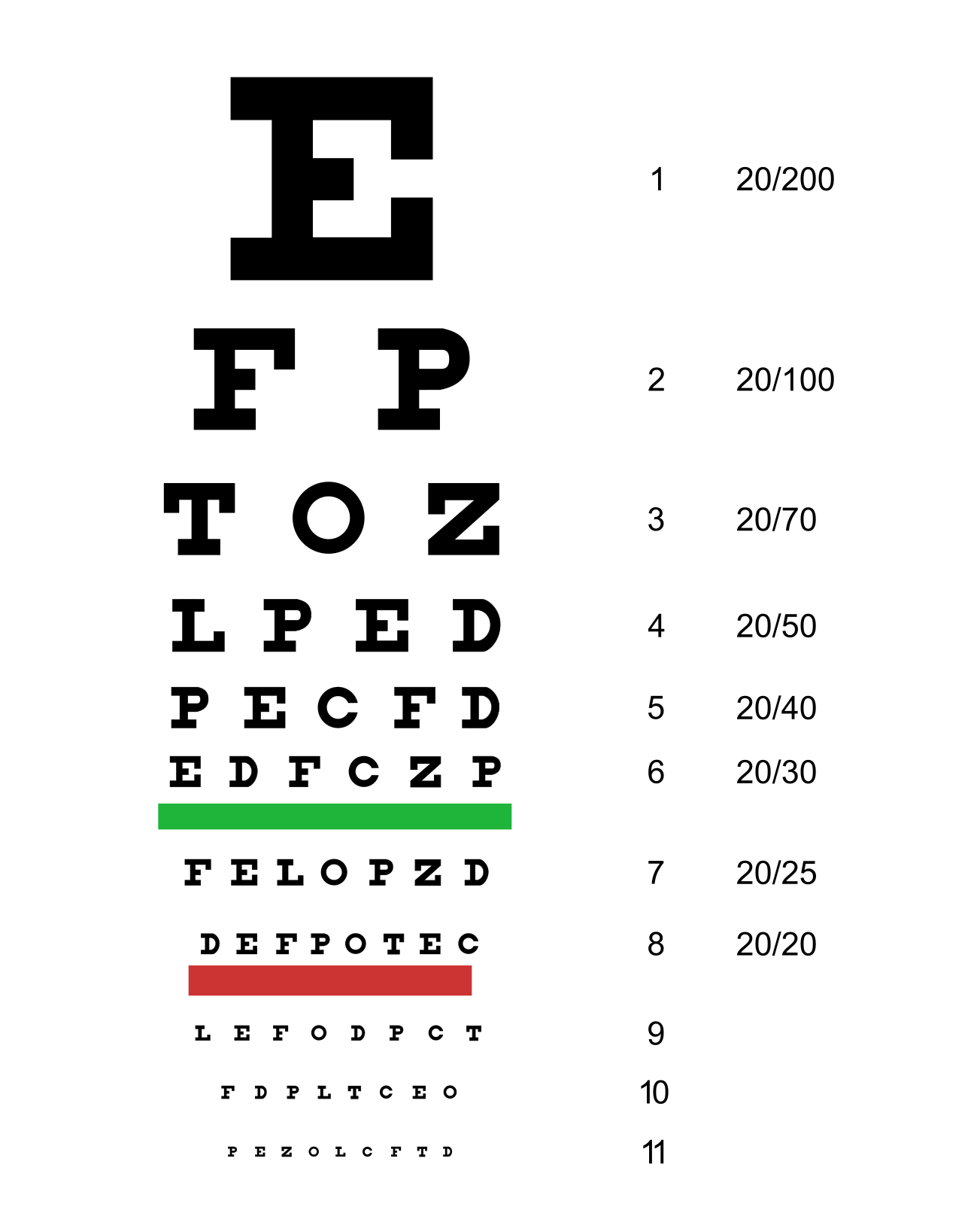
Image - A Snellen chart, used to assess distance visual acuity. The patient reads down the chart at a set distance, and acuity is recorded as a fraction such as 6/6
Creative commons source by Jeff Dahl [CC BY-SA 3.0 (https://creativecommons.org/licenses/by-sa/3.0)]
Near vision should also be assessed, using a near reading chart held at a comfortable reading distance with the patient wearing any reading glasses. Reduced near vision with preserved distance vision is common in presbyopia, the age-related loss of accommodation.
Colour Vision
Colour vision is assessed using Ishihara plates. Each plate is made up of coloured dots arranged so that a number is visible to those with normal colour vision but is difficult or impossible to identify for those with a colour vision deficit.
The patient is asked to identify the number on each plate, testing one eye at a time. The first plate is usually a ‘test plate’ visible to everyone, including those with colour blindness, which checks the patient has understood the task and has adequate acuity to see the dots.
Ishihara plates primarily assess red-green colour discrimination. Test each eye separately; reduced performance in a symptomatic eye may support acquired colour impairment from optic nerve disease, such as optic neuritis, even when visual acuity is relatively preserved. Assess red desaturation separately by comparing the same red target between the eyes and asking whether it looks washed out or less vivid on one side. Colour-plate testing and red-target comparison assess different aspects of colour perception; neither alone establishes a diagnosis of optic neuritis.
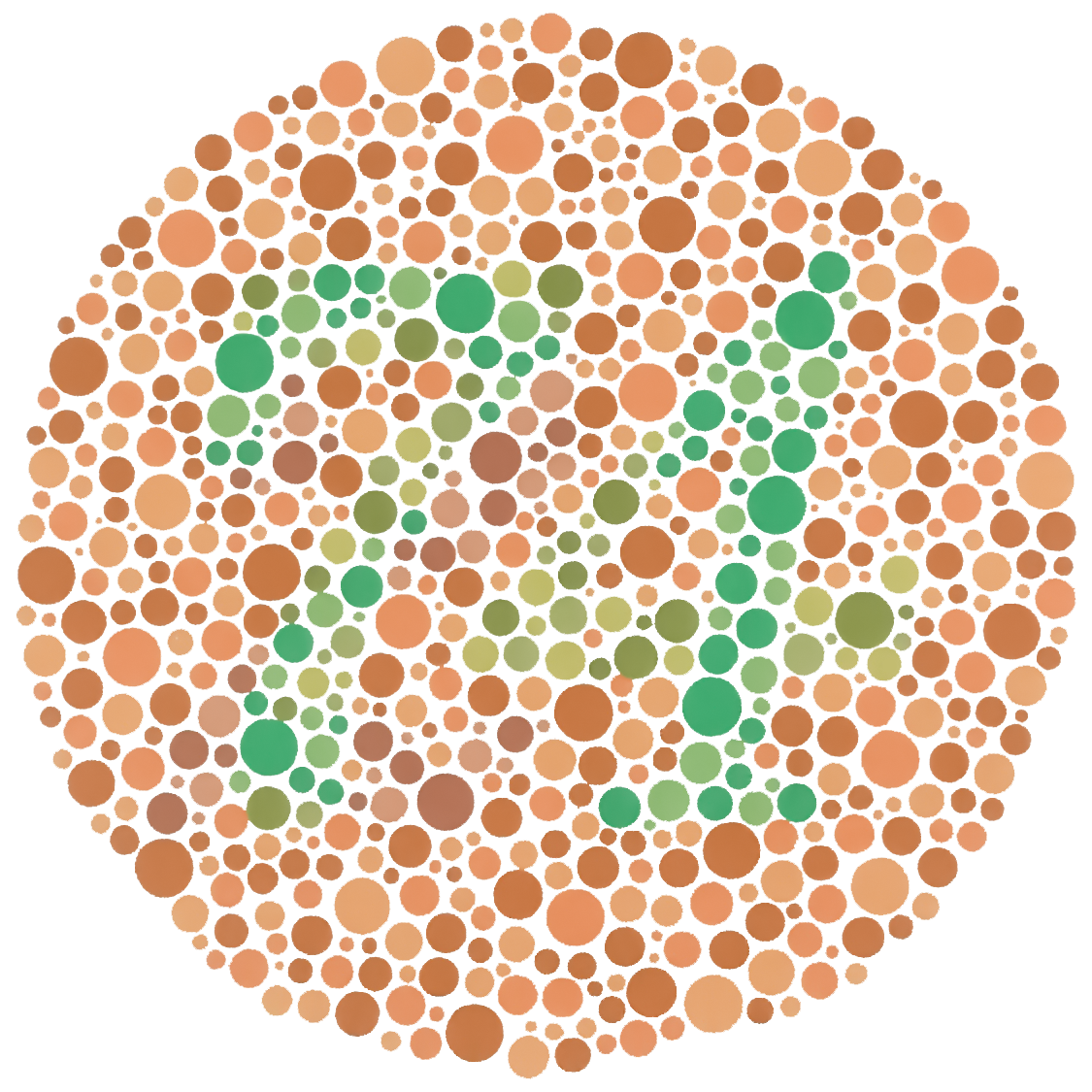
Image - An Ishihara red-green colour-discrimination plate. People with typical colour vision read 74; people with red-green colour deficiency may read a different number or no number. This plate is not a direct test of red vividness
Creative commons source by Shinobu Ishihara [Public domain]
Visual Fields
The visual fields are assessed by confrontation, comparing the patient’s field of vision with your own. Sit directly opposite the patient at about one metre, with your eyes level with theirs.
Test each eye separately. Ask the patient to cover one eye, and cover your own opposite eye so that you are mapping their field against yours as a reference. Ask the patient to look straight at your nose, then bring a target (such as a moving fingertip or a red-topped hat pin) in from the periphery in each of the four quadrants, asking the patient to say when they first see it. Their field should match yours if your own fields are normal.
The pattern of any visual field loss localises the lesion along the visual pathway, which is one of the most clinically valuable aspects of the examination:
- A defect in one eye only (a monocular field loss) suggests pathology anterior to the optic chiasm – in that eye, optic nerve or retina.
- A bitemporal hemianopia (loss of the outer half of vision in both eyes) is caused by compression at the optic chiasm, classically by a pituitary tumour.
- A homonymous hemianopia (loss of the same side of the visual field in both eyes) is caused by a lesion behind the chiasm, such as a stroke affecting the optic tract, radiation or occipital cortex.
You should also test for central scotomas (areas of lost vision within the central field) using a red target, as these occur in macular and optic nerve disease, and assess for visual inattention (neglect) by holding both hands in the periphery and wiggling the fingers of one or both at random; a patient who consistently misses one side when both are moved together has visual inattention, typically from a parietal lobe lesion on the opposite side.
The blind spot can also be mapped and compared with your own. The physiological blind spot lies just temporal to central vision and corresponds to the optic disc, where the optic nerve leaves the eye and there are no photoreceptors. With one of the patient’s eyes covered and your opposite eye closed, move a small red target horizontally across the field until it disappears for both of you; an enlarged blind spot suggests optic disc swelling, such as in papilloedema.
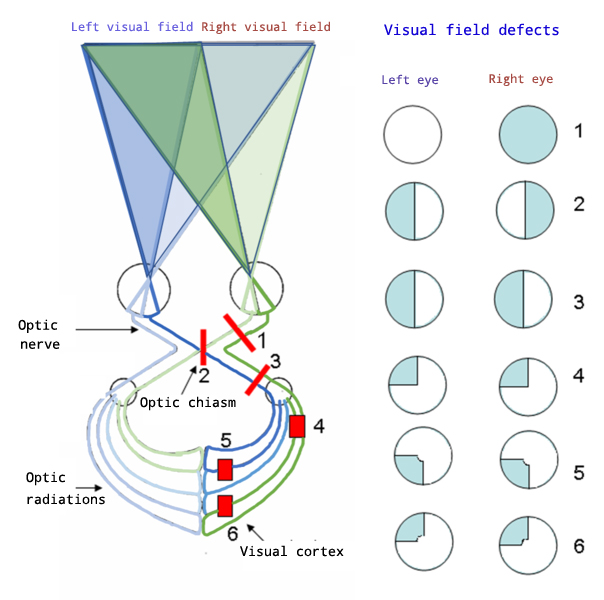
Image - Visual field defects mapped to the level of the lesion. A monocular defect localises in front of the chiasm, a bitemporal hemianopia at the chiasm, and a homonymous hemianopia behind it
Image source by As eo [CC BY-SA 4.0]
Fundoscopy
Fundoscopy (ophthalmoscopy) allows direct examination of the retina, optic disc and retinal vessels. It is best performed in a darkened room; dilating the pupil with a mydriatic such as tropicamide gives a much better view, although in an OSCE you would state your intention to do so and check there is no contraindication first.
Begin by assessing the red reflex from about an arm’s length away, looking through the ophthalmoscope at each pupil. The reflex is light reflected from the fundus and seen through the pupil; blood in the underlying choroidal circulation beneath the retina contributes its red-orange colour. The hue varies with pigmentation, so assess clarity and symmetry between the eyes. Absence of the reflex or a dark interruption suggests an opacity in the visual axis, such as a cataract or vitreous haemorrhage. In children, a white reflex (leukocoria) requires urgent assessment because it can indicate retinoblastoma or a congenital cataract.
Then move in close, following a retinal vessel back towards the optic disc. Assess the disc’s colour, margins and central cup. A swollen disc with blurred margins (papilloedema) suggests raised intracranial pressure; a pale disc indicates optic atrophy; and an enlarged, deeply excavated cup is seen in glaucoma.
Examine the retinal vessels and the retinal background, then ask the patient to look directly at the light to bring the macula into view. Important findings include the microaneurysms, dot-and-blot haemorrhages, hard exudates and neovascularisation of diabetic retinopathy; the arteriovenous nipping, flame haemorrhages and cotton-wool spots of hypertensive retinopathy; and the drusen or pigmentary changes of age-related macular degeneration.
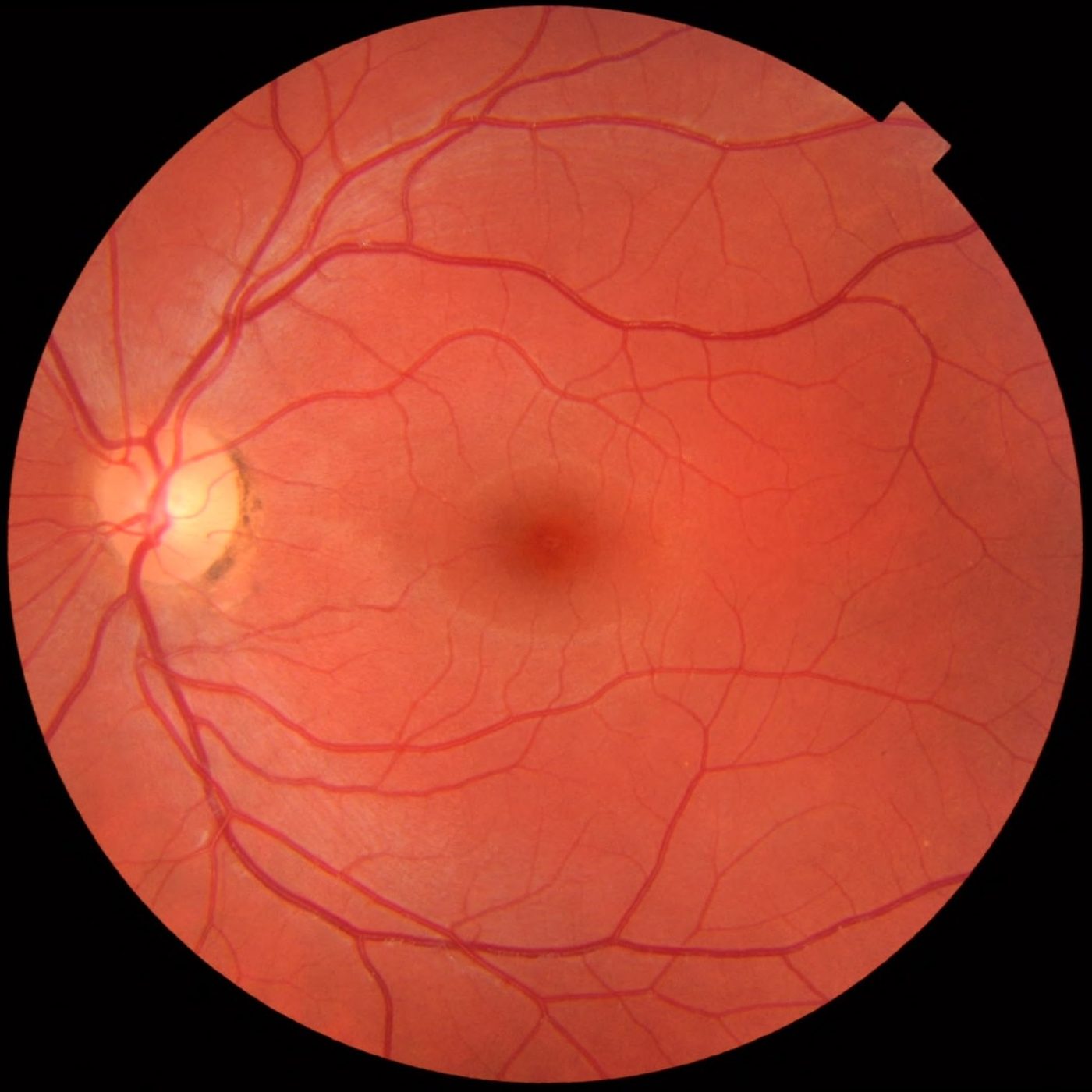
Image - A fundus photograph of a normal left eye. The optic disc is seen as the pale circular structure, with the retinal vessels radiating from it and the darker macula to the side
Creative commons source by Mikael Häggström [CC0 1.0 (https://creativecommons.org/publicdomain/zero/1.0)]
- 221