Elbow OSCE Examination
During any examination in an OSCE it is important to understand the pathology and reasoning behind each of the signs and symptoms elicited, even if the patient being examined is 'normal'. This article explains how to perform an elbow examination and the key findings you should look for, showing you what each sign means and what conditions it may indicate.
The elbow is examined using the classic musculoskeletal framework of look, feel and move, followed by a small number of special tests and an assessment of the surrounding neurovascular structures. Throughout, remember that the elbow is a hinge joint formed by the articulation of the humerus, ulna and radius, and that pronation and supination of the forearm occur at the superior radio-ulnar joint rather than the elbow hinge itself.
Introduction
Wash your hands and don personal protective equipment if appropriate.
Introduce yourself to the patient and ensure to mention your grade e.g. 3rd year medical student/junior doctor/consultant.
Confirm the patient's details, taking 3 points of identification usually: full name, date of birth and NHS/hospital number.
Obtain consent for the examination, ensuring to explain what the examination will entail.
Expose both upper limbs fully from the shoulders down. Examining both sides is essential, as many findings (such as swelling, deformity or a difference in carrying angle) are only obvious when the elbows are compared with one another.
Position the patient standing or sitting so that you can walk around them and view the limbs from the front, side and back.
Ask whether the patient is currently in any pain, and where it is, before you touch them. This both shows courtesy and helps you avoid causing distress during palpation and movement.
No specific equipment is required for an elbow examination, but offer a chaperone where appropriate and have a goniometer available if you wish to measure the range of movement precisely.
General Inspection
Begin by standing back and observing the patient as a whole. Look for signs of systemic disease, since the elbow is a common site for the skin and joint features of inflammatory conditions.
Note whether the patient appears comfortable or is holding the arm guarded and protected, which suggests pain or instability. Observe their general demeanour and whether they are well or unwell.
Scan the surrounding bedside for clues, such as mobility aids, an arm sling, splints or analgesia, all of which point towards recent injury, surgery or chronic joint pathology.
Look on the extensor surfaces for psoriatic plaques — well-demarcated, salmon-pink scaly plaques. The elbow is a classic site for psoriasis, and recognising it matters because of the strong association between psoriasis and psoriatic arthritis. Also note any obvious lumps over the elbow that may represent rheumatoid nodules, which are a sign of rheumatoid arthritis.
Look (Closer Inspection)
Inspect each elbow closely from the front, the side and behind, comparing left with right. Where one elbow is known to be symptomatic, inspect the asymptomatic side first so you have a baseline for normal before examining the affected joint.
Look for scars, which may indicate previous trauma or surgery such as fracture fixation, nerve transposition or joint replacement. The position of a scar can hint at the underlying procedure.
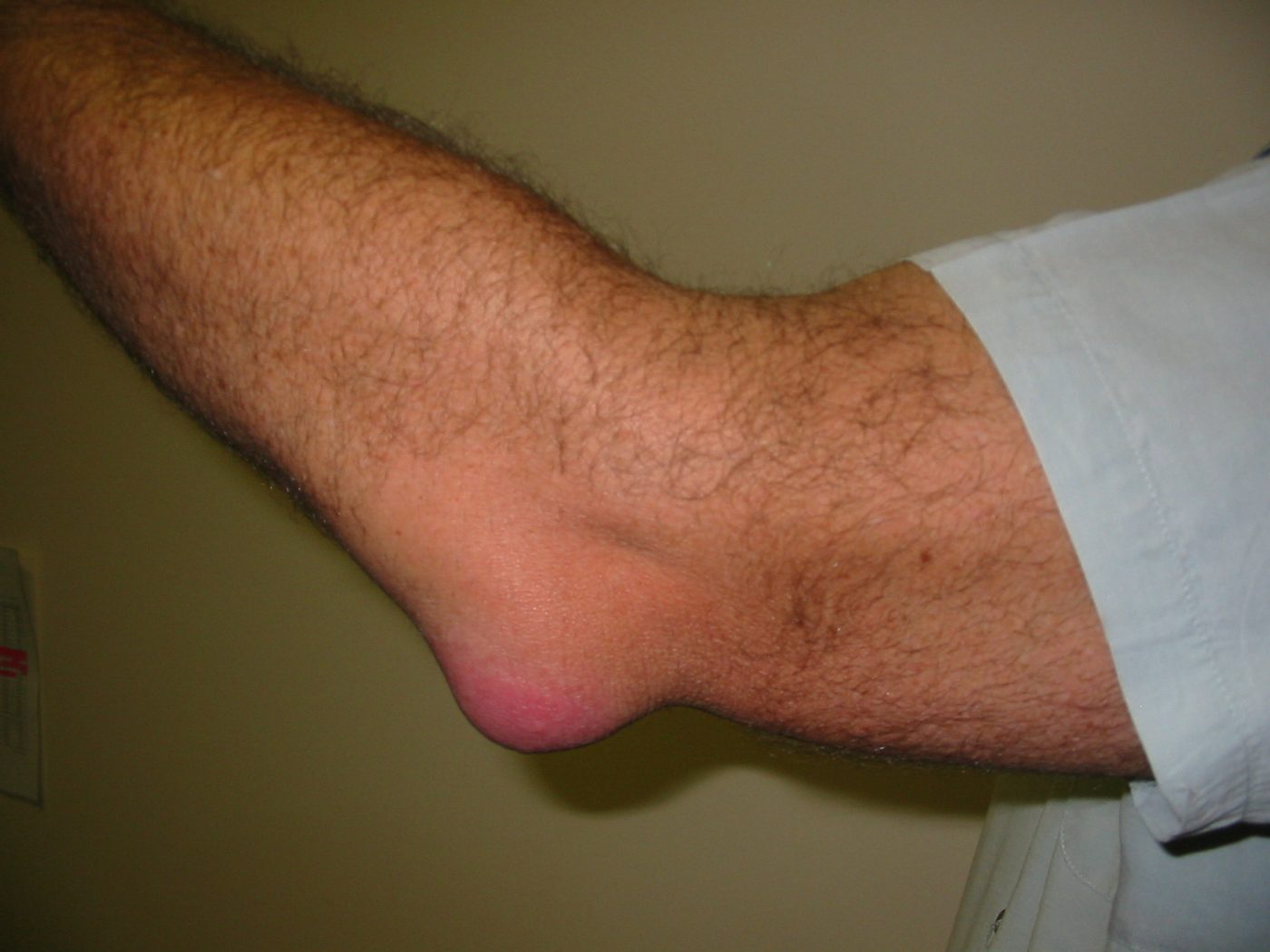
Look for swelling. Diffuse swelling of the joint may represent an effusion or inflammatory arthropathy, while a discrete, fluctuant swelling over the point of the elbow suggests olecranon bursitis (inflammation of the bursa overlying the olecranon, sometimes called 'student's elbow').
Look for muscle wasting of the upper arm or forearm. Wasting suggests disuse atrophy secondary to chronic joint pathology, or denervation from a lower motor neurone lesion such as nerve entrapment.
Look for rheumatoid nodules — firm, non-tender subcutaneous lumps over the extensor surface and olecranon — and psoriatic plaques, as described above.
Assess the carrying angle. With the arm extended and the palm facing forwards, the forearm normally deviates laterally away from the body by approximately 5–15°; this is the carrying angle, and it is typically slightly greater in women. An angle greater than 15° is termed cubitus valgus, which is associated with previous trauma or congenital conditions such as Turner's syndrome, and which can stretch the ulnar nerve over time (a 'tardy ulnar nerve palsy'). An angle that is reduced or reversed is termed cubitus varus ('gunstock deformity'), which classically follows a malunited supracondylar fracture of the humerus in childhood.
Finally, look for any fixed flexion deformity, in which the elbow cannot be fully straightened. This may follow previous joint trauma, longstanding arthritis or muscular spasticity.
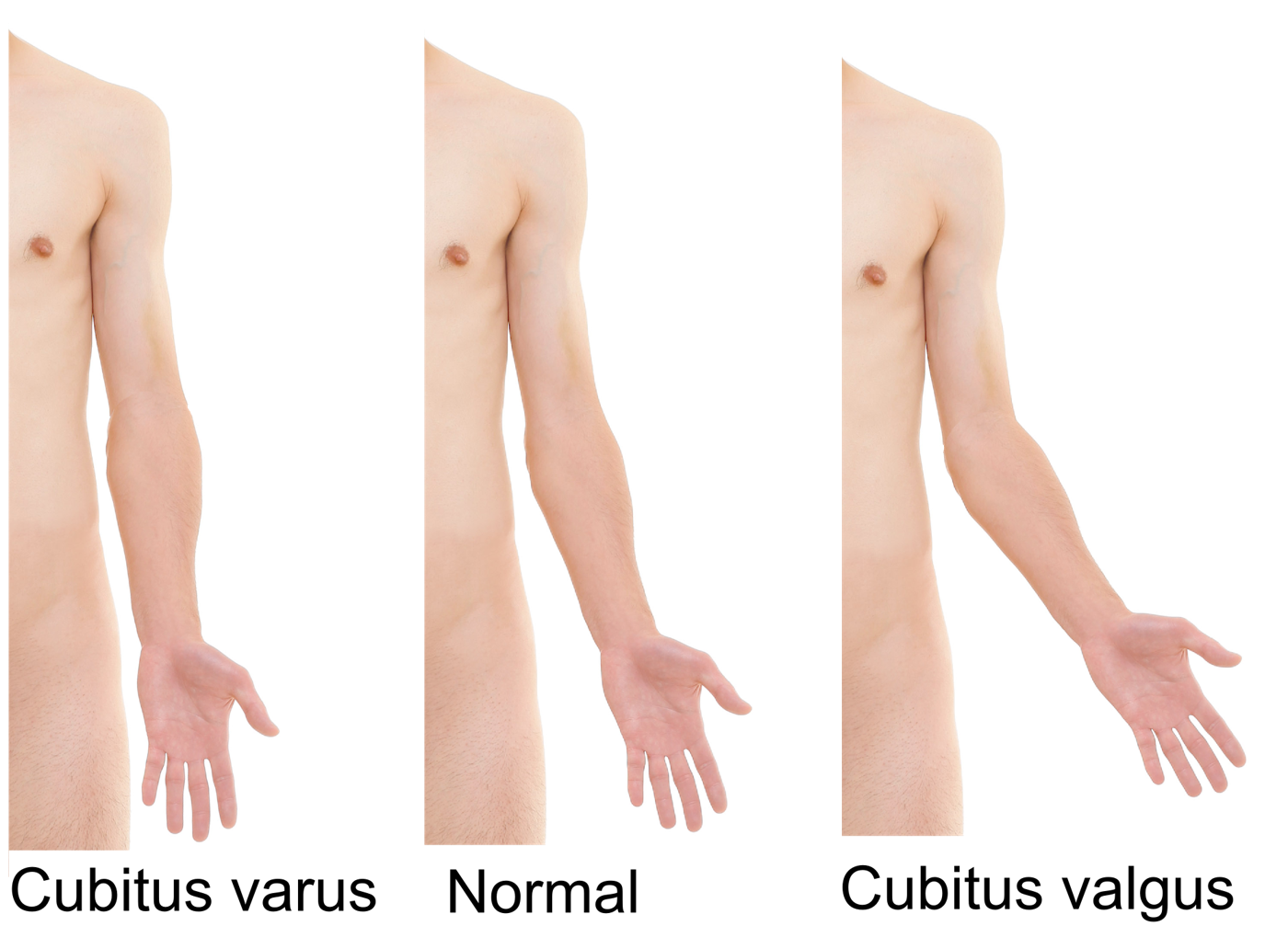
Image - The carrying angle of the elbow. An increased angle is cubitus valgus, while a reduced or reversed angle is cubitus varus, often following a supracondylar fracture
Creative commons source by Mikael Häggström [Public domain / CC0 1.0]
Feel
Before palpating, check once more that the patient is not in pain, and watch their face for discomfort throughout.
First assess temperature. Using the back of your hand, compare each elbow against the patient's own forearm and against the other side. A joint that feels noticeably warm points towards an active inflammatory process; when warmth is accompanied by swelling and tenderness, the differential includes septic arthritis, a flare of inflammatory arthritis, and olecranon bursitis. Septic arthritis is a medical emergency and must not be missed.
Systematically palpate the bony landmarks and soft tissues, asking the patient to tell you of any tenderness:
- The olecranon (the point of the elbow) and the overlying bursa — tenderness or a boggy swelling here suggests olecranon bursitis or a fracture.
- The medial epicondyle — tenderness here is found in medial epicondylitis ('golfer's elbow'), an overuse injury of the common flexor tendon origin.
- The lateral epicondyle — tenderness here is found in lateral epicondylitis ('tennis elbow'), an overuse injury of the common extensor tendon origin and the most common cause of elbow pain in adults.
- The head of the radius, found just distal to the lateral epicondyle (it can be felt to rotate as you pronate and supinate the forearm) — tenderness may indicate a radial head fracture or arthritis.
- The biceps tendon, palpated in the anterior cubital fossa as the patient flexes the elbow against resistance. It should feel taut and continuous. Tenderness suggests biceps tendonitis, while a palpable gap or a soft-tissue mass that has retracted up the arm ('Popeye' sign) suggests a distal biceps tendon rupture; in rupture, resisted supination of the forearm is weak.
Feel for any nodules over the extensor surface (rheumatoid nodules) and assess any swelling for whether it is fluctuant (suggesting fluid, as in a bursa or effusion) or firm (suggesting a nodule or bony abnormality).
Move
Movement is assessed first actively (the patient moves the joint themselves) and then passively (you move the joint for them while they relax). Comparing the two helps localise a problem: a reduction in active movement with preserved passive movement suggests a tendon, muscle or nerve problem, whereas an equal reduction in both suggests a problem within the joint itself, such as an effusion, arthritis or a mechanical block.
Assess the following movements at the elbow, comparing both sides:
- Flexion — ask the patient to bend the elbow and touch their shoulder. Normal range is approximately 0–145°.
- Extension — ask the patient to fully straighten the arm. The elbow should return to the neutral 0° position; some individuals, particularly those with joint hypermobility, can hyperextend slightly. An inability to fully straighten indicates a fixed flexion deformity.
Then assess forearm rotation, which occurs at the radio-ulnar joints. With the elbows tucked into the sides and flexed to 90° (to eliminate any contribution from shoulder rotation), ask the patient to turn the palms:
- Pronation — palms turned to face the floor, approximately 0–80°.
- Supination — palms turned to face the ceiling, approximately 0–85°.
During passive movement, place a hand over the joint to feel for crepitus — a grinding or crackling sensation as the joint moves. Crepitus reflects roughened articular surfaces and is commonly associated with osteoarthritis. Note any pain or restriction in the range of movement and the point in the arc at which it occurs.
Special Tests
A small number of provocation tests help confirm the common tendinopathies and assess ligamentous stability. They work by stressing the affected structure to reproduce the patient's pain.
Lateral epicondylitis ('tennis elbow') affects the common extensor origin, so it is provoked by loading the wrist extensors:
- Cozen's test — with the elbow extended, ask the patient to make a fist and extend the wrist against your resistance. Pain felt over the lateral epicondyle is a positive result.
- Mill's test — palpate over the lateral epicondyle, then with the forearm pronated and the wrist and fingers flexed, passively extend the elbow. This stretches the common extensor origin, and reproduction of pain over the lateral epicondyle supports the diagnosis.
Medial epicondylitis ('golfer's elbow') affects the common flexor origin, so it is provoked by loading the wrist flexors. With the elbow extended and forearm supinated, ask the patient to flex the wrist against resistance (sometimes called the reverse Cozen's test); pain over the medial epicondyle is a positive result.
To assess the collateral ligaments, which provide side-to-side stability, apply gentle stress with the elbow flexed to around 30°:
- Valgus stress tests the medial (ulnar) collateral ligament. Pain or excessive laxity suggests injury to this ligament, which is a common throwing injury.
- Varus stress tests the lateral (radial) collateral ligament.
Neurovascular Assessment
The elbow lies close to several important nerves, so a brief neurovascular screen completes the examination. This is particularly important after trauma or where deformity (such as cubitus valgus) may stretch a nerve.
The ulnar nerve passes behind the medial epicondyle in the cubital tunnel, where it is superficial and vulnerable. Compression or irritation here (cubital tunnel syndrome) causes tingling and numbness in the little finger and the ulnar half of the ring finger, and weakness of the small muscles of the hand. Gently tapping over the nerve behind the medial epicondyle (Tinel's test) may reproduce these tingling symptoms.
Briefly assess the median and radial nerves as well, checking sensation across the hand and power of the relevant muscle groups, as all three nerves cross the elbow.
Check the distal circulation by palpating the radial pulse and assessing capillary refill time in the fingers, which should be less than two seconds. A delayed refill or absent pulse raises concern for vascular compromise, which can complicate elbow fractures and dislocations.
Olecranon Bursitis
Olecranon bursitis deserves special mention as one of the most common and most visually striking elbow findings. The olecranon bursa is a fluid-filled sac that cushions the point of the elbow and allows the skin to glide smoothly over the bone. When it becomes inflamed, fluid accumulates, producing a soft, fluctuant swelling directly over the olecranon — often described as resembling a small egg or balloon at the tip of the elbow.
Causes include repetitive pressure or trauma (leaning on the elbows), inflammatory conditions such as rheumatoid arthritis and gout, and infection (septic bursitis). The key distinction to make at the bedside is whether the bursitis is infected: an infected bursa is typically warm, red, very tender and may be associated with fever, and warrants urgent treatment, whereas a non-infected bursa is usually painless and not inflamed.

Image - Olecranon bursitis, seen as a fluctuant swelling directly over the point of the elbow due to fluid accumulating within the inflamed bursa
Public Domain Source NJC123 [Public domain]
Completing the Examination
Thank the patient and wash your hands.
Summarise your findings.
To complete the examination, state that you would perform a thorough neurovascular assessment of the entire limb, examine the joint above and below (the shoulder and the wrist and hand), as joint pathology can refer pain and rarely occurs in isolation, and assess the patient's function — for example by asking them to perform everyday tasks such as eating or combing their hair.
Further investigations to suggest include plain radiographs of the elbow (to assess for fracture, dislocation, arthritis or an effusion), ultrasound or MRI where soft-tissue pathology such as a tendon tear or ligament injury is suspected, relevant blood tests (such as inflammatory markers, rheumatoid factor and serum urate where indicated), and aspiration of any effusion or bursa for microscopy, culture and crystal analysis if infection or crystal arthropathy is suspected.
- 4