
During any examination in an OSCE it is important to understand the pathology and reasoning behind each of the signs and symptoms elicited, even if the patient being examined is ‘normal’. This article explains how to perform an ear, otoscopy and hearing examination and the key findings you should look for, showing you what each sign means and what conditions it may indicate.
The ear is divided into three parts – the outer ear (pinna and external auditory meatus), the middle ear (tympanic membrane and ossicles), and the inner ear (cochlea and vestibular apparatus). Keeping this anatomy in mind helps you localise where a problem lies, which in turn separates the two broad types of hearing loss: conductive (a problem of the outer or middle ear getting sound to the cochlea) and sensorineural (a problem of the cochlea or auditory nerve).
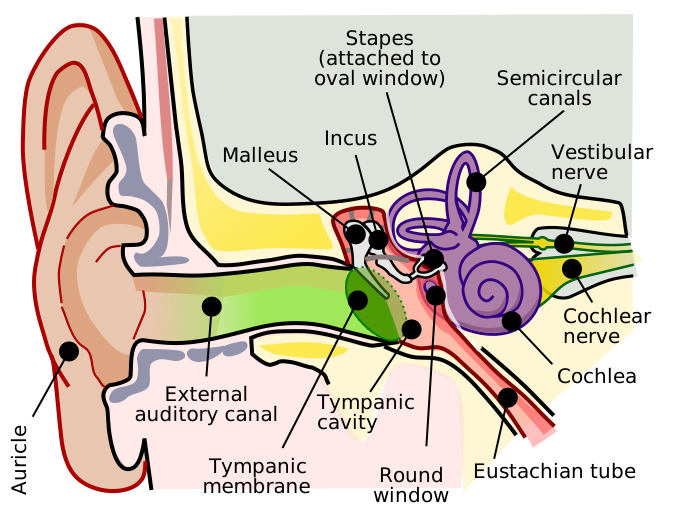
Image - Cross-section of the ear. The outer ear (green), middle ear (red) and inner ear (purple). Conductive loss arises in the outer or middle ear, sensorineural loss in the inner ear or auditory nerve
Creative commons source by Lars Chittka and Axel Brockmann [CC BY 2.5 (https://creativecommons.org/licenses/by/2.5)]
General Inspection
Begin by stepping back and observing the patient and their surroundings. Note whether the patient appears comfortable or in distress, and whether they are turning a particular ear towards you or watching your lips closely, which can be subtle clues to hearing impairment.
Look for any hearing aids, which immediately suggest a degree of established hearing loss, or a cochlear implant (a processor worn behind the ear with a magnetic disc on the scalp), which indicates severe sensorineural loss.
Inspect for an obvious facial nerve palsy, as the facial nerve (cranial nerve VII) runs through the temporal bone in close relationship to the middle ear and can be affected by middle ear disease, cholesteatoma, or surgery. Look at the bedside for any tissues, cotton buds, or evidence of discharge.

Image - A patient with left facial weakness attempting to show their teeth, with the mouth drawn towards the unaffected right side. The facial nerve’s course through the temporal bone means middle ear disease and ear surgery can cause facial weakness
Image source by Benjaminginterr [CC BY-SA 4.0]
Otoscopy
Otoscopy allows you to inspect the external auditory meatus and the tympanic membrane (eardrum). Examine the normal (asymptomatic) ear first so that you do not transfer infection and so that you have a comparison for the affected side.
Select the largest speculum that comfortably fits the canal, as this gives the best view and the most light. Turn the otoscope light on and hold it like a pen in your right hand for the patient’s right ear and your left hand for the left ear.
To straighten the naturally S-shaped ear canal in an adult, gently pull the pinna upwards and backwards. (In an infant or young child the canal is straightened by pulling the pinna downwards and backwards instead.) Brace the hand holding the otoscope against the patient’s cheek so that if they move suddenly the instrument moves with them, avoiding injury to the canal.
Advance the speculum under direct vision. Inspect the canal walls for wax, debris, discharge, swelling or foreign bodies. Wax (cerumen) is normal and protective but excessive wax may obscure the view and cause conductive hearing loss. Pus or debris in the canal suggests otitis externa.
Now examine the tympanic membrane. A normal eardrum is pearly grey, translucent and slightly concave. You should identify the handle of the malleus running downwards and backwards, the pars tensa below it, and a cone of light (light reflex) radiating anteroinferiorly from the tip of the malleus – classically at the 5 o’clock position in the right ear and the 7 o’clock position in the left ear. Above the malleus lies the smaller pars flaccida.
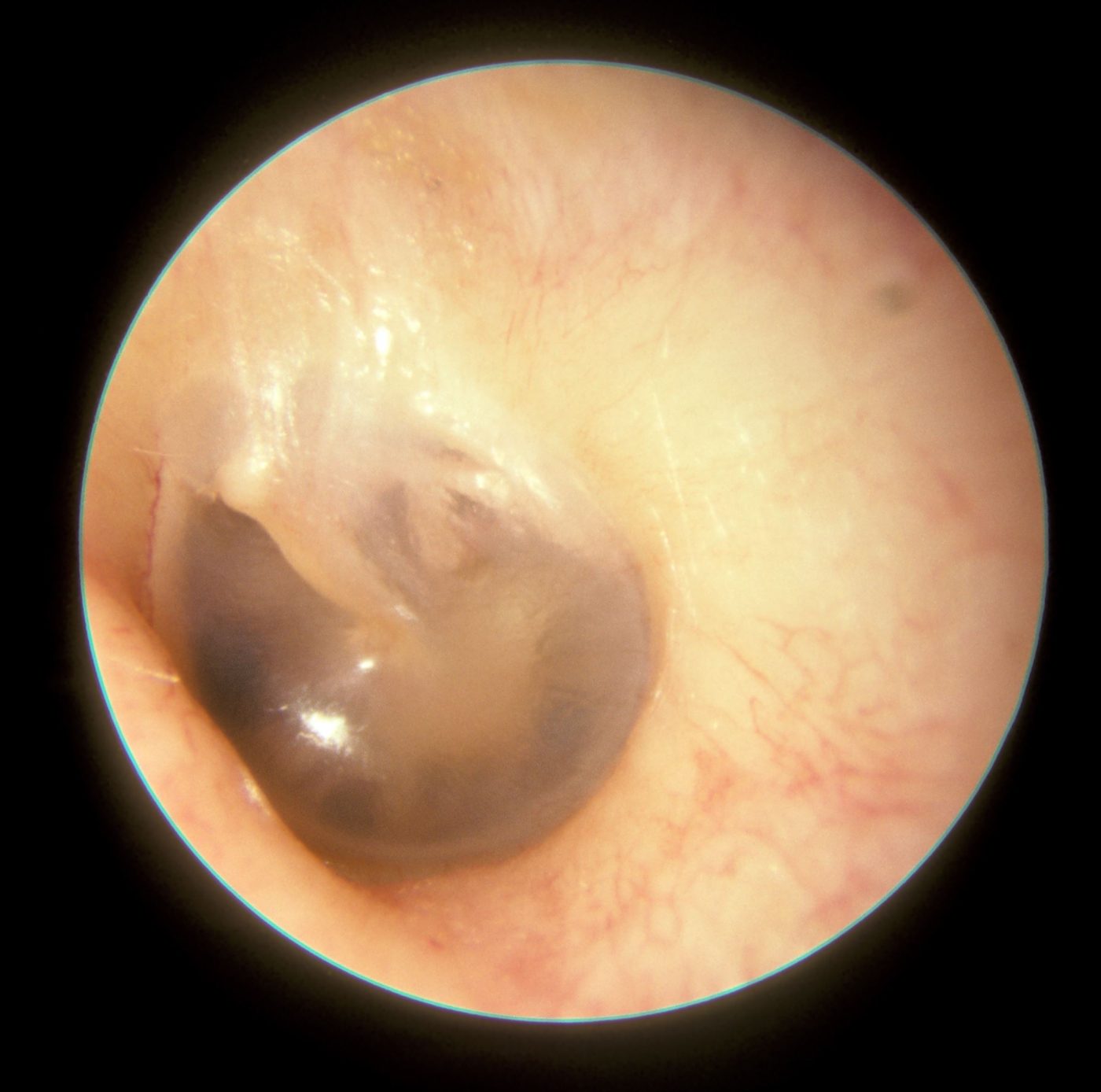
Image - A normal left tympanic membrane. It is pearly grey and translucent, with the handle of the malleus visible and a cone of light radiating anteroinferiorly
Creative commons source by Michael Hawke MD [CC BY-SA 4.0 (https://creativecommons.org/licenses/by-sa/4.0)]
Look for the following abnormalities, each of which reflects a specific pathology:
- A red, bulging eardrum with loss of the normal landmarks and light reflex suggests acute otitis media, where pus under pressure pushes the drum outwards.
- A dull, retracted drum with a visible fluid level or bubbles behind it suggests otitis media with effusion (‘glue ear’), caused by Eustachian tube dysfunction and negative middle ear pressure. This is a common cause of conductive hearing loss in children.
- A perforation appears as a defect in the drum. It may follow infection or trauma, and a persistent perforation causes conductive hearing loss.
- A retraction pocket or whitish keratin debris, classically in the attic (pars flaccida), raises suspicion of a cholesteatoma – an expanding collection of keratinising squamous epithelium that erodes bone and can cause serious complications.
- Grommets (tympanostomy tubes) may be seen as small ventilation tubes inserted through the drum to treat recurrent effusions.
- 243