
Deep Vein Thrombosis (DVT) OSCE Examination
During any examination in an OSCE it is important to understand the pathology and reasoning behind each of the signs and symptoms elicited, even if the patient being examined is ‘normal’. This article explains how to perform a deep vein thrombosis (DVT) examination and the key findings you should look for, showing you what each sign means and what conditions it may indicate.
A deep vein thrombosis is the formation of a thrombus (blood clot) within the deep venous system, most commonly in the veins of the calf but also in the thigh, pelvis or, less often, the arm. The major concern with a DVT is that part of the clot can break off and travel through the venous system to the lungs, causing a pulmonary embolism (PE) – a potentially life-threatening complication. The DVT examination is a focused, mostly unilateral assessment of one leg compared with the other, aimed at detecting the clinical features of a clot and identifying any complications.
Introduction
Wash your hands thoroughly and don personal protective equipment if appropriate.
Introduce yourself to the patient and ensure to mention your grade e.g. 3rd year medical student/junior doctor/consultant.
Confirm the patient’s details taking 3 points of identification usually; full name, date of birth and NHS/hospital number.
Obtain consent for the examination, ensuring to explain what the examination will entail.
Ask the patient if they are currently experiencing any pain, particularly in the legs, as a DVT is frequently tender and you should be gentle when palpating.
Position the patient lying on the bed at 45o, and expose both legs fully from the groin to the toes so that the two limbs can be directly compared. Maintaining the patient’s dignity, only expose what is necessary.
General Inspection
Begin by standing at the end of the bed and observing the patient as a whole. Note whether they appear comfortable or in distress, and look for signs that may point towards an underlying cause or complication. Patients with a DVT may be in pain from the affected leg, and those who have developed a pulmonary embolism may appear breathless (tachypnoeic), distressed, or be receiving supplemental oxygen.
Look around the bedside for objects and clues that give context to the patient’s condition. Relevant findings include compression stockings, evidence of recent surgery, mobility aids suggesting reduced mobility, intravenous lines, and monitoring equipment such as a pulse oximeter or oxygen mask. Many of the risk factors for DVT relate to venous stasis (immobility), so signs of recent immobilisation – such as a plaster cast, a walking frame, or a recently operated limb – are particularly relevant.
Compare the two legs side by side. A DVT is typically unilateral, so an obvious difference in size, colour or swelling between the two legs is an important early observation. Bilateral symmetrical swelling is much more likely to reflect a systemic cause such as heart failure, renal failure or hypoalbuminaemia than a DVT.
Closer Inspection of the Legs
Inspect both legs more closely, comparing the symptomatic leg against the asymptomatic side. Look specifically for the cardinal signs of a DVT:
- Swelling – unilateral swelling of the calf or whole leg is the most consistent sign of a DVT, caused by the thrombus obstructing venous return and increasing venous pressure distal to the clot. This raised pressure forces fluid out of the capillaries into the tissues.
- Erythema – the skin overlying the affected segment may appear red and inflamed because of the local inflammatory response to the thrombus.
- Dilated superficial veins – prominent, non-varicose superficial veins may develop as collateral channels when the deep veins are obstructed and blood is diverted into the superficial system.
- Varicose veins – tortuous, dilated superficial veins are a marker of venous insufficiency. They are not caused by an acute clot, but they signal abnormal venous function and are a recognised risk factor for a DVT, so note them when present.
- Skin changes – longstanding venous disease can cause hyperpigmentation (haemosiderin deposition), lipodermatosclerosis and venous ulceration, typically around the medial malleolus.
In severe, extensive proximal thrombosis, the leg can become markedly swollen and discoloured. A pale, swollen leg is termed phlegmasia alba dolens, while a tense, dusky, cyanotic leg – phlegmasia cerulea dolens – represents near-complete venous outflow obstruction and is a vascular emergency that threatens the limb.
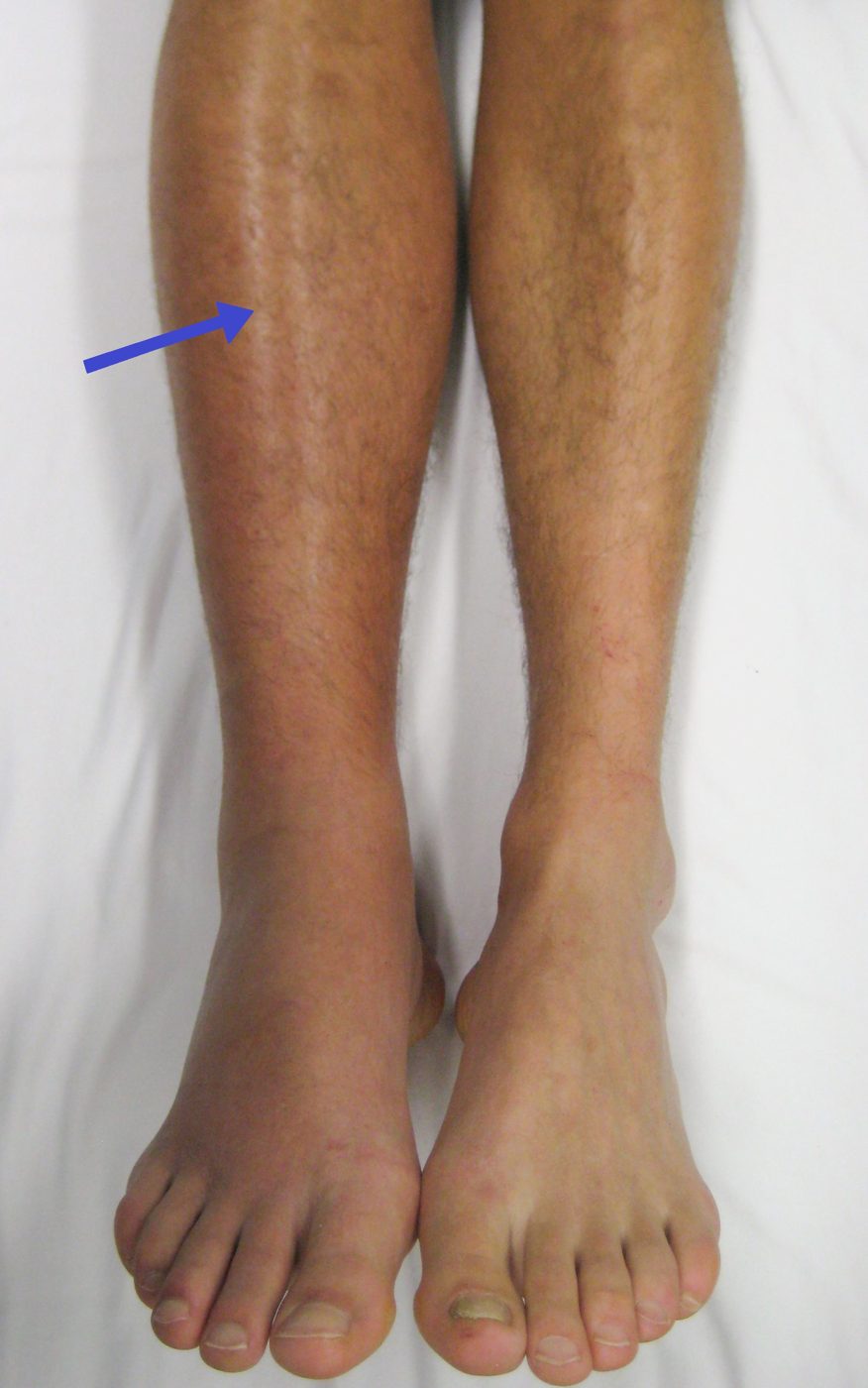
Image - A deep vein thrombosis of the right leg, showing unilateral swelling, redness and a visible increase in size compared with the left leg
Creative commons source by James Heilman, MD [CC BY-SA 3.0 (https://creativecommons.org/licenses/by-sa/3.0)]
Also inspect for venous ulcers, which are a feature of chronic venous insufficiency and may coexist with, or follow, a previous DVT as part of post-thrombotic syndrome. Venous ulcers are usually shallow, have an irregular border and characteristically occur in the gaiter area around the medial malleolus.
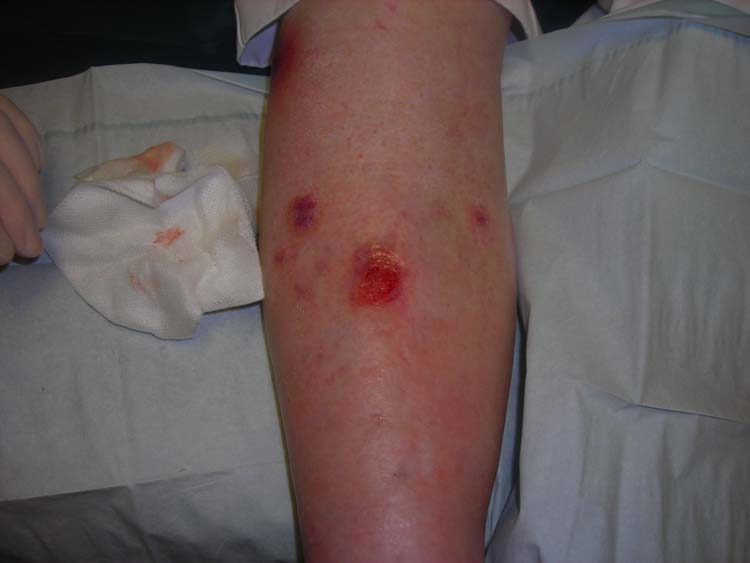
Image - A venous leg ulcer. Venous ulcers reflect chronic venous insufficiency and may follow a previous DVT as part of the post-thrombotic syndrome
Creative commons source by Jonathan Moore [CC BY 3.0 (https://creativecommons.org/licenses/by/3.0)]
Palpation of the Legs
Before palpating, again confirm the patient is not in too much pain and warn them that you will be touching the leg, as a DVT is often tender.
Assess and compare the temperature of both legs using the backs of your fingers, working up the limb and feeling at several points so the two sides are compared at matching levels. An area that feels warmer than the contralateral leg supports the diagnosis, as the local inflammation around a thrombus increases blood flow and warmth to the overlying skin. Be aware that warmth is not specific to a DVT and is also seen in cellulitis, which is an important differential for a hot, red, swollen leg.
Palpate gently along the line of the deep veins for tenderness. Tenderness along the deep venous system – particularly in the calf, popliteal fossa and adductor canal – is one of the clinical features used to estimate the probability of a DVT, and reflects the inflammatory reaction provoked by the clot within the vein.
While in the popliteal fossa, feel for any discrete swelling behind the knee. A fluctuant lump here may be a Baker’s cyst, which can mimic a DVT – if it ruptures it produces sudden calf pain and swelling that is clinically very difficult to distinguish from a clot, and is a recognised reason for an inconclusive examination that warrants ultrasound.
While palpating, also feel along any prominent superficial veins. A vein that feels firm, hard or cord-like and is tender, with overlying redness and warmth, suggests superficial thrombophlebitis – clot within a superficial vein accompanied by inflammation. This is a distinct entity from a DVT, but the two can coexist and superficial thrombophlebitis of the long saphenous vein can extend into the deep system, so it should always be noted and the deep veins assessed carefully.
You may have heard of Homan’s sign, in which forced dorsiflexion of the foot reproduces pain in the calf. Although traditionally taught, this sign is unreliable – it is neither sensitive nor specific – and is now generally discouraged, partly because of a theoretical concern that it could dislodge a clot. It should not be relied upon to diagnose or exclude a DVT, and modern practice uses validated risk scoring and imaging instead.
Measuring Calf Circumference
Objective measurement of leg swelling is more reliable than visual estimation, so the calf circumference of both legs should be measured and compared. Using a tape measure, identify the tibial tuberosity on each leg and measure the calf circumference at a fixed distance below it (commonly 10 cm) so that you are comparing the same point on each leg.
A difference in calf circumference of more than 3 cm between the two legs is considered clinically significant, increases the probability of a DVT, and is one of the criteria in the Wells score. Measuring at a fixed point relative to a bony landmark gives a reproducible value that can be tracked over time, rather than relying on subjective ‘eyeballing’ of the legs.
Assessment of Oedema
Test for pitting oedema by pressing firmly with your thumb over a bony area for around 10–15 seconds, then releasing. Begin at the medial malleolus and work up the shin (over the tibia) until no further oedema is found, which lets you record how far the swelling extends. If an indentation (pit) remains after you release, this confirms pitting oedema. The pit forms because the pressure of your finger displaces excess interstitial fluid; in a DVT, this fluid accumulates because the obstructed deep veins raise venous pressure and force fluid out of the capillaries into the tissues.
The distribution of the oedema is an important diagnostic clue. Oedema that is confined to the symptomatic leg is consistent with a DVT, and is one of the features used in DVT risk scoring. By contrast, bilateral pitting oedema points away from a DVT and towards a systemic cause such as congestive cardiac failure, chronic kidney disease, liver disease with hypoalbuminaemia, or the side effects of certain medications.
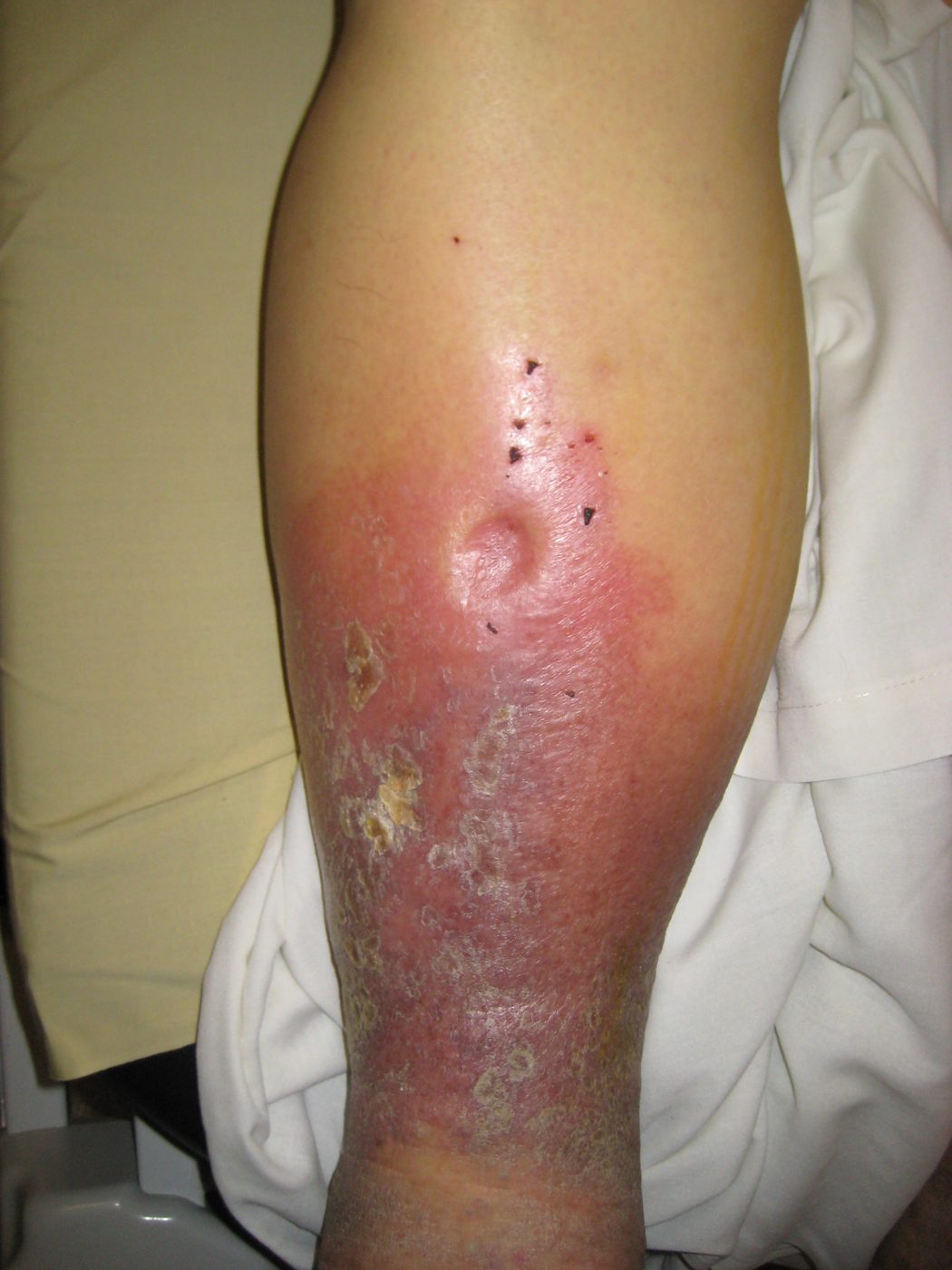
Image - Pitting oedema of the lower leg. After firm pressure is applied and released, an indentation remains in the skin. Oedema confined to one leg supports a diagnosis of DVT
Creative commons source by James Heilman, MD [CC BY-SA 3.0 (https://creativecommons.org/licenses/by-sa/3.0)]
Peripheral Pulses and Neurovascular Status
Although a DVT is a problem of the venous system, it is good practice to check the arterial pulses of the leg to ensure the arterial supply is intact and to help exclude an alternative or coexisting arterial diagnosis. This is particularly important before considering treatments such as compression stockings, which are unsafe if there is significant arterial insufficiency. Where the pulses are reduced or compression therapy is being considered, you would formally assess the arterial supply by measuring the ankle-brachial pressure index (ABPI) before any compression is applied.
Palpate the two pedal pulses in each foot:
- Dorsalis pedis pulse – felt on the dorsum of the foot, just lateral to the extensor hallucis longus tendon.
- Posterior tibial pulse – felt just behind the medial malleolus.

Image - Location of the dorsalis pedis pulse on the dorsum of the foot, lateral to the extensor hallucis longus tendon
SimpleMed original

Image - Location of the posterior tibial pulse, felt just behind the medial malleolus
SimpleMed original
Reduced or absent pedal pulses suggest peripheral arterial disease rather than a DVT. In the rare but serious phlegmasia cerulea dolens, massive venous obstruction can raise tissue pressure enough to compromise the arterial supply, so absent pulses in a tense, blue, swollen leg is an alarming finding requiring urgent vascular assessment. Also note the capillary refill time and the temperature of the toes as a quick check of distal perfusion.
Differential Diagnosis of a Swollen Leg
A unilateral hot, swollen, painful leg has several important causes other than a DVT, and recognising them is a key part of the examination. The clinical signs of these conditions overlap considerably, which is precisely why a suspected DVT is confirmed with imaging rather than examination alone.
- Cellulitis – a spreading bacterial skin infection producing a hot, red, tender and swollen leg, often with a clear margin, a portal of entry (such as a wound or tinea between the toes), systemic upset and fever. It is the commonest mimic of a DVT.
- Ruptured Baker’s cyst – rupture of a popliteal cyst releases fluid into the calf, causing sudden pain and swelling that closely resembles a DVT; a history of knee arthritis is a useful clue.
- Calf muscle injury or haematoma – a torn gastrocnemius (“tennis leg”) or a bleed into the calf can cause acute pain, swelling and bruising, usually with a clear history of sudden onset during exertion.
- Superficial thrombophlebitis – a tender, hard, cord-like superficial vein with overlying redness, as described above.
- Chronic venous insufficiency or lymphoedema – produce more chronic swelling and skin change, and lymphoedema is typically non-pitting in its later stages.
Importantly, bilateral leg swelling usually reflects a systemic cause – such as cardiac, renal or hepatic failure – rather than a DVT.
Risk Factors and the Wells Score
The clinical signs of a DVT are interpreted alongside the patient’s risk factors, which broadly follow Virchow’s triad – the three contributors to thrombosis:
- Venous stasis – immobility, recent long-haul travel, recent surgery, hospital admission, or limb immobilisation in a cast.
- Endothelial (vessel wall) injury – trauma, surgery or previous DVT damaging the vein.
- Hypercoagulability – active cancer, pregnancy and the postpartum period, the combined oral contraceptive pill or hormone replacement therapy, and inherited thrombophilias such as factor V Leiden.
In UK practice, when a DVT is suspected the clinical features are combined into a two-level Wells score for DVT, which estimates the likelihood of a clot and guides further investigation. Points are awarded for features such as active cancer, recent immobilisation or major surgery, localised tenderness along the deep veins, swelling of the entire leg, a calf that is more than 3 cm larger than the other side, pitting oedema confined to the symptomatic leg, dilated collateral superficial (non-varicose) veins, and a previous DVT; 2 points are subtracted if an alternative diagnosis is at least as likely as a DVT. A score of 2 or more makes a DVT likely, and a score of 1 or less makes it unlikely, which then directs whether the patient proceeds to ultrasound or has a D-dimer test first.
Completing the Examination
Thank the patient, help them to re-dress, and wash your hands.
Summarise your findings and state whether they are consistent with a DVT.
To complete the examination, state that you would like to:
- Calculate a two-level Wells score to formally estimate the probability of a DVT.
- Take a focused history exploring the risk factors above, and ask specifically about symptoms of a pulmonary embolism such as breathlessness, pleuritic chest pain and haemoptysis.
- Record a full set of observations (including respiratory rate and oxygen saturations) to screen for a PE.
- Request a D-dimer blood test where appropriate – a normal result helps to exclude a DVT in a patient with a low pre-test probability, but it is non-specific and can be raised by infection, inflammation, malignancy and pregnancy.
- Arrange a proximal leg vein Doppler (compression) ultrasound, which is the imaging investigation of choice for confirming a DVT.
- Measure the ankle-brachial pressure index (ABPI) to confirm an adequate arterial supply before applying compression stockings or bandaging.
- Send routine bloods including a full blood count, urea and electrolytes and coagulation screen, and consider further investigation for an underlying cause (such as an occult malignancy) where clinically indicated.
- 4