
Share:
During any examination in an OSCE it is important to understand the pathology and reasoning behind each of the signs and symptoms elicited, even if the patient being examined is ‘normal’. This article explains how to perform a cerebellar examination and the key findings you should look for, showing you what each sign means and what conditions it may indicate.
The cerebellum coordinates movement, balance and posture. Crucially, it exerts its influence on the same (ipsilateral) side of the body, so a unilateral cerebellar lesion produces signs on the same side as the lesion. A useful framework for remembering cerebellar signs is the mnemonic DANISH: Dysdiadochokinesia, Ataxia, Nystagmus, Intention tremor, Scanning (staccato) speech, and Hypotonia. Keep this in mind as you work through the examination.
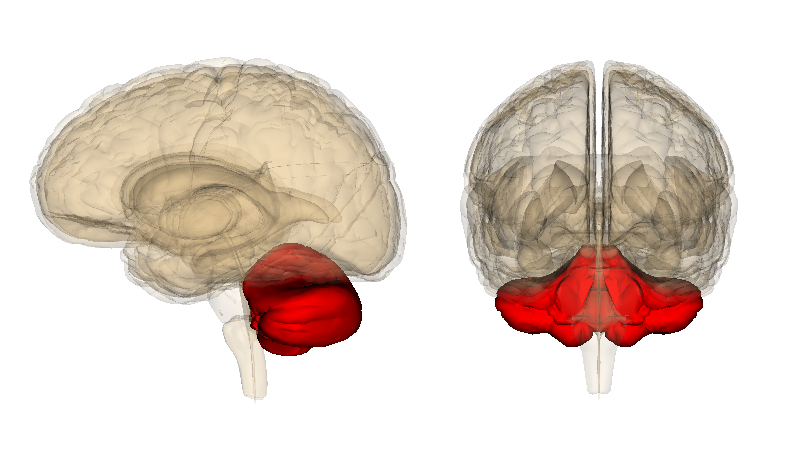
Image - The cerebellum (highlighted) sits in the posterior cranial fossa beneath the occipital lobes. It coordinates movement and balance, exerting its effects on the same side of the body
Creative commons source by Life Science Databases (LSDB) [CC BY-SA 2.1 JP (https://creativecommons.org/licenses/by-sa/2.1/jp/deed.en)]
Contents
Introduction
Wash your hands thoroughly before approaching the patient, as good hygiene reduces the risk of healthcare-associated infection.
Introduce yourself to the patient and ensure to mention your grade e.g. 3rd year medical student/junior doctor/consultant.
Confirm the patient’s details taking 3 points of identification; usually full name, date of birth and NHS/hospital number.
Obtain consent for the examination, ensuring to explain what it will entail. A clear explanation is particularly helpful here, as the cerebellar examination involves several unfamiliar coordination tasks the patient will need to follow.
Position the patient sitting comfortably, ideally on the edge of the bed or in a chair so that you can later observe their gait. Ensure there is enough space and a clear path for the patient to walk safely.
Expose the patient’s arms and legs appropriately so that movement and tone can be assessed.
Ask the patient whether they are in any pain before you begin, and enquire whether they feel steady on their feet, as some manoeuvres carry a risk of falls.
General Inspection
Begin with a general inspection of the patient and their surroundings, as this often gives valuable clues before any formal testing is performed. If the patient walks into the room, watch how they move from the outset, since a broad-based or unsteady gait may be apparent long before you formally test walking.
Look at the patient themselves for an abnormal posture or a tendency to lean or list to one side, which may reflect truncal ataxia (instability of the trunk). Observe for any obvious involuntary movements of the head or limbs and note whether the patient appears alert and comfortable or distressed.
Look around the bedside for mobility aids such as a walking stick, frame or wheelchair, which suggest the patient has difficulty with balance and walking. The presence of these aids hints at the severity of any ataxia before you have even started.
Note any prescriptions or medications, as several drugs are associated with cerebellar dysfunction. Long-term phenytoin use and chronic alcohol excess are classic causes of cerebellar degeneration, while lithium toxicity can produce an acute cerebellar syndrome.
It is helpful to keep the broad causes of cerebellar disease in mind throughout, as the pattern of signs helps to localise the problem. Common causes include stroke (ischaemic or haemorrhagic) affecting the posterior circulation, multiple sclerosis, posterior fossa tumours, chronic alcohol misuse, drug toxicity, and inherited conditions such as the spinocerebellar ataxias and Friedreich’s ataxia. As a rule, a unilateral lesion such as a stroke or tumour causes limb signs on the same side, a point we return to throughout the examination.
Speech
Assessing speech early is sensible, as cerebellar pathology characteristically affects the coordination of the muscles of articulation, producing dysarthria.
The classic cerebellar speech pattern is scanning or staccato speech, in which words are broken into separate syllables that are spoken with abnormal, irregular emphasis. This arises because the cerebellum can no longer smoothly coordinate the rate, rhythm and force of the muscles used in speaking.
To test for this, ask the patient to repeat phrases that demand rapid, coordinated articulation. Commonly used examples are ‘baby hippopotamus’ and ‘British constitution’. A patient with cerebellar disease will often struggle to produce these smoothly, with the syllables becoming slurred or fragmented.
Eye Movements
The cerebellum plays an important role in coordinating eye movements, so abnormalities here are a useful sign of cerebellar pathology.
Ask the patient to keep their head still and follow your finger with their eyes only. Move your finger through the cardinal positions of gaze in an ‘H’ shape, watching carefully for nystagmus.
Nystagmus is an involuntary rhythmic eye movement. Cerebellar dysfunction can impair gaze holding, producing sustained gaze-evoked nystagmus, and can make smooth pursuit jerky. In gaze-evoked nystagmus the fast phase may change with the direction of gaze; its direction alone is not a dependable rule for deciding which cerebellar hemisphere is affected. Interpret the eye findings alongside limb coordination, gait and other neurological signs. Concordant limb dysmetria provides a stronger clue to sidedness.
It is worth remembering that a few beats of nystagmus at the extremes of gaze can be physiological and normal, so look for sustained nystagmus within the normal range of eye movement. Also note any difficulty with smooth pursuit, where the eyes move in a jerky, ‘broken’ fashion rather than tracking the target smoothly.
While testing eye movements, you may also notice saccadic abnormalities, in which the rapid movements the eyes make to jump between targets are inaccurate and either overshoot or undershoot. This is another manifestation of the cerebellum’s loss of fine control over movement, in this case applied to the eyes rather than the limbs.
Upper Limb Coordination
The upper limbs are examined for the tone and coordination signs of cerebellar disease. Remember throughout that cerebellar signs are ipsilateral to the lesion.
First assess tone by passively moving the patient’s arm at the wrist and elbow. Cerebellar disease classically causes hypotonia (reduced tone), although this can be a subtle and unreliable sign.
It is also worth asking the patient to hold their arms outstretched with the palms up and eyes closed for a few seconds. In cerebellar disease one arm may slowly drift, often upwards or outwards (cerebellar drift). This contrasts with the downward, pronating drift (pronator drift) seen with a contralateral pyramidal (upper motor neurone) lesion, so the same manoeuvre both screens for an associated pyramidal lesion and helps you separate a cerebellar problem from a corticospinal one.
Next perform the finger-to-nose test. Ask the patient to touch the tip of their nose and then your fingertip, repeating this back and forth while you hold your finger at arm’s length and occasionally move its position. This test looks for two key signs:
- Intention tremor – a tremor that worsens as the hand approaches the target. It reflects the cerebellum’s inability to fine-tune the final part of a movement.
- Dysmetria (past-pointing) – inaccurate targeting, where the patient overshoots or undershoots your finger. This represents a failure to judge the distance and force required for the movement.
Now test for dysdiadochokinesia, which is the inability to perform rapid alternating movements. Ask the patient to repeatedly pat the palm of one hand with the front and then the back of the other hand, as quickly as they can. In cerebellar disease these movements become slow, clumsy and irregular, because the cerebellum can no longer coordinate the smooth switching between opposing muscle groups.
Finally, test for the rebound phenomenon. Ask the patient to hold their arms outstretched, then briefly push one arm down and release it. Normally the arm returns to its original position with minimal overshoot. In cerebellar disease, the arm overshoots and may fly upwards before correcting, as the cerebellum fails to dampen and arrest the corrective movement.
Lower Limb Coordination
Coordination is then assessed in the lower limbs, most usefully with the heel-to-shin test.
With the patient lying down, ask them to place the heel of one foot onto the opposite knee, then run the heel smoothly down the shin towards the ankle, before lifting it and repeating. Demonstrate the manoeuvre first, as it can be difficult to understand from instructions alone.
In a patient with cerebellar disease the heel will wobble off the line of the shin and the movement will be jerky and poorly controlled, reflecting the same loss of coordination (dysmetria and ataxia) seen in the upper limb. As always, compare the two sides, remembering that the signs appear on the same side as the lesion.
Assessing tone in the legs may again reveal hypotonia, though as in the arms this is a subtle finding.
If you are testing the reflexes, classical cerebellar disease may produce pendular reflexes, where the limb swings back and forth several times after the tendon is tapped rather than settling quickly. This reflects the loss of the cerebellum’s damping control over movement, the same mechanism that underlies the rebound phenomenon in the arms.
Gait and Romberg’s Test
Examination of gait is one of the most important parts of the cerebellar assessment and should be performed in a safe, clear space, staying close to the patient in case they become unsteady.
Before walking, it is useful to check for truncal ataxia by asking the patient to sit upright on the edge of the bed with their arms folded, without support. Difficulty staying upright, or swaying and toppling of the trunk, points to instability of the central axis of the body. This is an important distinction to draw out: truncal and gait ataxia reflect disease of the midline vermis, whereas the limb (appendicular) signs such as finger-to-nose dysmetria and heel-to-shin incoordination reflect disease of the cerebellar hemispheres.
Ask the patient to walk normally to the end of the room, turn, and walk back. A cerebellar (ataxic) gait is characteristically broad-based and unsteady, with the patient veering or staggering. With a unilateral cerebellar lesion the patient tends to veer towards the side of the lesion.
Next ask the patient to perform tandem (heel-to-toe) gait, walking in a straight line placing the heel of one foot directly in front of the toes of the other. This manoeuvre narrows the base of support and so exaggerates subtle ataxia that might not be apparent on normal walking. Patients with cerebellar disease find this particularly difficult and will struggle to stay on the line.
For Romberg’s test, ask the patient to stand with their feet together and stay close enough to support them. Assess balance with the eyes open first. Only ask them to close their eyes if they can maintain this position safely; stop and support them if they become unstable.
A classic positive Romberg’s test means the patient is steady with the eyes open but becomes markedly unsteady when they close them. Loss of visual compensation can reveal impaired joint-position sense (sensory ataxia), but severe bilateral vestibular loss can also produce this pattern. Test position sense directly and interpret the result with the rest of the neurological examination.
Cerebellar ataxia can make stance unstable even with the eyes open. If the patient cannot maintain the starting position, the classic Romberg comparison is not interpretable; do not record it as a negative test. Assess gait, truncal stability and limb coordination to characterise the ataxia.
Completing the Examination
Thank the patient and ensure they are comfortable and safe, then wash your hands.
Summarise your findings, noting in particular whether any signs are unilateral (suggesting a focal lesion such as a stroke or tumour) or bilateral (suggesting a more diffuse process such as alcohol-related degeneration, drug toxicity or a hereditary ataxia).
To complete the examination, suggest performing a full neurological examination of the cranial nerves and the upper and lower limbs to look for associated deficits, and a vestibular assessment if relevant. You should also suggest relevant bedside tests and investigations, such as blood tests (including a blood alcohol level and, where appropriate, drug levels such as phenytoin or lithium) and neuroimaging with an MRI of the brain to identify any structural cause within the posterior fossa.
Quiz
- 220