
During any examination in an OSCE it is important to understand the pathology and reasoning behind each of the signs and symptoms elicited, even if the patient being examined is ‘normal’. This article explains how to perform a breast examination and the key findings you should look for, showing you what each sign means and what conditions it may indicate.
The breast examination is, by its nature, an intimate examination. The single most important principle running through the whole station is dignity: a chaperone should always be offered and their presence documented, exposure should be kept to a minimum and only revealed when needed, and clear consent must be gained at every stage. Marks in an OSCE are lost far more often for poor communication and a missed chaperone than for missing a subtle lump.
Breast Inspection
Inspection is the most valuable part of the breast examination and should never be rushed. With the patient sitting upright, inspect both breasts in four positions, each of which is designed to reveal a different type of abnormality. At every stage, compare one breast against the other – asymmetry is often the key to spotting pathology.
You are systematically looking for changes in the Size, Shape, Symmetry and Skin of the breasts, as well as the position and appearance of the nipples.
Position 1 – hands resting on thighs. Ask the patient to relax with their hands on their lap. This relaxes the pectoral muscles and allows a baseline inspection of breast contour, skin and nipples.
Position 2 – hands pressed onto the hips. Ask the patient to press their hands firmly into their hips. This contracts pectoralis major. If a tumour is tethered to the underlying muscle or fascia, contracting the muscle will exaggerate any skin dimpling or pull a mass into view that was not obvious at rest.
Position 3 – hands raised above the head. Raising the arms lifts the breasts and stretches the skin, again making areas of tethering or skin retraction more obvious. It also brings the under-surface of the breast and the axillae into view.
Position 4 – leaning forward. Ask the patient to lean forward so the breasts hang freely (become pendulous). A breast that is fixed by an underlying mass may fail to fall symmetrically, again betraying tethering to deeper structures.
In larger or more pendulous breasts, gently lift each breast with the back of your hand to inspect the skin of the under-surface and the inframammary fold. Pathology is easily concealed in this skin crease, so it should be inspected directly rather than assumed to be normal.
The specific skin and contour changes to look for are:
- Skin dimpling or tethering – an area of skin pulled inwards. This occurs when a tumour invades and shortens the suspensory ligaments of Cooper, drawing the overlying skin down. It is a classic sign of underlying malignancy.
- Peau d’orange – skin that resembles orange peel, with pitting around the hair follicles. This is caused by cutaneous lymphoedema when tumour cells block the dermal lymphatic vessels, and is a hallmark of inflammatory breast cancer.
- Erythema and warmth – redness may indicate infection (mastitis or a breast abscess), but if it is widespread and rapidly progressive it should raise concern for inflammatory breast cancer, which can mimic infection.
- Ulceration or a fungating lesion – a breakdown of the overlying skin, sometimes with a raised, irregular edge or discharge. This represents a neglected or locally advanced tumour that has eroded through the skin and is an alarming sign of malignancy.
- Visible masses or asymmetry – note the position of any obvious swelling.
- Scars – from a previous lumpectomy, mastectomy, biopsy or breast reconstruction, which point to a previous diagnosis.
- Nipple changes – inversion, deviation, an obvious discharge, or scaly, eczema-like change of the nipple and areola (see the nipple section below).
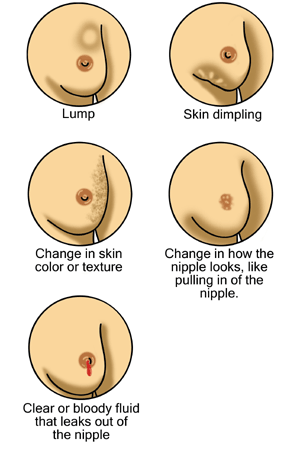
Image - Visible signs of breast cancer to look for on inspection, including a lump, skin dimpling, change in skin colour or texture, nipple inversion and nipple discharge
Creative commons source by Morning2k, source material from the National Institutes of Health [Public domain]
Breast Palpation
For palpation, reposition the patient lying flat (supine) on the couch, with the arm on the side being examined placed behind their head. This flattens and spreads the breast tissue evenly across the chest wall, making it easier to feel a mass against the underlying ribs. Remember to begin on the asymptomatic side if the patient has reported a lump.
Use the flat palmar surface of the middle three fingers to compress the breast tissue against the chest wall. At each point, feel at three depths – light, moderate and firm pressure – so that both superficial and deeper lesions are picked up. Palpate systematically so that no area is missed; common approaches are to spiral out in concentric circles from the nipple, to cover the breast in vertical strips, or to divide it into four quadrants plus the central area and examine each in turn. Whichever method you choose, the priority is consistent, complete coverage.
It is essential to include the axillary tail (of Spence) – the extension of breast tissue that runs up towards the armpit from the upper outer quadrant. The upper outer quadrant contains the most glandular tissue and is where the majority of breast cancers arise, so this area must be examined thoroughly.
If you feel a lump, characterise it fully – these features help distinguish a benign from a malignant lesion:
- Site – which quadrant, and the distance from the nipple.
- Size and shape.
- Consistency – a hard, craggy, irregular lump is suspicious of carcinoma, whereas a smooth, rubbery lump is more typical of a benign fibroadenoma.
- Margins – well-defined (more reassuring) versus irregular and poorly defined (more concerning).
- Mobility and tethering – a freely mobile lump is usually benign, whereas a lump fixed to the skin or to the underlying chest wall is highly suspicious of malignancy. To test for fixation to pectoralis major, hold the lump and ask the patient to press their hands onto their hips: if the mass becomes less mobile as the muscle contracts, it is tethered to the muscle.
- Tenderness – tender lumps are more often benign (e.g. a cyst or abscess), whereas malignant lumps are classically painless.
- Overlying skin and temperature – warmth and redness suggest inflammation or infection.
A smooth, highly mobile, rubbery lump in a younger woman suggests a fibroadenoma (the so-called ‘breast mouse’). A smooth, fluctuant, sometimes tender swelling that may transilluminate suggests a cyst. A hard, irregular, fixed and painless lump must be treated as cancer until proven otherwise.
The same examination sequence applies to male patients. In men, the most common finding is gynaecomastia – a smooth, firm, concentric disc of glandular tissue felt symmetrically beneath the areola, which results from a relative excess of oestrogen over androgen and has many causes including puberty, drugs (such as spironolactone or digoxin), liver disease and hypogonadism. This should be distinguished from simple lipomastia (fatty enlargement with no firm disc) and, importantly, from male breast cancer, which is typically a hard, eccentric (off-centre) lump fixed to the skin or chest wall and warrants the same urgent referral as in women.
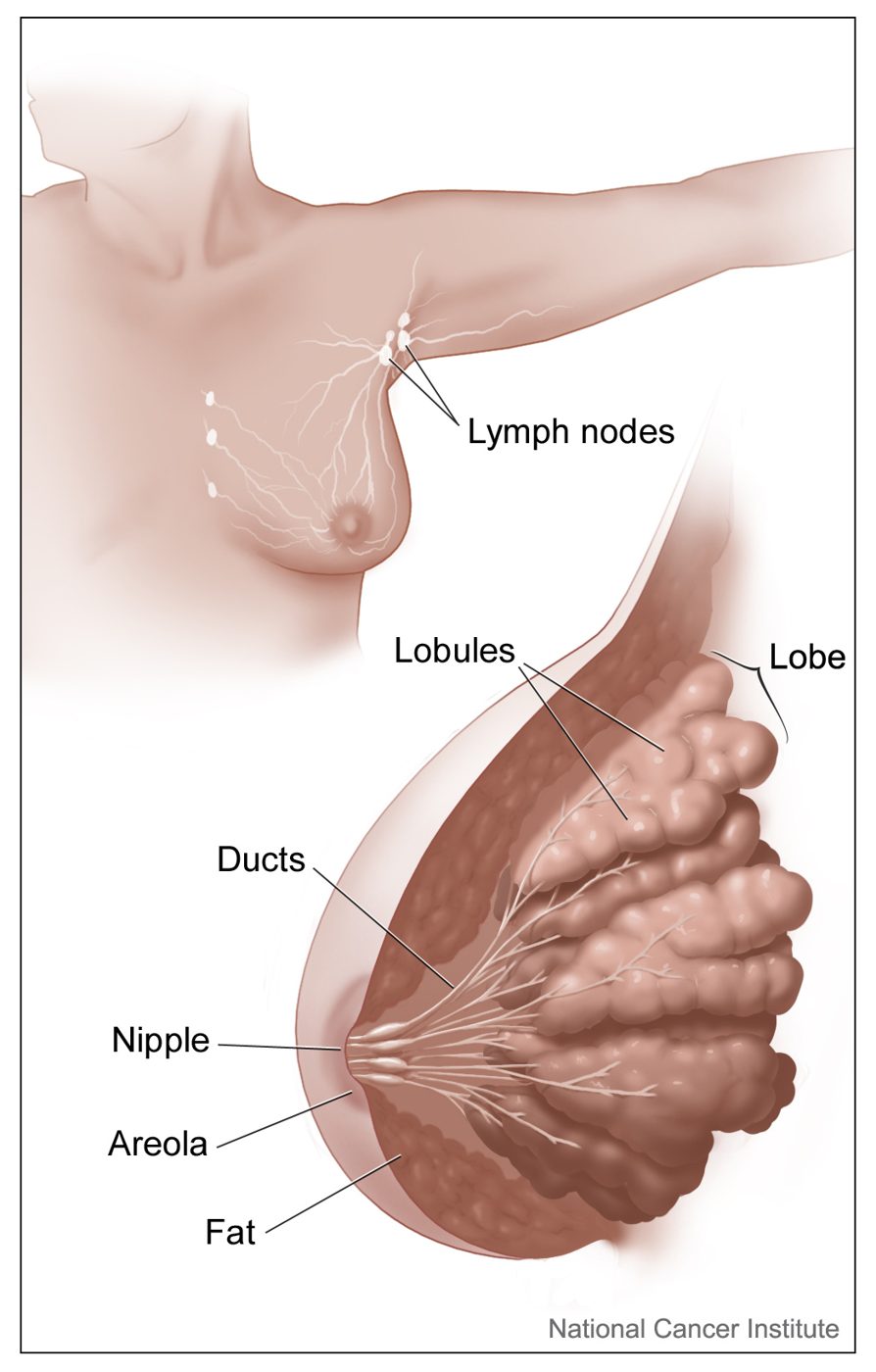
Image - Breast tissue and adjacent axillary lymph nodes. Axillary nodes are an important regional drainage group; breast cancer may also involve internal mammary and other regional nodes
Creative commons source by Don Bliss, National Cancer Institute [Public domain]
- 223