
During any examination in an OSCE it is important to understand the pathology and reasoning behind each of the signs and symptoms elicited, even if the patient being examined is 'normal'. This article explains how to perform an anterior segment eye examination and the key findings you should look for, showing you what each sign means and what conditions it may indicate.
The anterior segment is the front portion of the eye, comprising the structures in front of the vitreous: the eyelids and lashes, conjunctiva, sclera, cornea, anterior chamber, iris and pupil, and the lens. In an ideal setting these structures are inspected with a slit lamp, but a focused bedside examination using a pen torch, with magnification and fluorescein drops where available, can identify the majority of acute pathology and is the version most commonly tested at this stage.
Conjunctiva and Sclera
Ask the patient to look up while you gently pull down the lower lid to expose the inferior conjunctiva, then ask them to look in different directions to inspect the bulbar conjunctiva (overlying the white of the eye) and sclera.
Assess the pattern of any redness, as this is one of the most useful localising signs in the red eye. Diffuse redness that is more pronounced peripherally and spares the area around the cornea suggests conjunctivitis. A sectorial patch of redness involving one segment of the eye points to episcleritis; these superficial vessels can be moved with a cotton bud and blanch with topical phenylephrine, which helps distinguish it from deeper inflammation. Redness that is concentrated in a ring around the cornea (ciliary or circumcorneal injection) is more worrying and points to deeper pathology such as anterior uveitis, keratitis or acute angle-closure glaucoma.
A subconjunctival haemorrhage appears as a flat, well-demarcated area of bright red blood under the conjunctiva, with normal vision and no pain. It is caused by rupture of a small conjunctival vessel, often after coughing, straining or minor trauma, and is usually harmless and self-limiting, although it may prompt a check of blood pressure or clotting if recurrent.
Note any chemosis, a boggy, fluid-filled swelling of the conjunctiva that can balloon over the lid margin in marked cases. It reflects conjunctival oedema and is typically seen in allergic conjunctivitis, severe infection or orbital inflammation. While inspecting, also scan the conjunctival and scleral surfaces for any foreign body, abrasion or laceration, particularly after trauma; a full-thickness scleral laceration or a teardrop-shaped, peaked pupil should raise concern for a penetrating (open globe) injury, which requires the eye to be shielded and urgent ophthalmology referral without further manipulation.
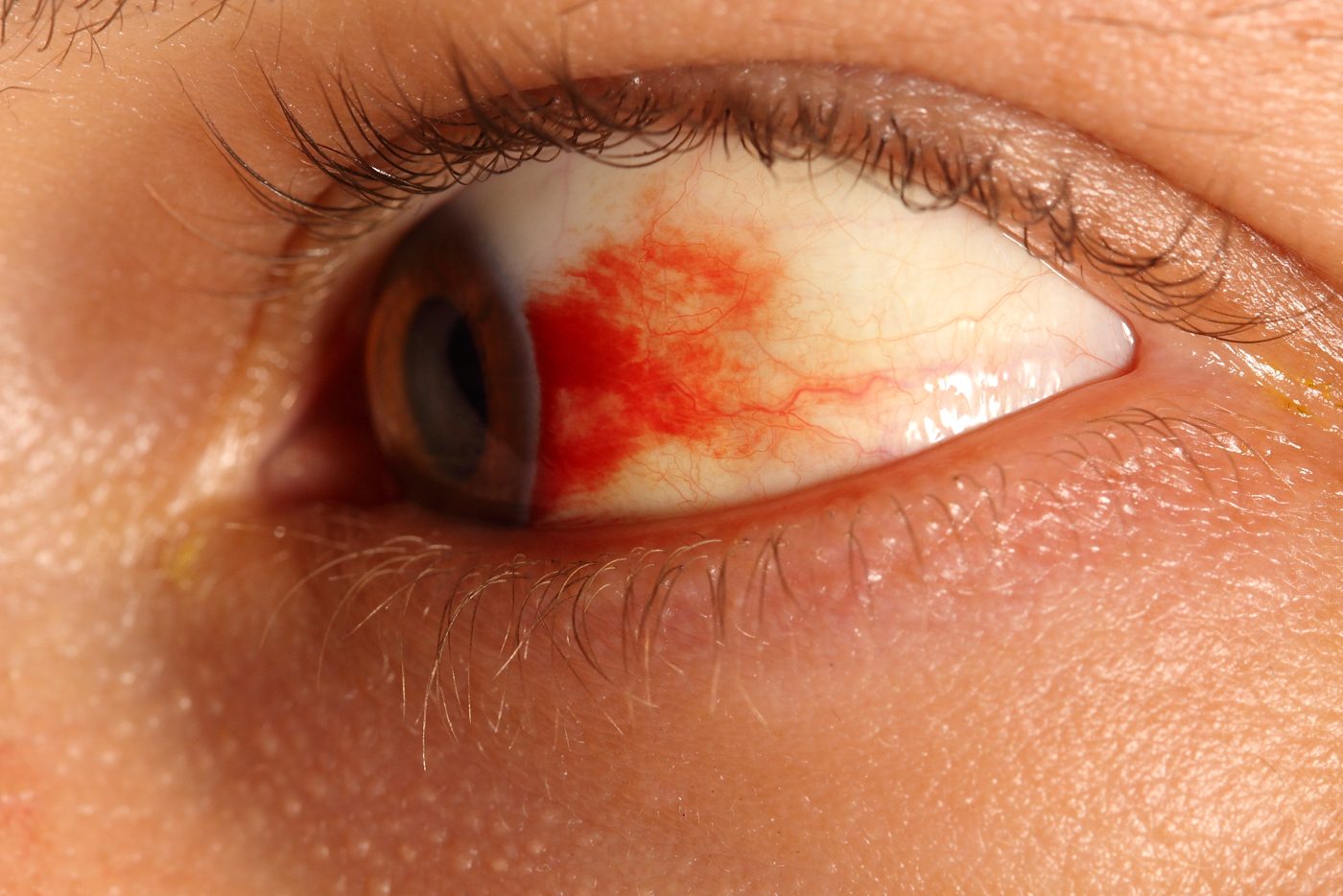
Image - A subconjunctival haemorrhage seen as a flat, well-defined patch of bright red blood beneath the conjunctiva, sparing the cornea. Vision and the pupil are unaffected
Creative commons source by Daniel Flather [CC BY-SA 3.0 (https://creativecommons.org/licenses/by-sa/3.0)]
Inspect the sclera itself for colour. A diffuse yellow tinge to the sclera indicates jaundice, reflecting a raised bilirubin. A localised area of deep, boring redness with severe pain that may wake the patient at night suggests scleritis, which is frequently associated with systemic autoimmune disease such as rheumatoid arthritis, whereas the milder, more superficial inflammation of episcleritis is usually self-limiting and far less painful.
Cornea
Using your pen torch and magnification, inspect the cornea. A healthy cornea is perfectly transparent and gives a crisp, sharp reflection of the light. Loss of this clarity is significant.
A hazy or cloudy cornea suggests oedema, which occurs when the corneal endothelium fails to keep the cornea dehydrated. This is seen in acute angle-closure glaucoma (where the sharply raised intraocular pressure overwhelms the endothelial pump) and in advanced infection. Look for any white opacity or infiltrate on the cornea, which represents a collection of inflammatory cells and is the hallmark of a corneal ulcer or microbial keratitis, an ophthalmic emergency particularly in contact lens wearers.
Look for foreign bodies on the corneal surface, and assess the smoothness of the surface. A useful bedside test is to shine the torch tangentially across the cornea to throw any surface irregularity into relief.
At the slit lamp the same principle is used more powerfully: the illumination beam is narrowed to a thin slit and directed obliquely so that it cuts an optical section through the clear cornea. This reveals the corneal layers in three dimensions - the surface epithelium, the stroma and the deep endothelium - and lets you judge the exact depth of any ulcer, infiltrate or foreign body.
To detect epithelial defects that are invisible to the naked eye, instil fluorescein drops and examine the cornea under a cobalt blue light. Fluorescein pools in and binds to areas where the protective surface epithelium has been lost, so any defect lights up as a bright green patch. A diffuse or geographic area of uptake indicates a corneal abrasion, while a characteristic branching, dendritic pattern of staining is highly suggestive of herpes simplex keratitis - an important diagnosis to make, as inadvertent treatment with topical steroids can be sight-threatening.
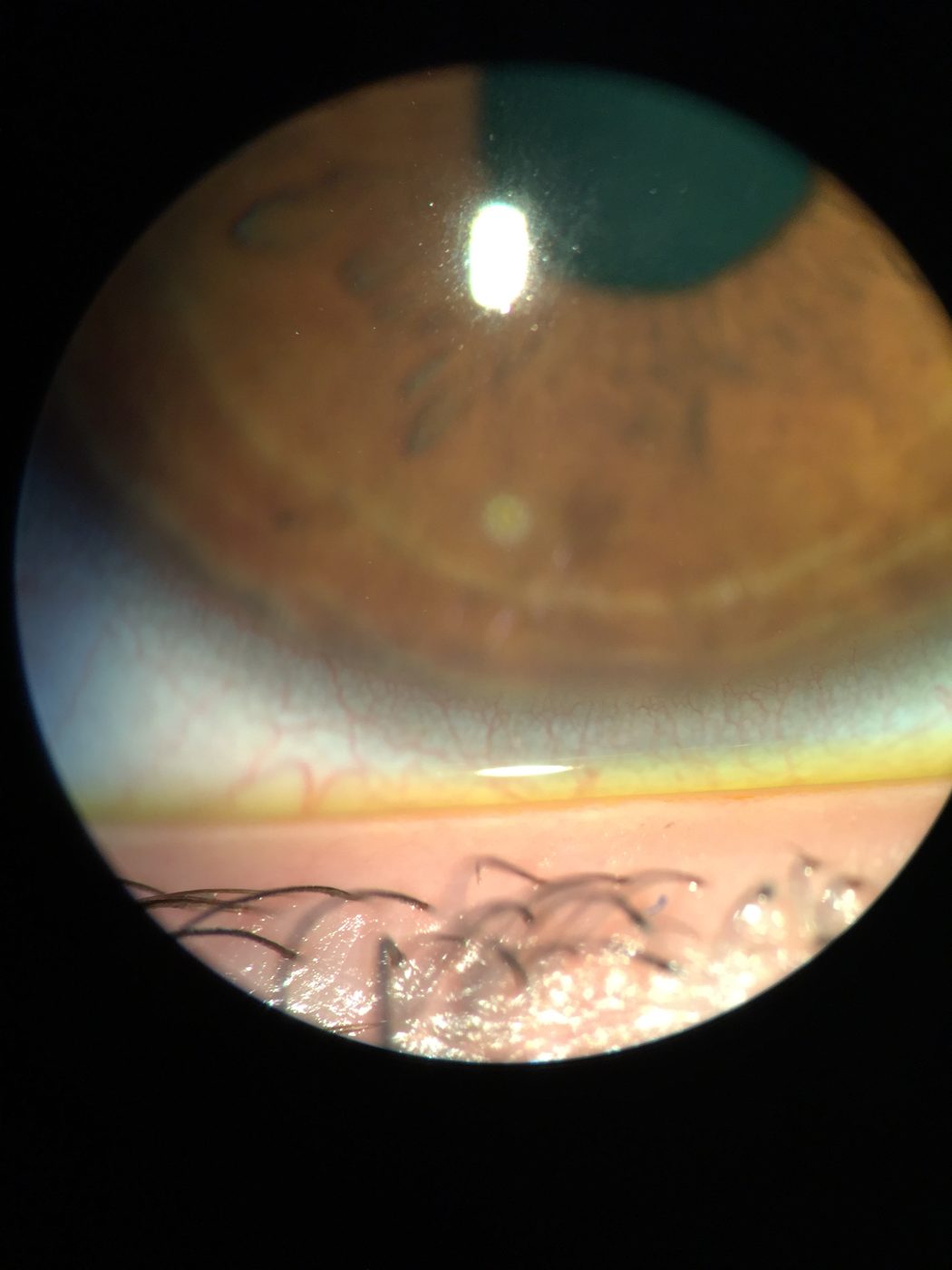
Image - A small corneal ulcer in a contact lens wearer, highlighted by fluorescein staining. The defect in the corneal epithelium takes up the dye and fluoresces, marking the area of epithelial loss
Creative commons source by Iceclanl [CC BY-SA 4.0 (https://creativecommons.org/licenses/by-sa/4.0)]
Anterior Chamber
The anterior chamber is the fluid-filled space between the cornea and the iris. With the pen torch, assess its depth and look for any abnormal contents.
A useful bedside manoeuvre is to shine the torch from the temporal side across the front of the eye. In a normal, deep chamber the whole iris is illuminated evenly. If the chamber is shallow, the iris is bowed forwards and casts a crescent of shadow on its nasal side. A shallow anterior chamber is an important finding because it predisposes to acute angle-closure glaucoma, in which the peripheral iris obstructs aqueous drainage and the intraocular pressure rises rapidly. At the slit lamp this is formalised by the van Herick technique: a thin beam is shone at the very edge of the cornea and the width of the peripheral anterior chamber is compared with the thickness of the cornea beside it. The narrower the gap relative to the corneal thickness, the more occludable the drainage angle is judged to be.
Next look closely for inflammatory activity within the chamber. In anterior uveitis (iritis) white cells and leaked protein enter the normally crystal-clear aqueous. With a bright, narrow slit-lamp beam angled into the chamber, individual cells can be seen drifting like dust motes, and a generalised haze of protein - flare - scatters the light in the way a sunbeam is made visible by dust in a room (the Tyndall effect). The number of cells and the degree of flare are graded to quantify the severity of inflammation, and their presence, together with circumcorneal redness, pain and photophobia, is what defines active anterior uveitis.
Look for an abnormal fluid level within the chamber, which settles inferiorly under gravity. A hyphaema is a level of blood in the anterior chamber, usually following blunt trauma to the eye, and warrants urgent assessment because of the risk of raised intraocular pressure and rebleeding. A hypopyon is a level of white, inflammatory cells (effectively pus) and indicates severe inflammation within the eye, such as a sight-threatening microbial keratitis with anterior chamber involvement or severe anterior uveitis (iritis).
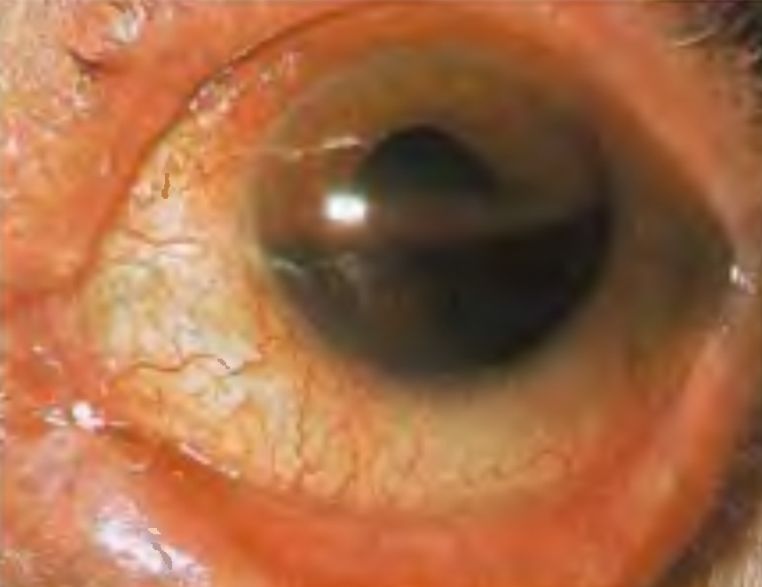
Image - A hyphaema, with blood settling under gravity to form a level in the lower half of the anterior chamber, typically following blunt ocular trauma
Creative commons source by Rakesh Ahuja, MD [CC BY-SA 2.5 (https://creativecommons.org/licenses/by-sa/2.5)]
Iris and Pupils
Inspect the iris for its colour and structure before assessing the pupils. A difference in colour between the two irides (heterochromia) can be congenital, but an acquired pale, washed-out iris on one side may accompany Horner's syndrome, especially when present from birth. Then assess the pupils, noting their size, shape and symmetry. They should be equal, central and round.
An irregular or distorted pupil may be due to posterior synechiae, adhesions between the iris and the lens that form in anterior uveitis and give the pupil a notched or scalloped outline. An irregular pupil may also follow trauma or previous surgery. A mid-dilated, oval and unreactive pupil in a red, painful eye with a cloudy cornea is a classic feature of acute angle-closure glaucoma.
Anisocoria (unequal pupils) should prompt you to decide which pupil is abnormal. A small degree of anisocoria is common and physiological; comparing the pupils in bright and dim conditions helps localise the problem. If the difference is greater in bright light, the larger pupil is failing to constrict and is the abnormal one (as in a third nerve palsy or Holmes-Adie pupil); if the difference is greater in the dark, the smaller pupil is failing to dilate and is abnormal (as in Horner's syndrome). A pathologically constricted pupil with partial ptosis suggests Horner's syndrome; a fixed dilated pupil with ptosis and an eye that is 'down and out' suggests an oculomotor (third) nerve palsy, which can be a surgical emergency if caused by a compressive aneurysm.
Assess the pupillary light reflexes. Shine the pen torch into one eye and observe the direct response (constriction of that pupil) and the consensual response (simultaneous constriction of the other pupil). The afferent (sensory) limb of this reflex travels in the optic nerve, while the efferent (motor) limb travels in the oculomotor nerve; because the pathway crosses centrally, light in one eye normally constricts both pupils equally.
Finally, perform the swinging light test to detect a relative afferent pupillary defect (RAPD), also known as a Marcus Gunn pupil. Swing the torch smoothly from one eye to the other every few seconds. Normally both pupils stay constricted throughout. If one optic nerve or retina is significantly diseased, swinging the light from the healthy eye to the affected eye causes both pupils to dilate, because the reduced signal carried by the damaged optic nerve produces less constriction than the consensual drive that was just removed. An RAPD is an objective sign of significant optic nerve disease (such as optic neuritis or ischaemic optic neuropathy) or extensive retinal disease.
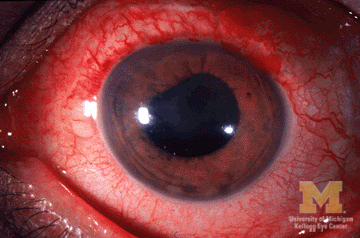
Image - Anterior uveitis (iritis), showing circumcorneal redness. Inflammation in the anterior chamber can lead to an irregular pupil through the formation of adhesions between the iris and lens
Creative commons source by Jonathan Trobe, M.D. [CC BY 3.0 (https://creativecommons.org/licenses/by/3.0)]
- 218