
During any examination in an OSCE it is important to understand the pathology and reasoning behind each of the signs and symptoms elicited, even if the patient being examined is 'normal'. This article explains how to perform an acromegaly examination and the key findings you should look for, showing you what each sign means and what conditions it may indicate.
Acromegaly is caused by excess growth hormone (GH) in adults, almost always due to a GH-secreting pituitary adenoma. Because GH drives the liver to produce insulin-like growth factor 1 (IGF-1), the soft tissues, cartilage and bones continue to grow. As the epiphyseal growth plates have already fused in adulthood, the result is not increased height (that would be gigantism in children) but rather a coarsening and enlargement of the extremities and face. Many of the signs in this examination are the direct consequence of soft-tissue overgrowth, while others reflect the local effect of the pituitary tumour or the metabolic complications of the disease.
Hand Examination
Inspect the hands first. In acromegaly the hands are typically large, broad and "spade-like", with thickened, doughy soft tissue and an increase in the size of the fingers. This is due to overgrowth of soft tissue, cartilage and bone driven by GH and IGF-1, rather than any swelling of the joints themselves. A simple way to gauge the degree of acral enlargement is to hold your own hand against the patient's, palm to palm, and compare the overall span; the patient's hand often noticeably overlaps your own.
Assess the skin thickness by gently pinching the skin over the third metacarpophalangeal joint and comparing it with the equivalent skin on your own hand. Excessively thick skin supports the diagnosis and reflects the generalised soft-tissue expansion seen throughout the body. The skin may also feel oily and sweaty, as acromegaly increases the activity of sweat and sebaceous glands, producing hyperhidrosis.
Inspect the fingertips for capillary blood glucose testing marks. Excess growth hormone is a counter-regulatory (anti-insulin) hormone, so it promotes insulin resistance and around one in three patients develops diabetes mellitus or impaired glucose tolerance.
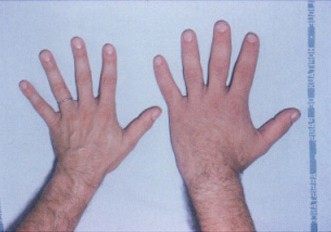
Image - An unaffected hand on the left compared with an enlarged acromegalic hand on the right, showing widened fingers and thickened soft tissue
Creative commons source by Philippe Chanson and Sylvie Salenave [CC BY 2.0 (https://creativecommons.org/licenses/by/2.0)]
Acromegaly is a common cause of carpal tunnel syndrome. The soft-tissue overgrowth within the wrist compresses the median nerve as it passes through the carpal tunnel, producing pain, tingling and numbness in the thumb, index, middle and radial half of the ring finger. Look for wasting of the thenar eminence (the muscle bulk at the base of the thumb) as a sign of long-standing median nerve compression.
Two bedside tests can provoke the symptoms of carpal tunnel syndrome:
- Tinel's test – tap firmly over the carpal tunnel on the palmar aspect of the wrist. A positive test reproduces tingling or paraesthesia in the median nerve distribution.
- Phalen's test – ask the patient to hold their wrists in full flexion (back-to-back) for around 60 seconds. A positive test again reproduces the median nerve symptoms.
Finally, palpate the radial pulse, assessing the rate and rhythm. A normal rate is 60–100 bpm. This begins to assess the cardiovascular complications of acromegaly, which are an important cause of excess mortality in these patients.
Facial Examination
Inspect the face carefully, as it carries some of the most recognisable features of acromegaly. Look for coarse facial features overall, with thickened skin and accentuated facial creases.
Specific features to look for include:
- Frontal bossing – prominence of the forehead and brow caused by overgrowth of the frontal bones and the underlying frontal sinuses.
- Prognathism – protrusion of the lower jaw (mandible) due to bony overgrowth, often producing an underbite (malocclusion) where the lower teeth sit in front of the upper teeth.
- Interdental separation – widening of the gaps between the teeth, as the jaw enlarges but the number of teeth stays the same.
- Enlarged nose and lips – broadening of the nose and thickening of the lips from soft-tissue overgrowth.
Ask the patient to open their mouth and inspect the tongue for macroglossia (an enlarged tongue). This is significant beyond appearance: enlargement of the tongue and the soft tissues of the upper airway predisposes patients to obstructive sleep apnoea, a very common and important complication of acromegaly.
If you have not already done so, note any deepening of the voice, which results from thickening of the vocal cords and enlargement of the laryngeal cartilages and paranasal sinuses.
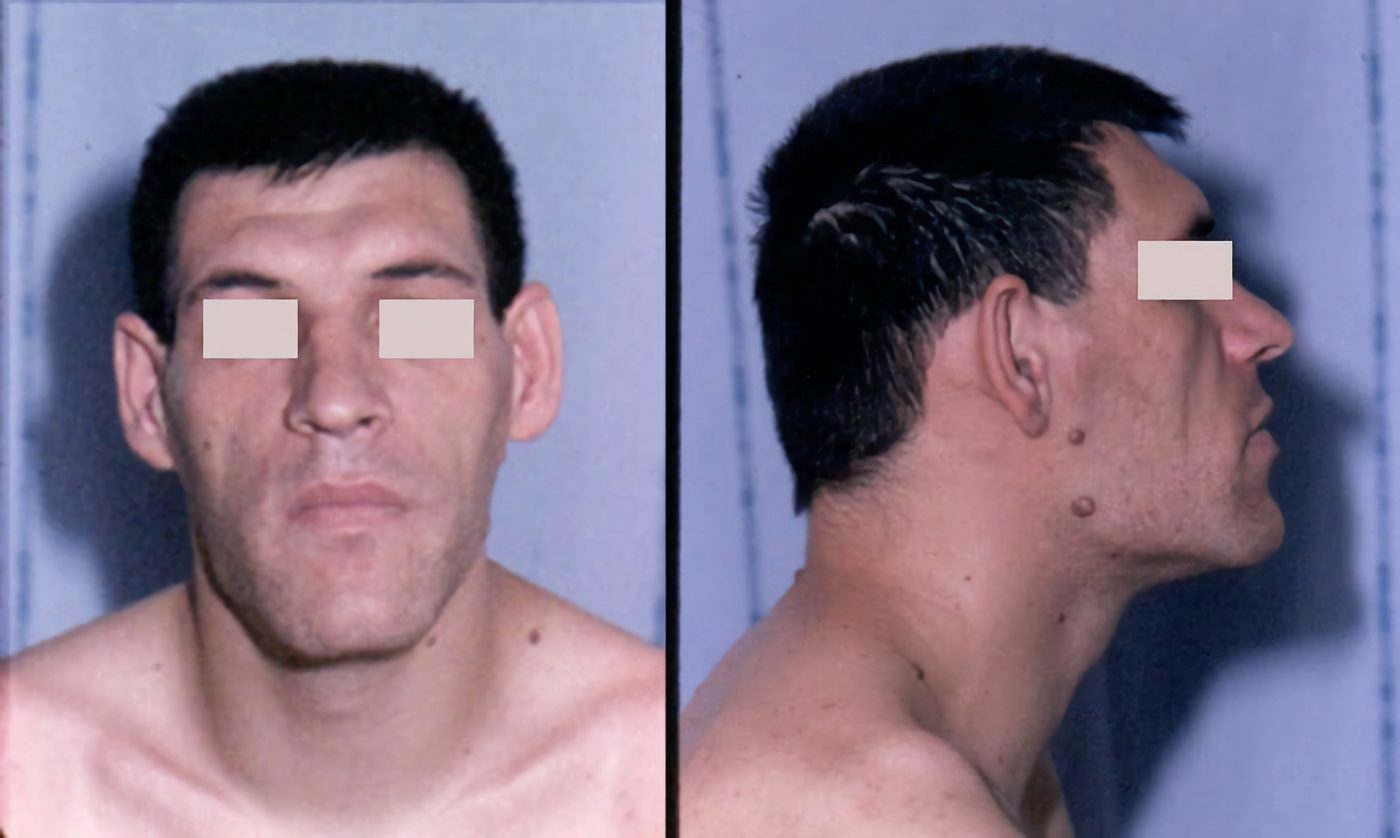
Image - The coarse facial features of acromegaly, including frontal bossing, an enlarged nose and prominent jaw, caused by bony and soft-tissue overgrowth
Creative commons source by Philippe Chanson and Sylvie Salenave [CC BY 2.0 (https://creativecommons.org/licenses/by/2.0)]
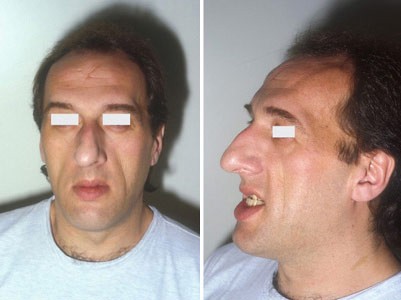
Image - Prognathism in acromegaly, with protrusion of the lower jaw produced by overgrowth of the mandible
Creative commons source by Philippe Chanson and Sylvie Salenave [CC BY 2.0 (https://creativecommons.org/licenses/by/2.0)]
Visual Fields and Eyes
Assessment of the visual fields is one of the most important parts of the acromegaly examination, because it tests for the local effects of the pituitary tumour. The pituitary gland sits in the sella turcica, directly beneath the optic chiasm. As a pituitary adenoma enlarges upwards (supra-sellar extension), it compresses the chiasm.
The fibres that cross within the optic chiasm are those carrying information from the nasal half of each retina, which correspond to the temporal (outer) half of each visual field. Compression from below therefore affects these crossing fibres first, producing the classic bitemporal hemianopia – loss of the outer halves of the visual field in both eyes.
Test the visual fields using confrontation: sit roughly one metre opposite the patient at the same eye level, ask them to cover one eye while you cover your opposite eye, and bring a moving finger or red hatpin in from the periphery in each quadrant, comparing the patient's field with your own. Always test each eye separately. A defect that respects the vertical midline and affects the temporal fields of both eyes strongly suggests chiasmal compression.
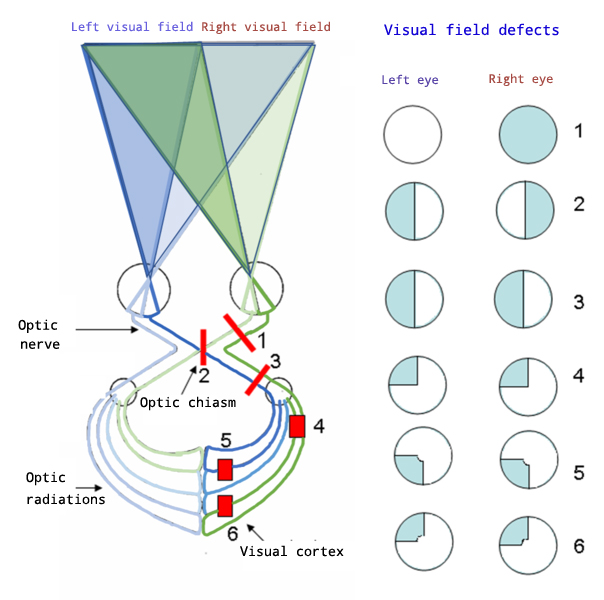
Image - Patterns of visual field loss. Compression of the optic chiasm from below by a pituitary adenoma classically produces a bitemporal hemianopia, with loss of the outer half of the field in both eyes
Image source by As eo [CC BY-SA 4.0]
Offer to complete the eye assessment by testing visual acuity, examining the eye movements (a large tumour may compress the cranial nerves in the cavernous sinus), and performing fundoscopy to look for optic atrophy from chronic compression.
A large pituitary adenoma can also disturb the surrounding gland. If the tumour compresses the pituitary stalk it disinhibits prolactin release, and roughly a quarter of GH-secreting adenomas co-secrete prolactin. The resulting hyperprolactinaemia may cause galactorrhoea (inappropriate milk production), menstrual disturbance or reduced libido, so offer to ask about these symptoms and, with a chaperone, to inspect for galactorrhoea.
Neck Examination
Examine the neck, paying particular attention to the thyroid gland. Acromegaly can cause a diffuse or multinodular goitre, as growth hormone and IGF-1 stimulate the growth of thyroid tissue. Inspect the neck from the front, ask the patient to swallow a sip of water (a thyroid swelling will move upwards with swallowing), and then palpate the gland from behind to assess its size, symmetry and any nodules.
Although most patients remain euthyroid, the increased prevalence of thyroid nodules is relevant because of the recognised association between acromegaly and thyroid neoplasia.
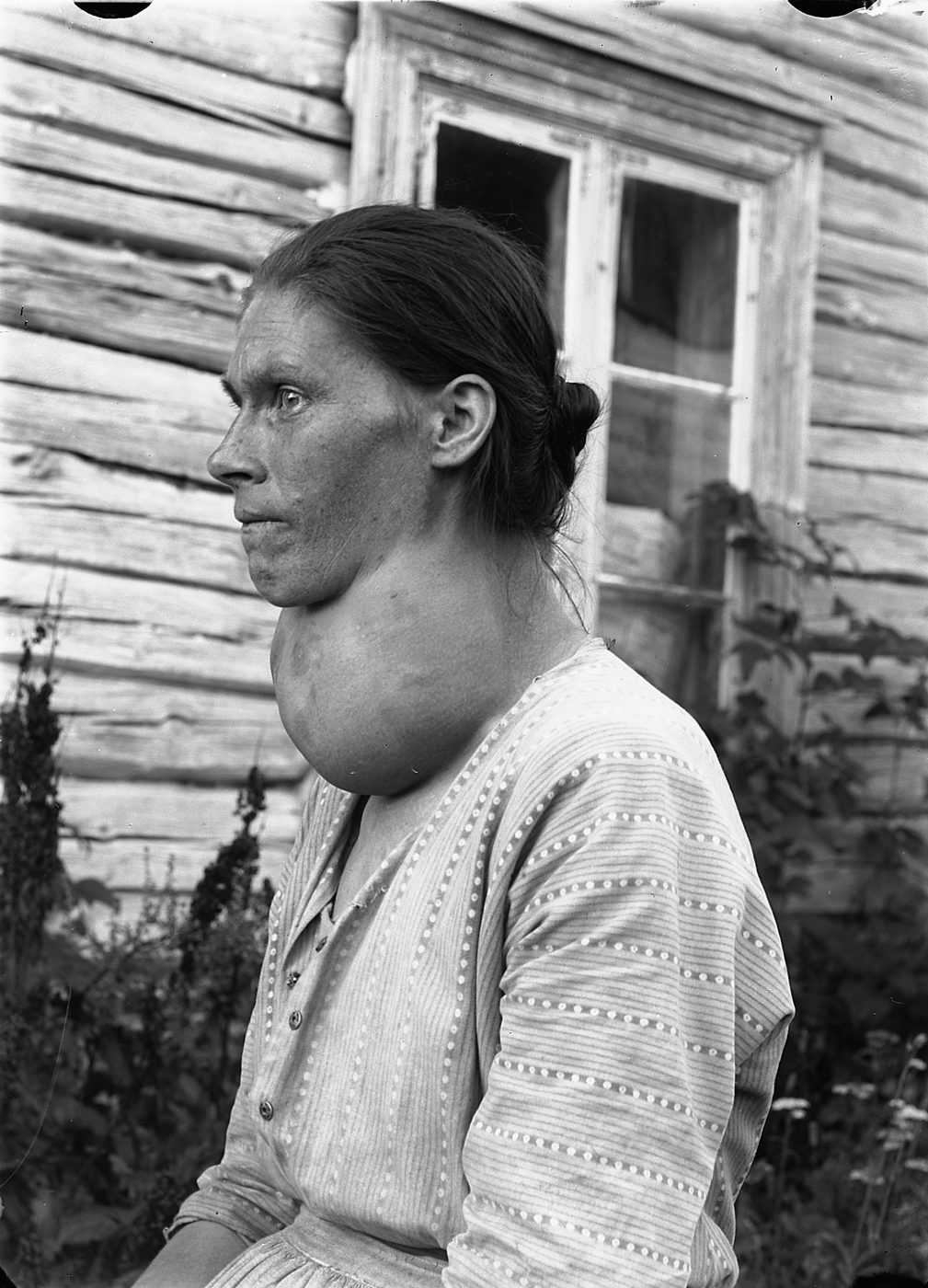
Image - A visible goitre. Growth hormone and IGF-1 stimulate thyroid tissue, so a diffuse or nodular goitre may be found on examining the neck in acromegaly
Image source by Martin Finborud [Public domain]
- 201