
During any examination in an OSCE it is important to understand the pathology and reasoning behind each of the signs and symptoms elicited, even if the patient being examined is ‘normal’. This article explains how to perform an abdominal (gastrointestinal) examination and the key findings you should look for, showing you what each sign means and what conditions it may indicate.
The abdominal examination follows the familiar pattern of inspection, palpation, percussion and auscultation, but it begins peripherally – at the hands, arms and face – because chronic gastrointestinal and liver disease leaves clues throughout the body before the abdomen is ever touched. Work systematically from the periphery inwards.
Hands and Arms
Take the patient’s hands and inspect them carefully. Chronic liver disease in particular produces a cluster of recognisable hand signs.
Look at the nails. Koilonychia (spoon-shaped nails that are concave and brittle) is a sign of chronic iron deficiency anaemia, which may result from gastrointestinal blood loss or malabsorption. Leukonychia means white nails and has several causes. White nail-bed patterns such as Terry nails may accompany chronic liver disease, but the appearance alone does not establish hypoalbuminaemia or impaired hepatic synthesis. Interpret the pattern alongside the other findings and blood tests. Clubbing (loss of the normal angle between the nail and nail fold) in a gastrointestinal context may be caused by inflammatory bowel disease, coeliac disease, liver cirrhosis or gastrointestinal lymphoma.
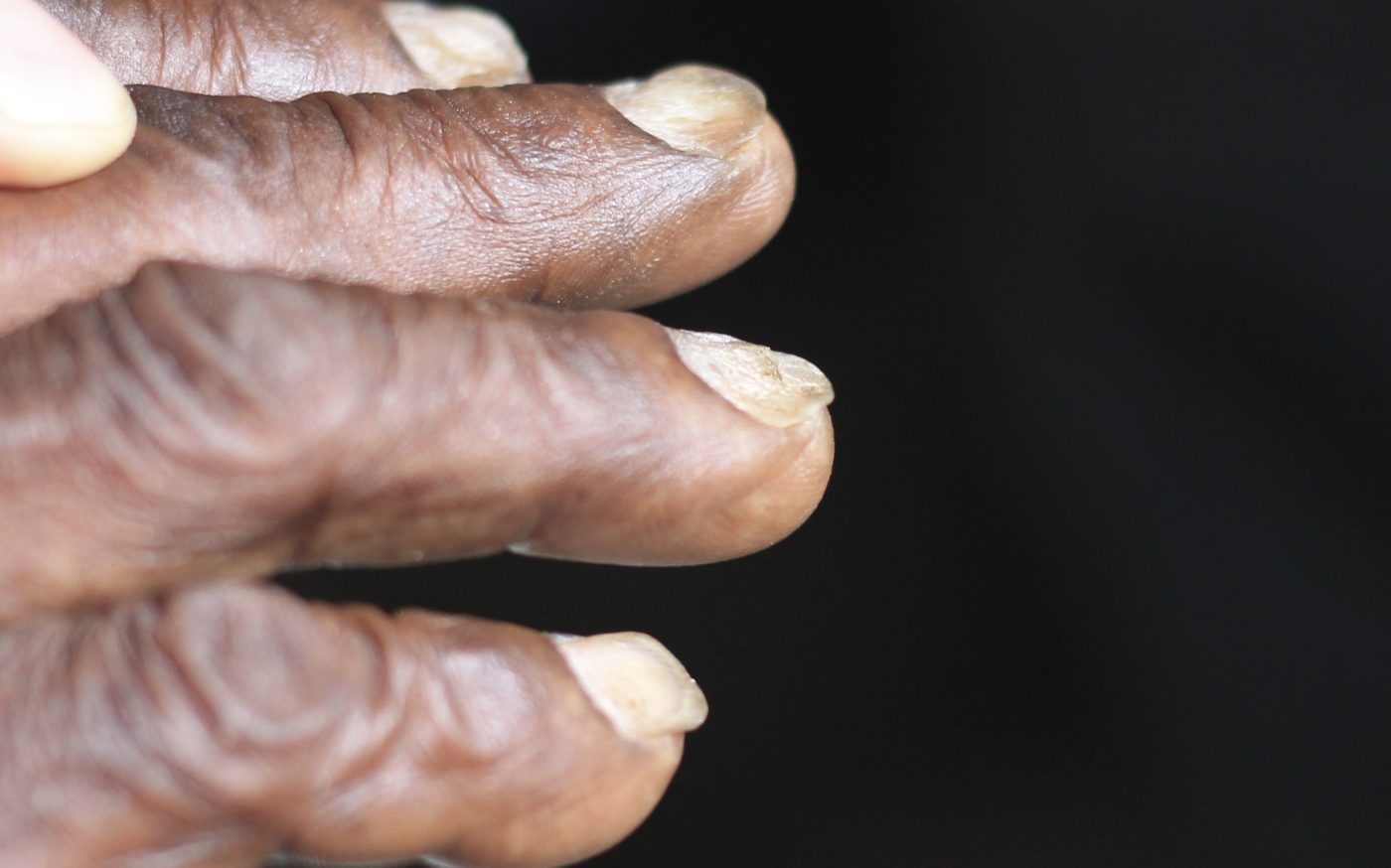
Image - Koilonychia (spoon-shaped nails). This concave nail deformity is associated with chronic iron deficiency anaemia
Creative commons source by CHeitz [CC BY 2.0 (https://creativecommons.org/licenses/by/2.0)]
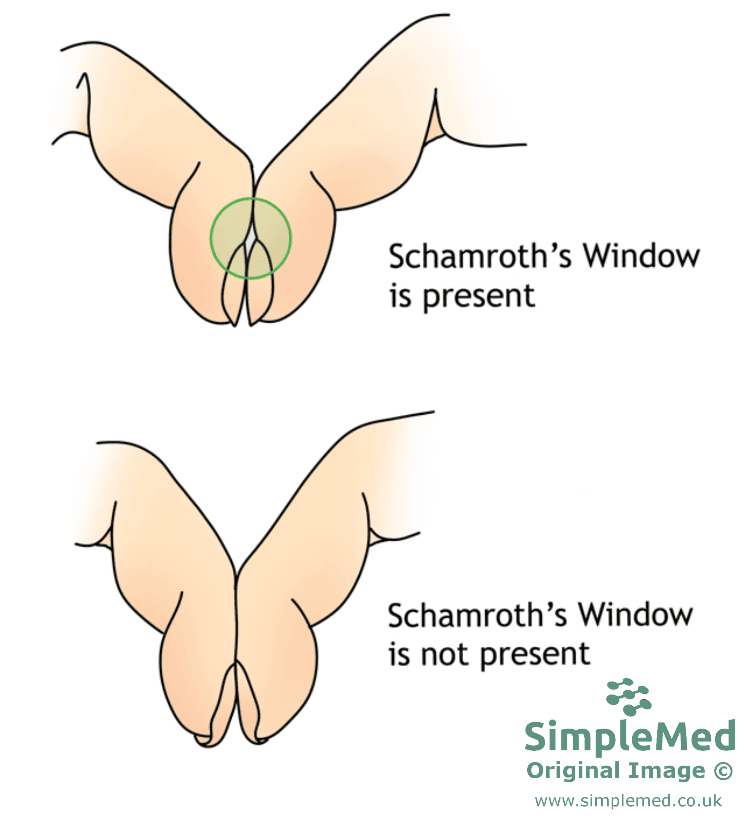
Image - Finger clubbing, with loss of the normal angle between the nail and nail fold. In a gastrointestinal context it points to inflammatory bowel disease, coeliac disease, cirrhosis or lymphoma
SimpleMed original
Note any tar staining of the fingers, a yellow-brown discolouration that points to smoking – a risk factor for several gastrointestinal cancers, peptic ulcer disease and Crohn’s disease.
Inspect the palms for palmar erythema, a reddening of the heel of the palm caused by the altered sex hormone metabolism and high circulating oestrogen levels of chronic liver disease (it can also be a normal finding in pregnancy). Look for Dupuytren’s contracture, a thickening of the palmar fascia that draws the fingers (classically the ring finger) into fixed flexion; this is associated with alcohol excess and therefore with alcoholic liver disease.
Assess the temperature of the hands and the capillary refill time as a quick measure of peripheral perfusion. A refill time of greater than two seconds may indicate poor perfusion, such as in shock from gastrointestinal haemorrhage or sepsis.
Ask the patient to hold their arms out straight and cock their wrists back for 15–30 seconds to check for asterixis (a flapping tremor). In the context of an abdominal examination this is a sign of hepatic encephalopathy, where the failing liver cannot clear nitrogenous waste such as ammonia, which then disrupts brain function. It can also be caused by carbon dioxide retention and uraemia.
While at the arms, assess for bruising, excoriations (scratch marks) and needle track marks. Easy bruising may accompany liver disease and should be assessed with the platelet count and coagulation tests; impaired hepatic synthesis and vitamin K deficiency can contribute to coagulation abnormalities. Excoriations may result from scratching because of pruritus associated with cholestasis, rather than proving deposition of bile salts in the skin. Track marks over the veins suggest intravenous drug use, an important risk factor for blood-borne viral hepatitis (hepatitis B and C) and its long-term complications of cirrhosis and hepatocellular carcinoma.
Face and Mouth
Move to the face and examine the eyes. Gently pull down the lower eyelid to inspect the conjunctiva, then ask the patient to look upwards while you inspect the sclera above the iris.
Look for conjunctival pallor, where the normally pink inner surface of the lower eyelid appears pale, indicating anaemia. Inspect the sclerae for jaundice (scleral icterus), a yellow discolouration that is often visible in the eyes before it is apparent in the skin. Jaundice reflects a raised serum bilirubin and may be pre-hepatic (haemolysis), hepatic (liver cell damage) or post-hepatic (biliary obstruction).
Around the eyes, look for xanthelasma (raised yellow cholesterol-laden plaques on the eyelids) and corneal arcus (a pale lipid ring in the peripheral cornea). Xanthelasma may accompany dyslipidaemia or cholestatic liver disease, but often occurs with normal circulating lipid levels. Corneal arcus is commonly age-related; in a younger patient it should prompt lipid assessment. Neither sign alone establishes hyperlipidaemia. Rarely, in Wilson’s disease, copper deposition produces brownish Kayser-Fleischer rings at the edge of the cornea.
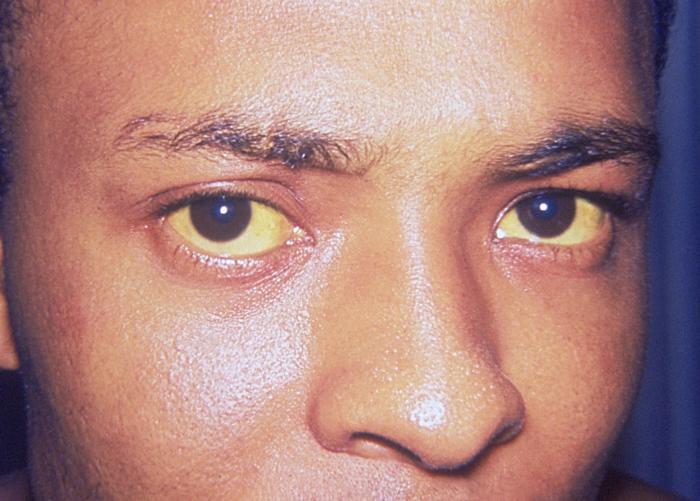
Image - Jaundice of the sclera. The yellow discolouration reflects a raised serum bilirubin and is often visible in the eyes before the skin
Public Domain Source by unknown author [Public domain]
Ask the patient to open their mouth and inspect it. Angular stomatitis (cracked, inflamed corners of the mouth) and glossitis (a smooth, swollen, erythematous tongue) are signs of iron, vitamin B12 or folate deficiency, which may arise from malabsorption. Look for oral candidiasis (white plaques) and aphthous ulceration, the latter being associated with inflammatory bowel disease and coeliac disease. Note the general state of hydration by inspecting the mucous membranes for dryness. As you do so, note any fetor hepaticus – a characteristic sweet or musty breath odour associated with advanced liver disease and portosystemic shunting. Volatile sulphur compounds contribute to the odour; it should not be equated with an ammonia smell.
Neck and Chest
Examine the cervical and supraclavicular lymph nodes. A palpable, hard, enlarged left supraclavicular node is known as Virchow’s node (and the finding as Troisier’s sign), and is a classic marker of gastric malignancy, as the thoracic duct draining the abdomen empties near this node.
Inspect the chest and upper abdomen for spider naevi – central red arterioles with radiating small vessels that blanch on pressure to the centre and then refill outwards. They occur in the distribution of the superior vena cava (above the nipple line) and, like palmar erythema, are caused by the high oestrogen levels of chronic liver disease. More than five spider naevi is considered abnormal in an adult. Also note gynaecomastia and loss of body hair in men, which reflect the same hormonal disturbance.
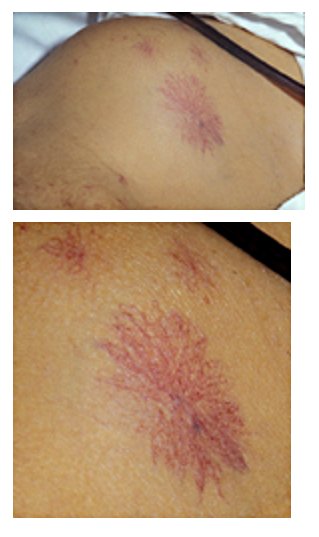
Image - A spider naevus, with a central arteriole and radiating vessels. Multiple spider naevi in the superior vena cava distribution suggest chronic liver disease
Creative commons source by Herbert L. Fred, MD and Hendrik A. van Dijk [CC BY 2.0 (https://creativecommons.org/licenses/by/2.0)]
Inspection of the Abdomen
Lower the bed so the patient is lying flat and kneel or crouch beside them so that your eyes are level with the abdomen. Inspecting tangentially in this way makes subtle masses, distension and pulsation far easier to see.
Look for scars, which give away the patient’s surgical history – for example a midline laparotomy scar, a right iliac fossa scar (appendicectomy), a small right subcostal (Kocher) scar (open cholecystectomy) or laparoscopic port scars. Identify any stoma and note its position and contents, as the site offers a clue to its type (a right iliac fossa stoma with a spout is usually an ileostomy, a left iliac fossa flush stoma usually a colostomy).
Note any distension, visible masses or obvious organomegaly. Look for caput medusae – distended veins radiating from the umbilicus – which forms when portal hypertension forces blood through collateral veins in the abdominal wall. Note any striae (stretch marks): silvery-white striae are common after pregnancy, weight change or with ascitic distension, while broad purple striae point to Cushing’s syndrome or steroid use. Inspect the flanks for bruising: Grey Turner’s sign (flank bruising) and Cullen’s sign (periumbilical bruising) suggest retroperitoneal haemorrhage, classically in severe acute pancreatitis.
Ask the patient to cough and watch the hernial orifices and any scars for bulging, which may reveal a hernia. Finally, look for visible peristalsis or pulsation; a prominent central pulsation may represent an abdominal aortic aneurysm.
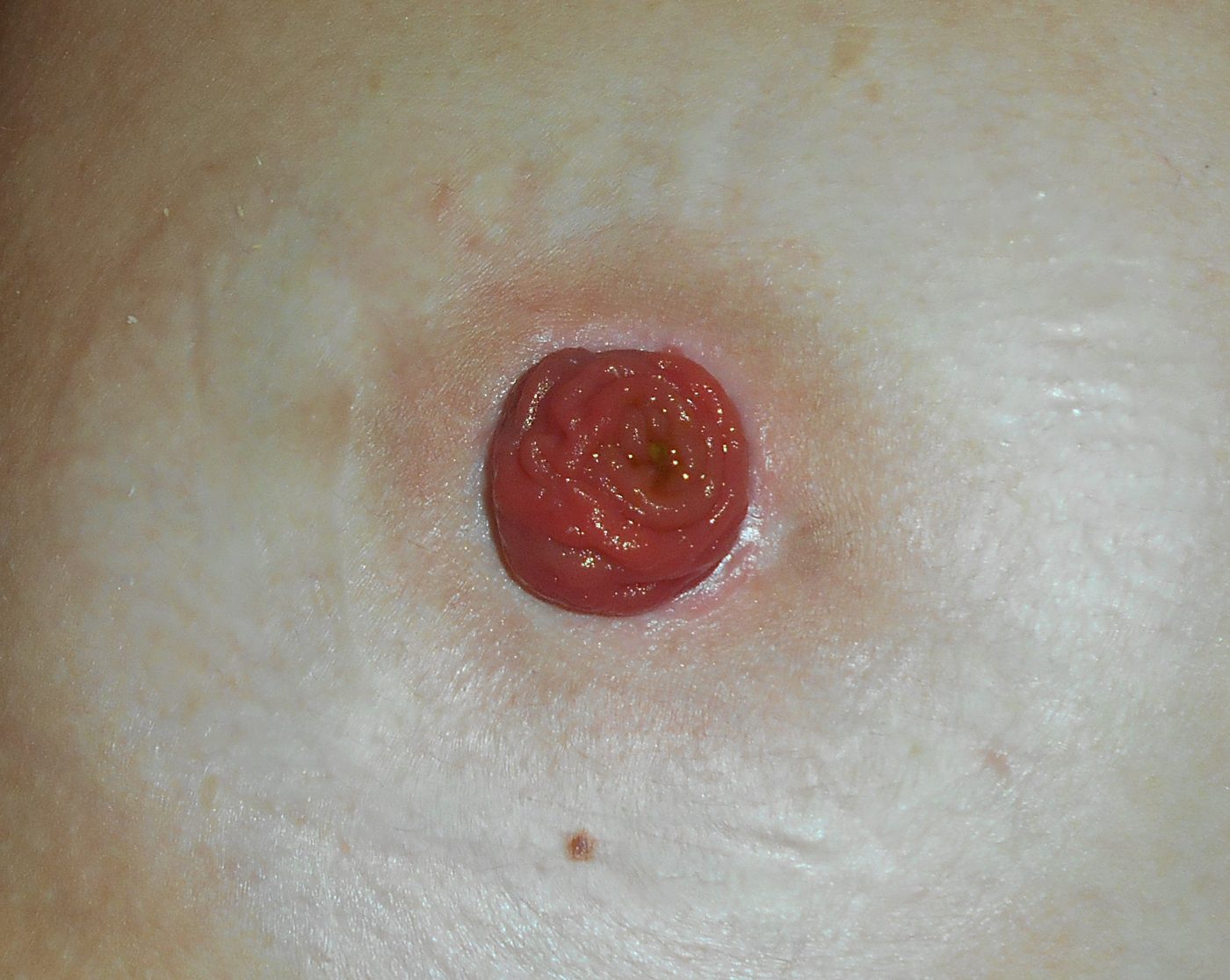
Image - An ileostomy. A spout and liquid to porridge-like output support an ileostomy; combine these findings with the anatomy and operative history when identifying a stoma
Photograph by Salicyna, licensed under CC BY-SA 4.0
- 234