
Next Lesson - Introduction to Autoimmunity
Core
Allergy is defined as a hypersensitive reaction which can be IgE mediated (e.g. peanut allergy) or non-IgE mediated (e.g. some forms of cow's milk protein allergy) in response to antigens present on extrinsic (from outside the body) allergens.
Major allergic disorders include hay fever (or allergic rhinitis), allergic conjunctivitis, asthma, eczema (an itchy, inflamed skin condition), urticaria (hives, an itchy raised rash), and insect, drug and food allergies.
Allergen is the term used to describe the protein or cellular component triggering the allergic reaction.
Atopy is the term used to describe the genetic tendency to produce IgE antibodies in response to exposure to substances that usually prompt no reaction. This means these people are more likely to develop allergic diseases such as asthma, eczema, and allergic rhinitis.
Anaphylaxis is the most severe form of allergy. It is a life-threatening response to an allergen with problems of the airway (such as swelling or narrowing of the airways), of breathing, and/or of the circulation (such as a drop in blood pressure resulting in shock, where the circulation can no longer supply the organs with enough blood). Without prompt treatment, anaphylaxis can rapidly become fatal.
Sensitisation is the term used to describe the production of IgE antibodies following a first exposure to an allergen. The allergen can then cause a reaction on the second and subsequent exposures, which did not happen on the first exposure. Being sensitised does not always mean a person has an allergy: a positive allergy test alone does not confirm it. Some allergic conditions are more common in children than in adults (e.g. food allergy, eczema). Many children outgrow food allergies such as cow's milk allergy, and atopic eczema most often presents in childhood. Others, such as allergic rhinitis, usually begin in childhood and adolescence and are common in the population as a whole (around 23 to 30% of people in Europe).
Food intolerance is when the body produces an adverse response to a food type, but which does not involve the immune system (e.g. bloating or diarrhoea a few hours after eating the food). Food intolerance is caused by the body not being able to digest a certain food or an ingredient in food (e.g. too little of the enzyme lactase in lactose intolerance, so that lactose, the sugar in milk, is not digested).
A food allergy is when exposure to a food type triggers a hypersensitivity reaction which can be IgE (immediate onset) or non-IgE (delayed onset) mediated.
There are two main types of presentation depending on the underlying molecular mediators of the reaction (a third, mixed type involves both IgE and non-IgE responses):
Immediate Onset Presentation - IgE mediated. Typical symptoms manifest through the skin, respiratory system, and gastrointestinal (GI) tract (e.g. urticaria, cough, wheezing, vomiting and diarrhoea). In severe cases, it can be life-threatening and cause anaphylaxis.
Delayed Onset Presentation - non-IgE mediated. In a study that followed infants in Hampshire, UK, from birth to 2 years of age, just under half of those with food allergy confirmed by a food challenge (a supervised test in which the food is given to see whether a reaction follows) had no demonstrable IgE, so their allergy was non-IgE mediated. Typical symptoms predominantly affect the GI tract and thus can be more difficult to diagnose as symptoms can be quite non-specific. This can include diarrhoea, abdominal cramps, and bloating.
Examples
There are 14 regulated allergens named in UK food law, as listed by the Food Standards Agency. In the United Kingdom, food businesses must tell customers if their food contains any of these 14 allergens.
The fourteen allergens on the list are celery, cereals containing gluten (such as wheat, rye, barley and oats), crustaceans (such as prawns, crabs and lobsters), eggs, fish, lupin (found in flour), milk, molluscs (such as mussels and oysters), mustard, tree nuts (such as almonds, hazelnuts and walnuts), peanuts, sesame seeds, soya, and sulphur dioxide and sulphites (at more than ten parts per million; found in dried fruits).
Diagnosis of food allergy is usually made following a stepwise approach. The first step is to elicit key elements when taking the clinical history:
- Context of the Reaction - age of onset, route of exposure, and intercurrent illness (any other illness at the time)
- Presenting Symptoms - timing of onset, severity, and duration. Particular questions should be asked about breathlessness, itching and gastrointestinal upset as these are common initial presenting features
- Foods Ingested - whether the food was new to the patient, how it was cooked, how much was eaten, and any previous reactions to it
- History - any personal or family history of atopic conditions, including asthma, eczema, hay fever and other allergies
Next, one should carry out a thorough physical examination to identify the clinical manifestation of the allergic reaction and develop a differential diagnosis. This involves looking across the whole skin for rashes and examining the throat and mouth. Physical examination should also, in addition to history taking, be an opportunity to look for any stigmata (physical signs) of other allergic conditions such as eczema.
If the history suggests IgE-mediated food allergy, allergy tests can be done to support the diagnosis. They are not used as a routine screen, and the results are always interpreted alongside the history. The skin prick test introduces a small amount of allergen into the superficial skin using a lancet (a small sterile pricking device). The skin is watched for a reaction, which shows mast cell activation (mast cells are immune cells that release histamine). Blood tests look for IgE antibodies to the suspected food.
If non-IgE-mediated allergy is suspected, the next step is a trial of an elimination diet, avoiding the suspected allergen (normally for 2 to 6 weeks), followed by planned reintroduction and with advice from a dietitian. If the suspected allergen is the cause, symptoms will improve on elimination and return on reintroduction. If the removal of the suspected allergen does not resolve the symptoms, check for accidental exposure and consider other potential allergens.
In some cases, it might be useful to assess cross-reactivity with other foods where allergy to a certain food can increase the risk of allergy to others sharing similar proteins. This can be done using the oral food challenge (OFC) where the suspected similar allergen is administered in a monitored and standardised setting to identify the level of responsiveness or tolerability and helps confirm any diagnosis of allergy. This is the gold standard, except where contra-indicated, for example where there is a history of previous anaphylactic reaction.
Once a food allergy is confirmed, preventing allergic reactions is largely patient-centred. It needs good patient awareness and education, so that patients can adapt their lifestyle. Patients need to be taught about the main foods to avoid and about how to read allergen information on food packaging. In the United Kingdom, the 14 regulated allergens must be emphasised within the ingredients list of pre-packed food, for example in bold, italic or coloured type. Separate 'may contain' warnings, which flag possible cross-contamination, are voluntary. Depending on the severity of the allergy some patients are advised to avoid even potential traces of foods contained in packaged goods.
While restricting the diet to avoid the allergen can be advisable in cases of severe allergy, it is important to ensure that a balanced diet is still achieved. This means that referral to dietitians can be useful for those with multiple or severe allergies.
In cases where the allergic reaction is not mediated by IgE antibodies and is mild to moderate, food reintroduction can be an option, guided by a healthcare professional (ideally a dietitian). Cow's milk protein allergy can be IgE-mediated, non-IgE-mediated or mixed, and it is the usual reason for using the milk ladder described below. Cow's milk protein allergy is distinct from lactose intolerance, which is not an allergy. Lactose intolerance results from reduced activity of the lactase enzyme in the jejunal brush border (the finger-like surface of the cells lining the jejunum, where lactase digests lactose). It leads to symptoms such as bloating, flatulence, and diarrhoea. Lactase activity normally declines after infancy, so lactose intolerance is often diagnosed in adolescence or adulthood.
Reintroduction is usually done progressively using the so-called milk ladder, starting with products containing more denatured proteins (proteins whose shape has been changed by heat, so the immune system recognises them less; hence, less allergenic) and stepping up to less denatured ones as tolerance is restored. The ladder usually follows a similar path to this: biscuit with milk as an ingredient (baked) -> cake or pancake with milk (milk is a more core ingredient here but it is still baked) -> lightly baked milk (e.g. cheese on a pizza) -> chocolate -> yoghurt (fermented) -> cheese (pasteurised) -> milk.
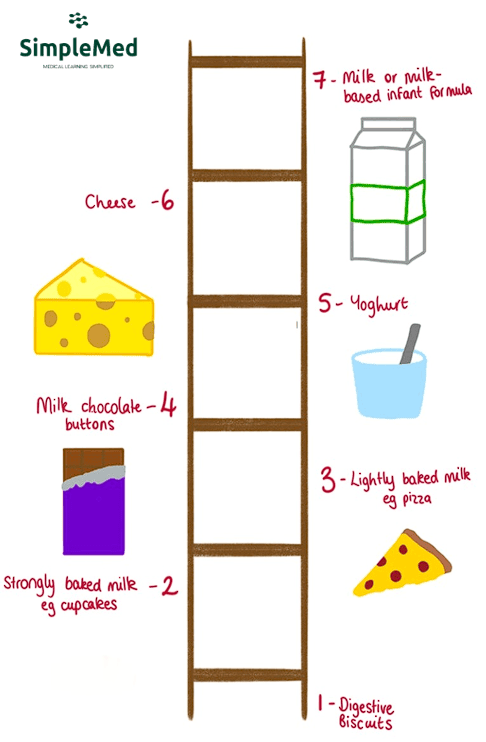
Diagram - Visual representation of the milk ladder
SimpleMed Original by Dr. Maddie Swannack
Some severe forms of allergic reactions can lead to anaphylaxis. This is a life-threatening situation and should be treated as an emergency.
It happens when mast cells release a large amount of histamine which leads to vasodilation (widening of the blood vessels, which lowers the blood pressure) and bronchoconstriction (tightening of the muscle around the airways, which narrows them). Patients and carers should be aware of the warning signs: swelling of the throat or tongue, difficulty breathing or wheezing, feeling faint or dizzy, confusion, and pale, blue or cold skin. Clinicians also look for a fast heart rate (tachycardia) and a sudden drop in blood pressure. Patients should be trained in the use of an adrenaline auto-injector (such as an EpiPen®), which is a device for injecting adrenaline in case of anaphylaxis. Correct use of such a device can be lifesaving.
Patients should also be issued with an allergy action plan for instructions on what to do in case of anaphylaxis. Rapid administration of adrenaline is the first line (first choice) treatment. Not using an adrenaline auto-injector when it is needed does more harm than using one when it is not needed. So when in doubt, it is best to use the adrenaline auto-injector and call for help. Patients should carry two auto-injectors at all times. If symptoms have not improved after 5 minutes, a second auto-injector is used. The person should lie down (or sit up if struggling to breathe) and should not stand or walk, even if they feel better.
It is important to remember that the half-life (the time taken for the amount of a drug in the body to halve) of adrenaline in the body is short, so while an adrenaline auto-injector can be lifesaving, the effects will not last that long. Symptoms can also come back after they first settle (a biphasic reaction). This is why it is very important to call 999 as soon as the adrenaline is given, say that it is anaphylaxis, and go to hospital for ongoing management and observation, even if the person feels better. Patient and family/carer education around this is essential. Anyone who has had anaphylaxis should be offered referral to a specialist allergy service. An adrenaline nasal spray (EURneffy) is also available as an alternative to an auto-injector for people who are prescribed it.
Edited by: Dr. Maddie Swannack
Reviewed by: Dr. Thomas Burnell and Dr. Marcus Judge
- 3209